Français (France)
  Nederlands (nl-NL)
 00:00 • intro | 00:05 • the Temple of Hatshepsut | 02:11 • the Expedition to the Land of Punt | 03:44 • Chapels and sanctuaries | 08:37 • The Colossi of Memnon
Personal creation from visual material collected during my trip Egypt (2024)
Map of places or practices in Luxor on this site
• Use the markers to explore the content •
Luxor, the Temple of Hatshepsut and the Colossi of Memnon
Two major monuments on the western bank of ancient Thebes
Across the Nile from modern Luxor stretches the western necropolis of ancient Thebes, one of the most important archaeological landscapes in Egypt. Here, between cultivated fields and desert cliffs, pharaohs built funerary temples, royal tombs and monumental statues linked to memory, worship and kingship. This video focuses on two of the most celebrated sites of that landscape: the Temple of Hatshepsut at Deir el-Bahari and the Colossi of Memnon.
These monuments illustrate the artistic and political ambition of the New Kingdom. They also reveal how architecture was designed in direct relationship with the surrounding terrain. The cliffs behind Deir el-Bahari, the open plain before the Colossi, and the wider setting of western Thebes all contributed to the symbolic meaning of these constructions.
The Temple of Hatshepsut, a unique architectural statement
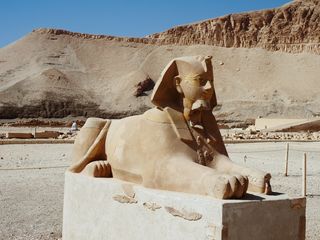
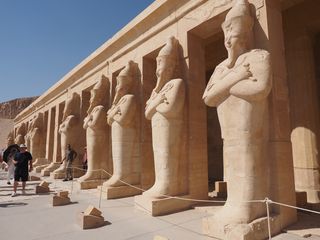
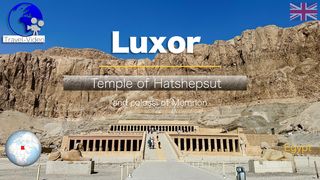
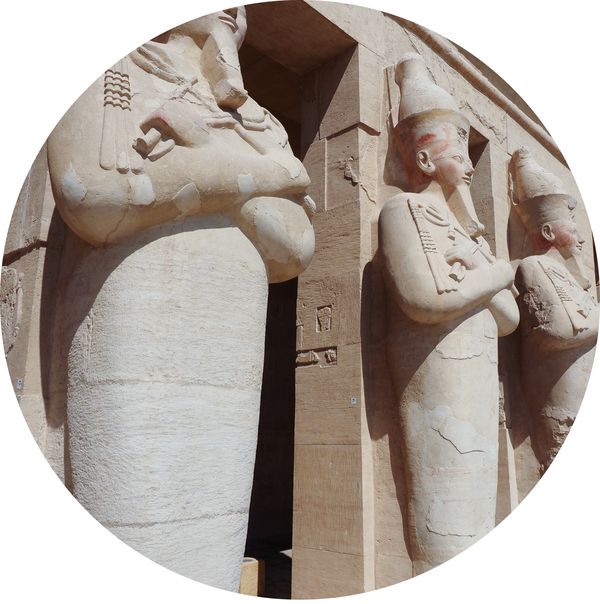
The Temple of Hatshepsut is one of the most distinctive monuments of ancient Egypt. Built in the fifteenth century BCE for the female pharaoh Hatshepsut, it rises in three terraces connected by broad ramps and aligned on a central axis. Colonnades frame the terraces, while the vertical cliffs behind the temple create a striking natural backdrop.
The monument served as Hatshepsut’s funerary temple, where rituals in her memory were performed after death. At the same time, it was a political statement. As one of the rare women to rule as pharaoh, Hatshepsut used architecture, inscriptions and imagery to reinforce her legitimacy and divine status.
Among the most famous reliefs are those depicting the expedition to the Land of Punt. These scenes show ships, exotic products, trees, animals and diplomatic encounters, presenting a successful overseas mission associated with wealth and royal authority. They are among the most informative visual records of long-distance exchange in pharaonic Egypt.
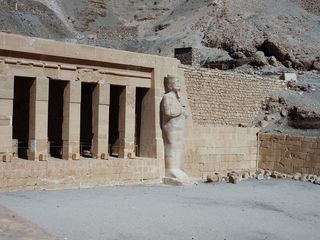
The temple also included chapels and sanctuaries dedicated to deities such as Amun, Hathor and Anubis. This demonstrates that the complex was not merely commemorative, but part of the wider religious life of Thebes.
The Colossi of Memnon, guardians of a vanished temple
Not far from Deir el-Bahari stand the Colossi of Memnon, two enormous seated statues of Amenhotep III. Each originally flanked the entrance to that king’s vast mortuary temple, once one of the largest religious complexes in western Thebes. Most of the temple has disappeared through flooding, stone reuse and long-term decay, but the statues remain as powerful landmarks.
Carved from quartzite and rising to about eighteen meters, the Colossi represent the king in formal seated posture, projecting stability and permanence. In Greco-Roman times they became famous because one of the statues was said to emit sounds at dawn after earthquake damage. Visitors associated this phenomenon with Memnon, a legendary hero, giving the statues the name still used today.
Today they preserve the memory of a lost monument and help visitors imagine the scale of Amenhotep III’s original temple complex.
Historical and cultural context
Both the Temple of Hatshepsut and the Colossi of Memnon belong to the New Kingdom, when Thebes was a major royal and religious center. During this era, pharaohs invested heavily in monumental building projects to celebrate their reigns and ensure lasting remembrance.
Ancient Thebes was symbolically divided by the Nile. The eastern bank housed temples linked to daily worship, such as Karnak and Luxor Temple, while the western bank was associated with death and rebirth, following the setting sun. Mortuary temples on the west therefore connected royal cult, funerary ritual and cosmic renewal.
These monuments also show two different expressions of royal power: one through an integrated temple complex rich in narrative reliefs, the other through colossal sculpture dominating the plain.
What the videos on this site make especially clear
Videos built largely from carefully selected and animated photographs are especially effective for monuments such as these. They allow viewers to appreciate the terraces of Hatshepsut’s temple, the rhythm of its colonnades and its close relationship with the cliffs behind it.
Slow visual movement helps reveal the reliefs of the Punt expedition, often difficult to study quickly on site. It also emphasizes the immense scale of the Colossi of Memnon, whose proportions can be hard to grasp in a single still image.
By moving between temple architecture and monumental statuary, the video also clarifies how different forms of royal representation shaped the landscape of western Thebes.
A key chapter of ancient Egyptian civilization
The Temple of Hatshepsut and the Colossi of Memnon remain among the most memorable monuments of Luxor. Together they illustrate architectural innovation, royal ideology and the enduring visual power of ancient Egypt. This video offers a clear introduction to both sites and invites further exploration through the detailed pages linked to each monument.

Audio Commentary Transcript
The Mortuary Temple of Hatshepsut
The Mortuary Temple of Hatshepsut, located at Deir el-Bahari on the west bank of the Nile near Luxor, is a funerary complex built for Queen Hatshepsut, one of the few women to rule Egypt as a pharaoh. Characterized by its successive terraces, colonnades, and access ramps, the temple was designed by the architect Senenmut. It served as a site for the queen's funerary rites as well as a sanctuary for the worship of Amun-Re. The structure reflects a blend of Theban architectural traditions with innovative elements, highlighting Hatshepsut's unique status and her enduring impact on royal Egyptian art.
The temple comprises three distinct terraces, each with its own symbolic and functional role. The first terrace is adorned with frescoes depicting Hatshepsut's expedition to the land of Punt, highlighting her role as a voyaging leader and her quest to enrich Egypt with foreign treasures. The second terrace celebrates her achievements and divine legitimacy through detailed reliefs, while the third, the most sacred, houses sanctuaries for rituals and the posthumous veneration of the queen.
The Colossi of Memnon
The Colossi of Memnon are two monumental statues representing Pharaoh Amenhotep III. Initially situated at the entrance to his vast mortuary temple, these statues stand on the west bank of the Nile, opposite Luxor. The temple, one of the most imposing of its era, has now disappeared, leaving the statues as solitary witnesses to its former greatness. The name 'Colossi of Memnon', given during the Greco-Roman period, refers to Memnon, a hero of the Trojan War, famed to be the son of the Dawn. This name highlights the cultural interactions between the ancient Egyptian and Greek civilizations.
Music:
- - YouTube video library - Night Snow - Asher Fulero
- - YouTube video library - No.1 A Minor Waltz - Esther Abrami
- - YouTube video library - Swans In Flight - Asher Fulero
Disclaimer: Despite its appropriateness, copyright issues prevent the use of egyptian traditional music in "Luxor • Temple of Hatshepsut and Colossi of Memnon", hence the use of royalty-free music. Despite our careful selection, some might regret this decision, which is necessary to avoid potential lawsuits. Although difficult, this decision is the only viable solution.