Français (France)
  Nederlands (nl-NL)
 00:00 • intro | 00:04 • the temple of Karnak... | 00:21 • ... and his morning visitors | 00:47 • the avenue of the ram-headed sphinxes | 02:48 • the Great Hypostyle Hall | 05:15 • Obelisks of Thutmose and Hatshepsut | 06:25 • Chapel of Maat | 08:16 • the Sacred Lake | 10:56 • the Pillar Hall
Personal creation from visual material collected during my trip Egypt (2024)
Map of places or practices in Luxor on this site
• Use the markers to explore the content •
Luxor and Karnak, Splendours of Ancient Egypt’s Greatest Sanctuary
A monumental complex in the heart of ancient Thebes
On the east bank of the Nile at Luxor stands Karnak, one of the most remarkable religious sites of the ancient world. More than a single temple, Karnak is a vast ceremonial complex built and enlarged over many centuries. It includes pylons, courts, sanctuaries, chapels, obelisks, sacred lakes and processional avenues. Dedicated principally to the god Amun, it became the foremost religious center of ancient Thebes and one of the clearest expressions of pharaonic power.
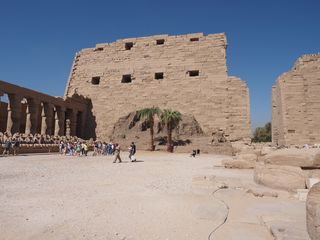
This video explores several of the site’s most memorable spaces: the ram-headed Sphinx avenue, the Great Hypostyle Hall, the obelisks of Thutmose and Hatshepsut, the Chapel of Ma’at, the Sacred Lake and the Pillared Hall. The presence of early visitors also reminds us that Karnak remains one of Egypt’s most visited historical monuments.
The principal spaces shown in the video
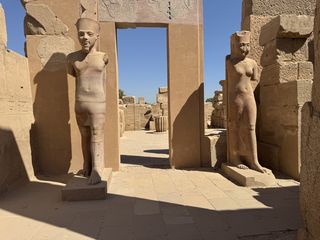
The approach to Karnak is marked by an avenue lined with ram-headed sphinxes, symbolic guardians linked to Amun. These sculpted figures once framed ceremonial routes and created a formal transition between the outer world and the sacred precinct. Even today, they communicate the monumental scale of the site before one enters the main enclosures.
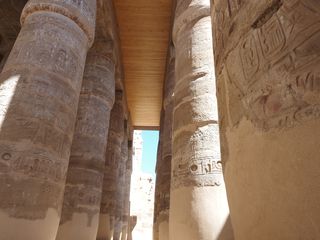
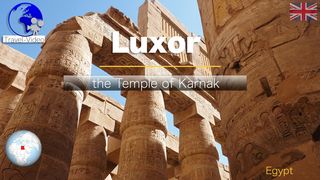
The Great Hypostyle Hall is among the most celebrated achievements of Egyptian architecture. Its dense forest of towering columns creates a powerful sense of space, rhythm and controlled light. The carved surfaces, capitals and massive stone beams reveal extraordinary technical skill and artistic ambition. This was not simply a covered hall, but an architectural statement of cosmic order and royal authority.
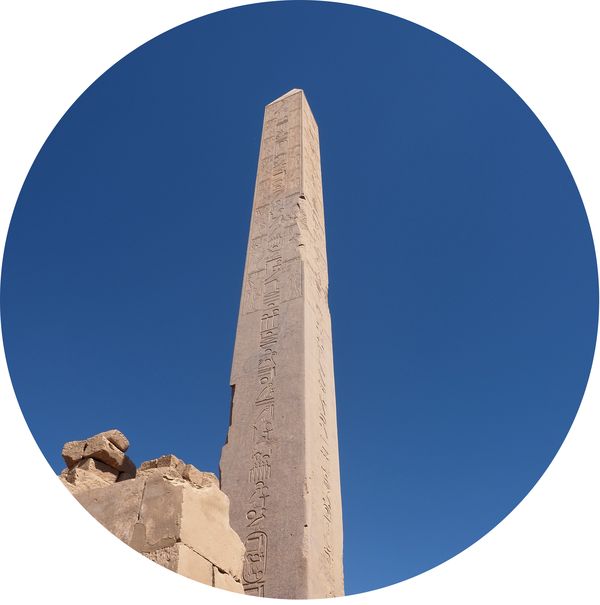
The obelisks of Thutmose and Hatshepsut rise as vertical symbols of kingship and devotion. Carved from single blocks of stone, they demonstrate advanced engineering while proclaiming the names of their royal patrons.
The Chapel of Ma’at, dedicated to the goddess of truth, justice and cosmic balance, illustrates the diversity of cult activity within the larger sanctuary. Nearby, the Sacred Lake served ritual purification and priestly ceremonies. The Pillared Hall and other subsidiary spaces reveal how Karnak grew through successive additions rather than a single building campaign.
Historical, religious and architectural context
Karnak developed from the Middle Kingdom through the Ptolemaic era, with major expansion during the New Kingdom. Rulers such as Senusret I, Thutmose III, Hatshepsut, Seti I and Ramesses II all contributed new structures, inscriptions or monumental embellishments. Each reign added another layer, turning Karnak into a monumental record of Egyptian state ideology.
Amun occupied a central place in Theban religion and was associated with kingship, fertility and cosmic stability. Together with Mut and Khonsu, he formed the principal local triad. The temple complex therefore functioned not only as a place of worship, but also as an economic and political institution supported by land, labor and priestly administration.
Architecturally, Karnak is organized through axial movement. Visitors pass through massive pylons into open courts, then toward increasingly restricted and sacred zones. This spatial progression reflects the transition from public ceremonial space to divine enclosure.
Built largely in sandstone, the complex allowed for monumental scale and durable decoration. Walls and columns were covered with reliefs showing battles, offerings, festivals and royal legitimization. Karnak was both sanctuary and visual archive of pharaonic continuity.
What the videos of this site make especially clear
Videos built largely from carefully selected and animated photographs are particularly effective for a site as extensive as Karnak. They help viewers follow the ceremonial axes, understand the arrangement of courts and gateways, and appreciate the relationship between separate structures.
Slow visual movement is especially valuable in the Great Hypostyle Hall, where scale can be difficult to grasp in still images alone. It also allows closer reading of carved inscriptions, relief scenes and column details that may be missed during a rapid visit.
Wider views restore the connection between obelisks, pylons, sacred water and processional avenues. Gradual transitions make the immense complexity of Karnak easier to understand than a fragmented on-site impression.
A summit of Egyptian civilization
Karnak remains one of the fullest surviving expressions of ancient Egypt’s religious ambition and architectural mastery. Its immense scale, long construction history and extraordinary decoration preserve the memory of many dynasties in one sacred landscape. This video offers a clear and progressive introduction, while the related detailed pages invite deeper exploration of one of the world’s great archaeological sites.
Music:
- - YouTube video library - Apocalyptic Echoes - Jimena Contreras
- - YouTube video library - Majestic Hills, (© Majestic Hills by Kevin MacLeod is licensed under a Creative Commons Attribution 4.0 license. https://creativecommons.org/licenses/by/4.0/
- Source: http://incompetech.com/music/royalty-free/index.html?isrc=USUAN1100423
- Artist: http://incompetech.com/)
- - YouTube video library - Pachabelli
Disclaimer: Despite its appropriateness, copyright issues prevent the use of egyptian traditional music in "Luxor • Wonders of the Karnak Temple", hence the use of royalty-free music. Despite our careful selection, some might regret this decision, which is necessary to avoid potential lawsuits. Although difficult, this decision is the only viable solution.


Audio Commentary Transcript
The Karnak temple
The Karnak Temple, an unrivaled jewel of ancient Egypt, offers a unique experience, marked by its morning influx of tourists. Mainly served by mass tourism from Hurghada, the early hours are often saturated with visitors. It is only after these crowds depart, heading back to the sun-soaked beaches, that the true spirit of the temple reveals itself. In the afternoon, as tranquility returns, visitors can truly appreciate the grandeur and hidden treasures of Karnak, far from the morning hustle. This contrasts sharply with the Luxor Temple, which, although popular, does not experience the same level of intense and ephemeral visitation.
The avenue of ram-headed sphinxes
At the entrance to Karnak Temple, an avenue of ram-headed sphinxes guides visitors to the first courtyard, where similar figures continue to mark the sacred pathway. These statues, representing the god Amun-Ra, serve as protective guardians and symbolize the transition from the profane to the sacred world. Carved with care, they reflect the grandeur and deep spirituality of the site, a vital center of worship in ancient Egypt.
Origin and evolution ot the temple of Karnak
The Karnak Temple, located near Luxor, is one of the largest religious complexes of antiquity, mainly dedicated to the god Amun. The initial foundations of the temple date back to the reign of Senusret I from the 12th dynasty, around 1971 to 1926 BCE. However, the most significant expansion of the site occurred under the pharaohs of the 18th dynasty, such as Thutmose III and Amenhotep III, as well as Ramesses II from the 19th dynasty. The temple is famed for its hypostyle hall with 134 massive columns and served as the cultural and administrative center of ancient Egypt. Today, Karnak continues to attract researchers and visitors from around the world, bearing witness to Egypt’s architectural and historical grandeur.
The temple of Karnak has undergone transformations and progressive destruction over the centuries due to both natural and human factors. After Akhenaten’s death, his temples dedicated to Aton were dismantled under Tutankhamun and Horemheb, with their stones reused to restore the cult of Amun. Great builders like Ramses II and Ramses III continued the expansion of the complex, but by the end of the New Kingdom, political instability and the growing influence of the priests weakened the site’s maintenance. Later, Assyrian invasions, followed by Persian, Greco-Roman, and Christian rule, led to further modifications, with some structures being plundered or repurposed. During the Coptic period, parts of the temple were converted into churches, before the entire site was gradually abandoned under Islamic rule.
In addition to these human-induced destructions, erosion, rising groundwater levels, and possibly minor earthquakes contributed to the partial ruin of certain sections, notably pylons and columns. Despite these challenges, Karnak remains one of the most impressive testimonies to Pharaonic architecture, continually reshaped through the ages.
The obelisks
The obelisks of Thutmose and Hatshepsut are symbols of divine and royal power, erected in honor of Amun-Ra. Hatshepsut’s obelisk, one of the tallest still standing, affirms her reign and legitimacy. Reaching towards the sky, these monoliths reflect the sacred link between the pharaohs and the gods.
The Sacred Lake
The Sacred Lake at Karnak, located within the vast temple complex, was crucial for the purification rituals of priests before entering the temple. Also used by pharaohs and sometimes their families during significant ceremonies, this lake symbolized spiritual purification and rebirth. A central element in reinforcing the divine legitimacy and ritual power of the pharaoh, the lake reflects the deep spirituality and religious practices of ancient Egypt.
The Pillar Hal
The Pillar Hall at Karnak, distinct from the grand hypostyle hall, is an elegant space characterized by its alignment of massive pillars. Although less ornate than those in the hypostyle hall, these pillars support a structure that served as a reception hall or a transitional area leading to smaller chapels and inner sanctuaries. Each pillar is designed to reflect the grandeur and stability of the temple, emphasizing the importance of the rites and ceremonies conducted there. This hall played a crucial role in the processions and daily activities of the temple, facilitating the movement of priests and worshippers.