Français (France)
  Nederlands (nl-NL)
 00:00 • intro | 00:32 • the Serapeum and Pompey's pillar | 04:22 • the Qaitbay citadel | 05:05 • the Library of Alexandria | 05:30 • the Kom El Shoqafa catacombs |
Personal creation from visual material collected during my trip Egypt (2024)
• Use the markers to explore the content •
Alexandria, a City of Contrasts Between Antiquity and the Modern Mediterranean
A Singular Metropolis Shaped by Many Civilisations
Founded on the coast of Egypt by Alexander the Great in 331 BCE, Alexandria remains one of the most fascinating cities of the Mediterranean world. Its history brings together Greek foundations, late pharaonic Egypt, Roman administration, early Christian traditions, Islamic dynasties and modern urban development. Few cities have changed so often while preserving such a powerful identity.
For centuries Alexandria was famous for its lighthouse, its ancient library and its role as a major commercial port linking the Mediterranean to the Nile Valley and beyond. Today, the city still embodies exchange, memory and reinvention. This video introduces several emblematic sites that illustrate those many layers: ancient remains, a medieval fortress, a contemporary library and an underground necropolis. Each monument belongs to a different age, yet all help explain why Alexandria is often described as a city of paradoxes.
Monuments from Very Different Eras
The Serapeum and the so-called Pompey’s Pillar recall the Greco-Roman period of Alexandria. The Serapeum was a major sanctuary dedicated to Serapis, a deity created through the blending of Egyptian and Greek religious traditions. It ranked among the most important sacred centres of the ancient city.
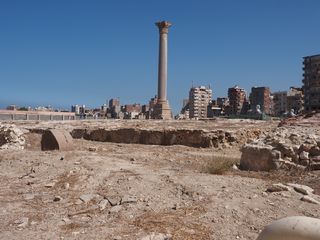
Today only fragments of the original complex remain, but they still suggest its former scale. Nearby rises Pompey’s Pillar, which was not built for Pompey but erected in honour of the Roman emperor Diocletian. Tall, isolated and highly visible, it remains one of the best-known ancient monuments of Alexandria.
The Citadel of Qaitbay belongs to a much later period. Built in the fifteenth century by the Mamluk ruler Al-Ashraf Sayf al-Din Qa’it Bay, it occupies the traditional site associated with the ancient Lighthouse of Alexandria. Facing the sea, it reflects the strategic importance of defending the harbour and maritime approaches.
The modern Bibliotheca Alexandrina symbolically reconnects the city with its intellectual fame. Its contemporary design and cultural mission express a renewed ambition to place Alexandria once again among major centres of knowledge.
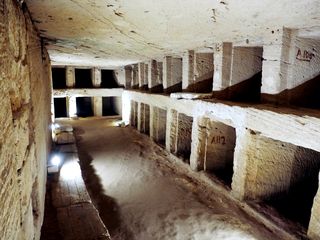
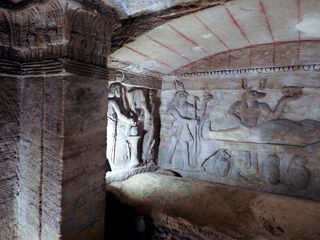
The Catacombs of Kom el Shoqafa offer yet another aspect of the city. This underground funerary complex combines Egyptian, Greek and Roman influences in a uniquely hybrid artistic language.
Historical Context and Alexandrian Identity
Alexandria became the capital of the Ptolemaic kingdom after the death of Alexander. Under the Ptolemies, it developed into one of the greatest intellectual centres of the ancient world. Scholars, merchants and travellers moved through its ports and streets, linking cultures across regions.
After incorporation into the Roman Empire, the city retained immense economic and strategic importance. It also became a major centre of early Christianity, producing influential theological debates and institutions. Later Islamic, Ayyubid, Mamluk and Ottoman periods reshaped its urban form and political role.
In the modern era, Alexandria regained commercial vitality through its port and cosmopolitan communities. Europeans, Levantines, Egyptians and others contributed to its social character. This long sequence of transformations explains why the city often appears full of contrasts: ancient yet modern, African yet Mediterranean, scholarly yet popular, dense urban fabric beside an open seafront horizon.
What the Videos on This Site Make Especially Clear
The videos presented on this site are often created from carefully selected photographs arranged in a coherent visual sequence. This method is particularly effective for a city as historically layered as Alexandria, where monuments from very different periods coexist within a modern urban environment.
Views of the Serapeum area and Pompey’s Pillar immediately show how isolated ancient remains survive within the contemporary city. The contrast between Roman stonework and present-day surroundings becomes easier to grasp.
For the Citadel of Qaitbay, wider images highlight the relationship between military architecture and the sea. The placement of towers, walls and defensive lines becomes more understandable when seen against the coastline and harbour setting.
The Bibliotheca Alexandrina also benefits from this visual approach. Its curved forms, large volumes and symbolic openness toward the Mediterranean are clearer through successive perspectives than through description alone.
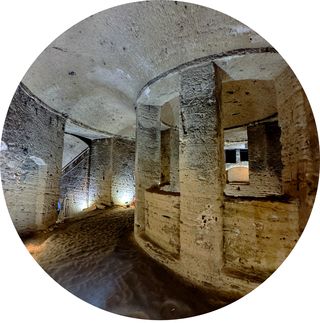
The Catacombs of Kom el Shoqafa, often difficult to appreciate fully during a visit because of their underground layout, become more legible through a sequence of images showing stairs, chambers and sculpted decoration.
Finally, moving from one site to another reveals the chronological diversity of Alexandria. Few cities allow viewers to pass so quickly through so many centuries of history.
A City Where Centuries Still Meet
Alexandria remains a unique place where ancient memory, medieval defence and modern cultural ambition continue to coexist. Its monuments do not tell the story of a single civilisation, but of many worlds connected by trade, scholarship and the Mediterranean Sea.
The detailed pages linked to this video offer the opportunity to explore each major site more closely, from architecture and symbolism to the wider historical destiny of this remarkable city.
Music :
- - YouTube video library - Fall of the Solar King, (© Fall of the Solar King by Twin Musicom is licensed under a Creative Commons Attribution 4.0 license. https://creativecommons.org/licenses/by/4.0/
- Artist: http://www.twinmusicom.org/)
- - YouTube video library - Hopeless - Jimena Contreras
Disclaimer: Despite its appropriateness, copyright issues prevent the use of egyptian traditional music in "Alexandria • Ancient Ruins of the City of All Paradoxes", hence the use of royalty-free music. Despite our careful selection, some might regret this decision, which is necessary to avoid potential lawsuits. Although difficult, this decision is the only viable solution.

Audio Commentary Transcript
Alexandria
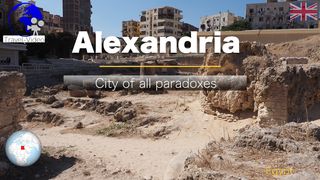
Alexandria is arguably the most paradoxical city in human history, a city where a rich cultural past starkly contrasts with what has survived to our time. At the heart of this historic city stands Pompey's Column, not as a marker of the emperor's tomb as the Crusaders en route to Jerusalem once believed, but commemorating the suppression of a revolt against Roman authority, then led by Diocletian. This column has long been the only monument evoking the rich history of the city at this location. It was not until 1945 that the discovery of the first remains revealed the presence of one of the most prestigious temples of the era when the Greeks of the Ptolemaic dynasty wielded pharaonic power in Egypt, the Serapeum dedicated to the syncretic god Serapis, a fusion of the Apis bull and Greek deities. This temple was connected by a secret passage to a vast network of knowledge, embodied by the legendary Library of Alexandria, of which nothing remains today, likely a victim of successive earthquakes that led to its destruction, sharing the fate of that ancient world wonder, the Lighthouse of Alexandria, described by Herodotus.
Pompey's Column
Pompey's Column, standing 27 meters tall, is carved from red granite from Aswan and was erected around 297 in honor of Emperor Diocletian. At its base lies a cartouche of Ramses II, likely reused from an earlier monument. This intriguing detail links Pharaonic Egypt to Roman grandeur, bearing witness to the site’s rich history.
The Serapeum
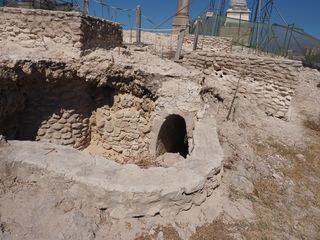
The Serapeum, once a majestic temple and a symbol of religious tolerance, struggles to attract the attention of visitors, overshadowed by the Pompey's Pillar erected above it, despite the sphinxes that flank it.
This staircase, which seems to lead to a basement, is actually a nilometer—an architectural device used to measure the Nile's water levels through a one-kilometer channel connecting it to the river. The accurate measurement of the river's height was crucial as it directly influenced the taxes levied on the Egyptians. Located within the Serapeum, the nilometer underscores the temple's role in tax collection, highlighting the Greco-Egyptian syncretism characteristic of the Ptolemaic era.
The Qaitbay Citadel
This fort, known as the Qaitbay Citadel, was built in the late 15th century on the exact site where the famous Lighthouse of Alexandria once stood, destroyed by a series of earthquakes between 956 and 1323. The citadel was partially constructed using stones from the old lighthouse. Significant remnants of this ancient world wonder remain underwater. Perhaps one day, an underwater museum will allow these preserved ruins to be viewed in their natural environment.
The Library of Alexandria
The Library of Alexandria, once the largest in the world, has left no trace, neither of its buildings nor its collections. A construction project to create a grand library, continuing the ambition of the one gradually destroyed between the siege of the city by Julius Caesar and Theodosius' edict in 391 AD, culminated in 2002 with this modern version of the ancient temple of knowledge.
The Catacombs of Kom El Shoqafa
It was here, around 1900, that a donkey fell into a well. This incident led to the rediscovery of one of Alexandria's marvels, the catacombs of Kom El Shoqafa. Originally designed as a private tomb for a wealthy family from Alexandria, at a time when the city was a cultural crossroads blending Egyptian, Greek, and Roman influences, the site gradually expanded into a vast underground necropolis. It would go on to be used for nearly three centuries at the beginning of our era.
The Catacombs of Kom El Shoqafa are one of the most remarkable examples of underground funerary architecture from the Greco-Roman period in Egypt, distinguished particularly by their unique architectural design centered around a large well. This well, the central element of the complex, was used to lower the deceased into the depths of the earth, thus facilitating their transport to their final resting place. This method not only allowed for a respectful funeral ritual but also effective preservation of the bodies in the multiple chambers and galleries that extend around the central well. These subterranean structures, carved into the rock, reflect a blend of Egyptian, Greek, and Roman influences, illustrating the cultural integration of the city of Alexandria in antiquity.