Français (France)
  Nederlands (nl-NL)
 00:00 • intro | 00:55 • Temples of Ramses and of Nefertari | 02:35 • Salvage of Abu Simbel | 03:24 • Temple of Ramses ('Great Temple') | 11:18 • Temple of Nefertari ('Small Temple')
Personal creation from visual material collected during my trip Egypt (2024)
• Use the markers to explore the content •
Abu Simbel, the Temples of Ramesses II and Nefertari on the Nile
A Masterpiece of Ancient Egypt and World Heritage
In southern Egypt, near the frontier of ancient Nubia and the waters of Lake Nasser, Abu Simbel stands among the most celebrated monumental sites of the ancient world. Carved into the sandstone cliffs during the reign of Ramesses II in the 13th century BCE, the two temples combine royal propaganda, religious symbolism and remarkable engineering. Their dramatic setting between desert landscapes and the modern reservoir created by the Aswan High Dam adds further power to the site.
Abu Simbel consists of two neighbouring sanctuaries: the Great Temple, dedicated to Ramesses II and several major deities, and the smaller temple honouring Queen Nefertari together with the goddess Hathor. This video introduces both monuments while also exploring the extraordinary rescue campaign that ensured their survival in the twentieth century.
Two Rock-Cut Temples of Royal Prestige
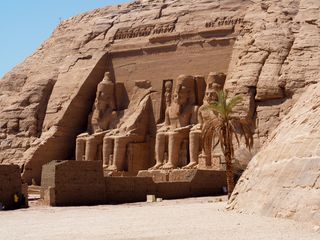
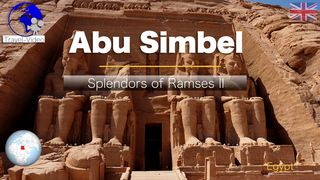
The Great Temple of Ramesses II is instantly recognised by its monumental façade dominated by four colossal seated statues of the king. Carved directly from the cliff face, these figures proclaim royal authority at the southern approaches of Egypt. Between and beside them appear smaller representations of members of the royal family, reinforcing the dynastic message of the monument.
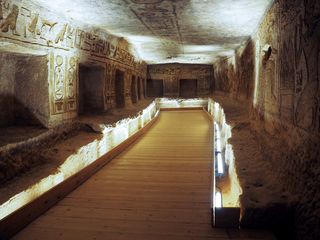
Inside, the temple follows a carefully ordered sequence of halls leading toward the most sacred chamber. Pillared rooms, sculpted walls and ritual spaces create a gradual transition from the public exterior to the divine interior. Among the most famous reliefs are scenes celebrating military victories, especially the Battle of Kadesh, presented as proof of royal strength and legitimacy.
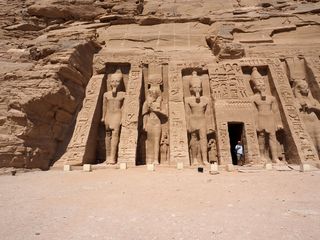
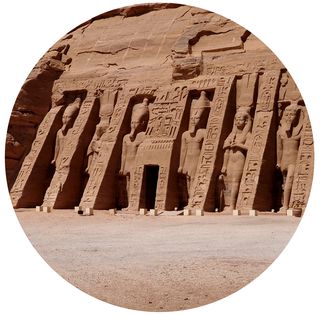
The Temple of Nefertari, often called the Small Temple, is more modest in scale yet highly refined. Its façade displays standing statues alternating between Ramesses II and the queen, an unusual honour in Egyptian art that underlines her exceptional status. The interior decoration is closely linked to Hathor, goddess of love, music, protection and feminine power.
Together, the two temples form a coordinated statement of kingship, religion and imperial presence in the south of the kingdom.
Historical, Political and Architectural Context
Abu Simbel was created during the Nineteenth Dynasty, one of the most powerful periods of the Egyptian New Kingdom. Ramesses II ruled for many decades and became known for an ambitious building programme extending across Egypt and Nubia. Temples, statues and inscriptions were used to project continuity, divine favour and political stability.
The southern location of Abu Simbel was strategically important. Nubia was rich in resources, especially gold, and controlled routes linking Egypt with inner Africa. By establishing monumental temples here, the pharaoh affirmed Egyptian authority while also integrating the region into the symbolic geography of the state.
Architecturally, Abu Simbel differs from freestanding temples built of assembled stone blocks. Here, the mountain itself becomes architecture. Façades, halls and sanctuaries were excavated directly into the rock, creating a unified space where sculpture and structure are inseparable. This approach demanded careful planning, precise carving and long-term organisation of labour.
The Great Temple is also famous for its solar alignment. On specific dates, sunlight penetrates deep into the sanctuary, illuminating selected statues. Whether interpreted ritually, politically or astronomically, this feature demonstrates the sophisticated relationship between architecture and celestial observation.
The Rescue of Abu Simbel
In the twentieth century, the construction of the Aswan High Dam transformed the Nile Valley and led to the creation of Lake Nasser. Rising waters threatened many ancient Nubian monuments, including Abu Simbel. Without intervention, the temples would have been partially submerged.
Under the leadership of UNESCO, an international rescue campaign was launched in the 1960s. Abu Simbel became one of the most famous heritage preservation projects ever attempted. The temples were carefully cut into large blocks, dismantled, moved to higher ground and reconstructed within an artificial hill designed to reproduce their original appearance and orientation.
This operation combined archaeology, engineering and international cooperation on an unprecedented scale. The site seen today therefore represents both ancient craftsmanship and modern conservation achievement.
What the Videos on This Site Make Especially Clear
The videos presented on this site are often created from carefully selected photographs arranged in a coherent visual sequence. For Abu Simbel, this method is particularly effective because it allows close observation of monumental sculpture while also preserving a sense of place and scale.
Wide views help reveal the dramatic setting of the temples beside desert landscapes and the waters of Lake Nasser. They show how the monuments were positioned to dominate their environment and to impress approaching travellers.
Closer images make it easier to study facial features, hieroglyphic inscriptions, carved garments, pillars and relief scenes. Details that may pass quickly during an on-site visit can be examined more attentively through a structured progression of images.
Changes of angle and light also enhance understanding of the façades. The colossal statues gain depth through shadow, while interior carvings become clearer when seen from selected viewpoints. The contrast between the massive exterior cliffs and the ordered sacred interiors is especially readable in visual sequence.
Finally, the rescue story itself becomes easier to grasp when the current setting is linked to the historical challenge of relocation. The relationship between the temples, the lake and the reconstructed hill can be understood more naturally through successive images.
A Dialogue Between Antiquity and Modern Preservation
Abu Simbel unites two extraordinary stories: the artistic ambition of pharaonic Egypt and one of the greatest international rescue operations in heritage history. Few places illustrate so clearly how monuments from the distant past can remain meaningful in the modern world.
The detailed pages linked to this video offer the opportunity to explore the Temple of Ramesses II and the Temple of Nefertari more closely, from architectural design and royal symbolism to their preservation for future generations.


Audio Commentary Transcript
The Temples of Abu Simbel and Their Spectacular Rescue
The temples of Abu Simbel in Egypt are among the few sites in the world to showcase two remarkable feats of engineering over 3,000 years apart. Originally constructed in the 13th century BCE under the reign of Ramses II, these monumental temples were carved into Nubian sandstone, a resilient rock, to honor the pharaoh’s greatness and to venerate the gods. This ancient project produced two temples: one dedicated to Ramses II himself and the gods Amun, Ra, and Ptah, and another to his wife Nefertari, linked to the goddess Hathor.
In the early 1960s, the colossal monument of Abu Simbel, over 3,000 years old, faced the threat of disappearing beneath the waters of the Nile due to the construction of the Aswan High Dam. This infrastructure project, designed to control floods and provide electricity to Egypt, threatened to submerge this masterpiece under the waters of the new lake. To save this treasure, an unprecedented rescue operation was launched, laying the foundation for what would become the UNESCO World Heritage protection program in 1972. The temple of Ramses II, a symbol of power, was meticulously cut into blocks, moved, and reassembled higher up within an artificial cliff, carefully reconstructed to preserve its original rock-cut appearance. The lines visible at the top of the rock still bear witness to this endeavor.
The Nile, both life-giving and destructive, has always shaped Egypt’s destiny. As a source of fertility, it deposited its rich silt during floods, nourishing the land and the civilizations that depended on it. But its power, when it overflowed, could also engulf lands and treasures. By saving Abu Simbel, the international community preserved not only a temple but also a fragment of Egyptian history, wrested from the whims of the river.
The temple of Ramses
At the base of the colossal statues of Ramses, smaller figures depict his children and family members, underscoring the importance of his royal lineage. On either side, the falcon god Horus, protector of the pharaoh, stands watch. The second statue, likely damaged by an ancient earthquake, still has its fallen fragment at the temple's feet, preserved in the faithful reconstruction of Abu Simbel.
In the central niche of the façade stands a statue of Re-Horakhty, the solar god who combines Re, the sun, with Horakhty, a form of Horus associated with the horizon. This solar symbol emphasizes the importance of the sun for Ramses II. On either side, two elegant reliefs show the pharaoh in worship, surrounded by hieroglyphs and cartouches inscribing his royal names, affirming his divine connection.
At the top of the temple, a row of baboons — likely originally 24 to symbolize the complete cycle of day and night — worships the sun, affirming the connection between Ramses II and the eternal solar cycle.
In the temple's great hypostyle hall, eight colossal columns representing Ramses II as Osiris greet visitors. These impressive pillars, sculpted in the image of the deified pharaoh, symbolize his eternal power and role as protector of Egypt, guiding towards the sacred heart of the temple.
At the back of the sanctuary in Abu Simbel, four seated statues represent, from left to right: Ptah, Ramses II, Amun, and Re-Horakhty. Ptah, the god of darkness, remains in shadow, while the other three statues are illuminated by sunlight twice a year. Originally, this phenomenon occurred around February 21 and October 21, but since the temple was relocated higher on the cliff to prevent flooding from Lake Nasser, it now occurs on February 22 and October 22. This moment symbolizes the pharaoh's union with the solar gods, affirming his divine power and cosmic connection to the cycle of light.
Egyptian bas-reliefs follow unique conventions, combining profile and frontal views to present the most recognizable perspective of each body part. The head and legs are shown in profile, while the torso faces forward, ensuring immediate clarity. Sometimes, two right hands or two left hands emphasize symbolic gestures. This composite style is not meant to be realistic but to convey a sacred and readable message, with a magical function: these images are designed to 'live' in the afterlife, allowing the depicted figures to continue existing and interacting in the realm of the gods.
The walls of Ramses II's temple at Abu Simbel are adorned with bas-reliefs, once enhanced with paint to add depth and color to the scenes. Built to celebrate Ramses II's divine and military power, the temple was intended to assert his authority over newly conquered Nubia and demonstrate his privileged connection with the gods. The main themes depict the pharaoh honoring deities, especially Re-Horakhty, and his military victories, such as the Battle of Kadesh. These motifs portray Ramses as an invincible ruler and protector of Egypt, consolidating his power over his territories.
The temple of Nefertari
The temple dedicated to Nefertari, wife of Ramses II, is distinguished by the harmonious and symbolic arrangement of the colossal statues guarding its entrance, three of Ramses and three of Nefertari. Notably, Nefertari is depicted on the same scale as Ramses, which is uncommon and highlights her exceptional status among the queens of ancient Egypt. She is also adorned with a large crown, elevating her stature even beyond that of Ramses at her side.
This unique façade, where Nefertari is as present and imposing as the pharaoh himself, bears testimony to her political and cultic significance. This arrangement celebrates their union and co-reign, underscoring their interdependence in life as in the eternal memory of their civilization.
A striking difference with the nearby Temple of Ramses is the presence of imposing hieroglyphs on the façade. It is likely that the temple's designers intended to emphasize the symbolism of this temple, which is dedicated to Queen Nefertari, closely associated with one of the principal deities of the Egyptian pantheon, the goddess Hathor.
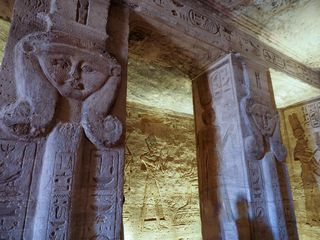
Hathor, goddess of love, beauty, music, and maternity, plays a central role in the Egyptian pantheon. Here, flanking Nefertari, she is depicted with her iconic horns encircling a solar disk, symbolizing her protective and divine status. This mural illustrates the close relationship between Nefertari and Hathor, elevating the queen to an almost divine stature.
On the columns, the same Hathor is sculpted with more stylized features but still identifiable by her cow horns and ears. This less elaborate representation highlights another aspect of her role, that of nourisher and guardian, reflecting her omnipresent presence and influence in this temple dedicated to Queen Nefertari.
The Temple of Nefertari at Abu Simbel, although dedicated to Queen Nefertari and Hathor, the goddess of love and music, also prominently illustrates the presence and significance of Ramses II. This temple not only serves as a tribute to his great royal wife but also showcases the power and piety of the pharaoh himself. Through detailed reliefs, Ramses II is omnipresent, depicted in victorious battle scenes and divine interactions with the gods, including Hathor. These representations reinforce his role as a warrior ruler and protector of Egypt, while highlighting his close and sacred relationship with Hathor, thus emphasizing the dual nature of this temple: a place of worship and a monument to the glory of Ramses II.
Music :
- - YouTube video library - Los Encinos - Quincas Moreira
- - YouTube video library - Nature Nurture
- - YouTube video library - Surrender - Asher Fulero
Disclaimer: Despite its appropriateness, copyright issues prevent the use of egyptian traditional music in "Abu Simbel • Temples of Ramses & Nefertari, Egyptian Wonders", hence the use of royalty-free music. Despite our careful selection, some might regret this decision, which is necessary to avoid potential lawsuits. Although difficult, this decision is the only viable solution.