Français (France)
  Nederlands (nl-NL)
 00:00 • intro | 00:25 • the entrance of the temple | 02:28 • the peristyle courtyard | 04:59 • the hypostyle hall | 06:35 • the reliefs | 08:23 • the mammisi
Personal creation from visual material collected during my trip Egypt (2024)
Map of places or practices in Edfu on this site
• Use the markers to explore the content •
Edfu and the Temple of Horus: a masterpiece of ancient Egypt
A major sanctuary on the Nile
At Edfu, between Luxor and Aswan, stands one of the best-preserved religious monuments of ancient Egypt: the Temple of Horus. Rising near the Nile, this vast sanctuary still dominates the modern town through the scale of its walls, gateways, halls, and sculpted decoration. It is one of the most valuable surviving monuments for understanding how Egyptian sacred architecture functioned in the final centuries of pharaonic tradition.
This video offers a clear approach to the complex, moving from the monumental entrance toward increasingly sacred interior spaces. It also reveals the richness of carved surfaces, the discipline of the architectural plan, and the relationship between open courts and enclosed halls. Edfu appears not simply as an archaeological site, but as a carefully designed religious institution where power, ritual, and stone construction were closely linked.
Main spaces and features visible in the monument
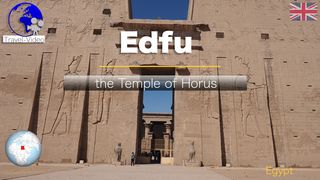
The entrance immediately impresses through its massive pylon, formed by two towering structures framing the central gateway. This façade marked the passage from ordinary space into sacred territory. Its carved scenes and inscriptions expressed royal authority and divine protection.
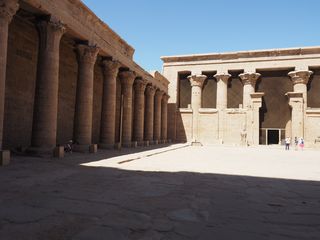
Beyond the gateway lies the peristyle court, a large open space surrounded by colonnades. This court was the most accessible part of the temple precinct and remains one of the best places to appreciate the monument’s scale. It balances open sky, rhythmic columns, and the heavy masonry of the surrounding walls.
The hypostyle hall introduces a different atmosphere. Supported by rows of columns, darker and more enclosed than the court, it leads the visitor gradually toward the innermost parts of the sanctuary. The contrast between bright exterior zones and shadowed interiors is one of the temple’s strongest architectural effects.
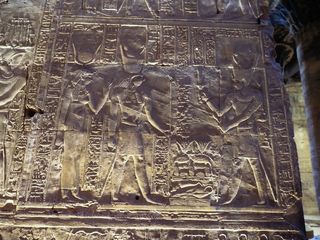
The bas-reliefs are among the most remarkable elements shown in the video. Walls preserve ritual scenes, divine figures, hieroglyphic inscriptions, and ceremonial gestures linked to temple life. Their abundance turns the monument into a vast visual archive of religious practice.
The mammisi, or birth house, also appears in the sequence. This secondary structure was associated with symbolic celebrations of divine birth and helps complete the understanding of Edfu as a larger ceremonial complex rather than a single isolated building.
Historical setting and architectural significance
The visible temple was built mainly during the Ptolemaic period, beginning in the third century BCE. Greek rulers who governed Egypt after Alexander the Great chose to support traditional cults and commission monumental sanctuaries in established Egyptian forms. Edfu belongs fully to that political and religious strategy.
The god worshipped here was Horus, the falcon deity associated with kingship, victory, and territorial order. His cult at Edfu held particular regional importance and was reinforced through annual festivals and processions that connected the temple to surrounding communities.
Architecturally, the monument demonstrates a highly controlled sacred sequence. The visitor advances through successive zones: monumental façade, open court, roofed halls, priestly areas, and central sanctuary. Each space had a defined function and a different degree of access.
The temple’s remarkable state of preservation is partly due to its gradual burial beneath sediment and later occupation after ancient worship ended. When cleared in modern times, it emerged as one of the most complete surviving temples in Egypt, essential for the study of architecture, ritual, and sacred administration.
What the videos on this site make especially clear
Videos created largely from carefully selected and animated photographs are particularly effective for a monument such as Edfu. They allow close observation of features that can be difficult to grasp during a rapid visit, including the height of the pylon, the depth of the halls, and the density of carved decoration.
Slow movements and progressive transitions make the logic of the plan easy to understand. The viewer can follow how the route passes from public spaces into increasingly restricted sacred zones. This spatial progression, central to Egyptian temple design, becomes immediately readable.
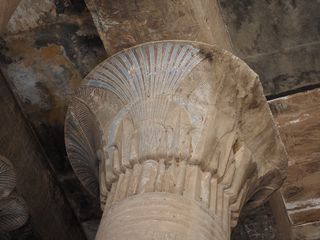
Close views also reveal the quality of the reliefs: divine figures, hieroglyphic texts, offering scenes, column capitals, and ornamental details. The video helps explain how architecture and symbolic imagery were conceived as one unified system.
The succession of images also clarifies the relationship between mass, shadow, and light. It shows how ancient builders used scale, stone surfaces, and controlled illumination to shape the visitor’s experience.
An essential monument of ancient Egypt
The Temple of Horus at Edfu combines monumental power, refined decoration, and strong religious continuity. Its exceptional preservation makes it one of the most instructive sites in the Nile Valley. Visitors wishing to continue the discovery can explore the dedicated pages on the temple and its mammisi for a deeper understanding of this remarkable ensemble.
Links to related pages

Videos
• Egypt •

Audio Commentary Transcript
The Temple of Horus at Edfu, constructed between the 3rd and 1st centuries BCE during the Ptolemaic dynasty, is one of the best-preserved monuments of ancient Egypt. Although built long after the great pyramids and temples of the New Kingdom, it reflects the continuity of Egypt’s religious and cultural traditions during the Greco-Roman period.
The Entrance of the Temple and the Pylon
The bas-reliefs of the Temple of Horus at Edfu, created under the Greek pharaohs of the Ptolemaic dynasty, showcase a unique blend of Egyptian art and Hellenistic influence. The figures exhibit slightly more naturalistic proportions, with greater attention to anatomical details, while the scenes are marked by increased dynamism. Although adhering to traditional Egyptian iconography, these representations incorporate Greek stylistic elements, such as refined ornamental motifs and idealized features, characteristic of Hellenistic art. This fusion reflects the Ptolemies' adaptation to legitimize their rule in Egypt.
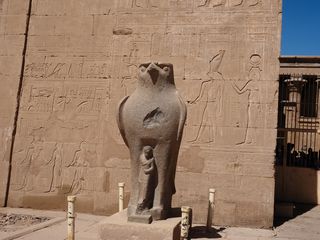
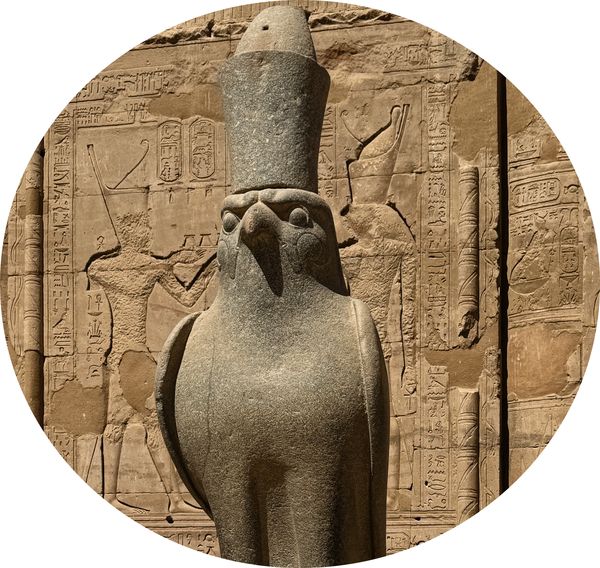
At the main entrance of the Temple of Edfu, leading to the grand peristyle courtyard, stand two imposing statues of the god Horus, flanking either side of the doorway. The first depicts Horus with a small statue of the pharaoh between his legs, symbolizing divine protection and the unity between the king and the deity. The second, more stylized statue, bears the double crown of Upper and Lower Egypt, embodying Horus's sovereign power and cosmic authority as the guardian of the kingdom. These sculptures highlight Horus's central role in ancient Egyptian religion and politics.
The peristyle courtyard
The peristyle courtyard of the Temple of Horus at Edfu is a vast open space surrounded by a grand colonnade. This area served as a gathering place for devotees, hosting public ceremonies and ritual processions. The columns are richly adorned with reliefs depicting offerings and mythological scenes, emphasizing the spiritual and social significance of this space in the worship of Horus.
The hypostyle hall
At the entrance to the hypostyle hall of the Temple of Edfu, two statues of Horus stand proudly on either side of the doorway. One, stylized and wearing the crown, closely resembles the statue at the main entrance of the complex. The other, crouched in a protective stance, appears to be watching over the sacred space. These representations emphasize Horus's role as the divine guardian of the temple.
The peristyle courtyard, whose name comes from the Greek peri meaning 'around' and stulos meaning 'column', is an open space surrounded by colonnades. The hypostyle hall, on the other hand, derives its name from hypo, meaning 'under', and stulos. It is characterized by a roof supported by rows of columns, symbolizing an architectural transition towards the temple's most sacred spaces.
The reliefs of the Temple of Horus at Edfu, typical of the Ptolemaic period, stand out for their refined and realistic style compared to earlier periods. Each detail is meticulously carved, reflecting an exceptional level of artistic mastery. These scenes depict rituals, myths such as the battle between Horus and Seth, while balancing Egyptian tradition with Greek influences, thereby emphasizing cosmic order and the grandeur of the temple.
The sacred barque, carried here in procession by priests, symbolizes the divine journey of the god Horus through the world. It was used to transport his statue during religious ceremonies, especially during major festivals, thus connecting the earthly realm to the cosmic plane. This ritual, depicted with remarkable precision in the reliefs, highlights the importance of these processions in maintaining divine order and universal harmony.
The corridors surrounding the sanctuary
The corridors surrounding the sanctuary were used for ritual processions and symbolically protected the sacred heart of the temple. The reliefs carved into their walls depict mythological scenes, such as the battle between Horus and Seth. The latter, sometimes shown as a pig, embodies the chaos that Horus must overcome to restore cosmic order.
The mammisi
The mammisi, or 'birth house', is a small temple dedicated to the divine birth of Horus, the son of Hathor and Horus the Elder. Located near the main temple, it symbolizes the perpetual renewal of cosmic order and dynastic continuity. This site was used for rituals celebrating the mythological birth of the gods, while also reinforcing the connection between the pharaoh and the deities, affirming his role as the legitimate son of the gods and guarantor of universal stability.
Music:
- - YouTube video library - Elogy - Asher Fulero
- - YouTube video library - Wonder
Disclaimer: Despite its appropriateness, copyright issues prevent the use of egyptian traditional music in "Edfu • Temple of Horus, a Treasure of Ancient Egypt", hence the use of royalty-free music. Despite our careful selection, some might regret this decision, which is necessary to avoid potential lawsuits. Although difficult, this decision is the only viable solution.