

 Français (France)
  Nederlands (nl-NL)
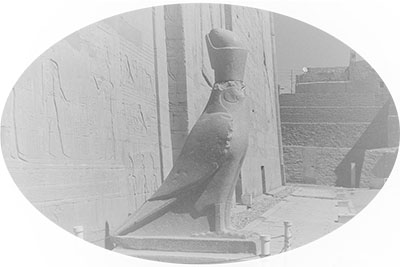
 The Temple of Horus, located in Edfu, Egypt, is one of the most significant religious monuments of the Nile Valley. Dedicated to the falcon god Horus, it reflects the importance of traditional worship in ancient Egypt and the continuity of sacred practices during the Ptolemaic period. Exceptionally well preserved, the site helps explain how Egyptian temples functioned, the role of priests, and the place of ceremonies in public life. Its inscriptions and ritual spaces also provide valuable evidence for the study of language, religious beliefs, and the expression of sacred authority.


Monument profile
Temple of Horus
Monument category: Egyptian temple
Monument family: Temple
Monument genre: Religious
Cultural heritage: Ancient Egypt
Geographic location: Edfu • Egypt
Construction period: 3rd century BC
• Links to •
• Dynasties that contributed to the construction of the monument •

• List of videos about Edfu on this site •
Edfu • Temple of Horus, a Treasure of Ancient Egypt
Temple of Horus at Edfu: Development, Use, and Historical Transmission
Ptolemaic Foundation and Political Purpose
The Temple of Horus at Edfu, on the west bank of the Nile between Luxor and Aswan, is one of the best-preserved major sanctuaries of ancient Egypt. The visible monument belongs mainly to the Ptolemaic period, when rulers of Macedonian origin governed Egypt after the conquests of Alexander. Construction of the present temple began in 237 BCE under Ptolemy III Euergetes I on the site of earlier sacred structures dedicated to Horus.
Its foundation served specific political and religious aims. Edfu was already an established cult center of Horus, a deity strongly associated with kingship, victory, and territorial protection. By sponsoring a monumental rebuilding in traditional Egyptian form, the Ptolemaic dynasty sought to reinforce legitimacy among Egyptian priesthoods and provincial elites. The project demonstrated continuity with earlier pharaonic models while presenting the reigning dynasty as rightful guardians of sacred order.
Construction proceeded in carefully planned phases over several reigns. The sanctuary core, halls, courtyards, enclosure structures, and decorative program required sustained royal investment. This continuity indicates that Edfu remained a site of high importance within the state’s religious network. Rather than a symbolic gesture alone, the temple was conceived as a fully functioning institution capable of sustaining ritual life, priestly administration, and regional prestige.
Cult Activity and Institutional Role
The temple was dedicated to Horus of Behdet, the local manifestation of the falcon god. Edfu possessed a developed theological identity in which Horus held primary status. Inscriptions preserved on the walls record rituals, mythological texts, liturgical formulas, and ceremonial sequences linked directly to the functioning of the sanctuary.
At the center of worship stood the divine cult statue housed within the sanctuary. Priests performed daily rites that included purification, clothing of the image, incense offerings, food presentations, and recitations. These ceremonies were not occasional acts but the regular maintenance of divine presence within the temple.
The site was also known for festival processions. The most famous celebrated the ritual union of Horus of Edfu with Hathor of Dendera. During this event, Hathor’s sacred bark traveled to Edfu, where ceremonies marked divine encounter, renewal, and fertility. Such festivals strengthened ties between regional cult centers and brought wider participation beyond the resident clergy.
The temple also functioned as an economic and administrative institution. It managed agricultural revenues, personnel, storage facilities, workshops, and sacred goods. Priests, scribes, attendants, and laborers formed a structured community attached to the monument. Edfu was therefore both a ritual center and an organized establishment integrated into the local economy.
Completion, Roman Continuity, and End of Ancient Worship
Major structural works were completed in 57 BCE under Ptolemy XII Auletes, although decorative additions continued afterward. By the late Ptolemaic period, the temple stood as a complete ceremonial complex whose walls preserved extensive texts regulating ritual performance and defining sacred space.
After Egypt became a Roman province in 30 BCE, the temple continued in use. Roman authorities often maintained established cult institutions during the early imperial centuries. Some emperors added inscriptions or completed decorative elements, confirming that Edfu retained recognized religious significance.
The decline of traditional temple worship became more visible during Late Antiquity. As Christianity expanded and imperial policy increasingly restricted pagan cults, temple activity gradually ceased. Edfu lost its original liturgical role, and portions of the complex were reused in practical ways unrelated to earlier worship. Settlement growth around the monument and accumulated Nile sediments gradually buried large sections of the structure.
This partial burial, while obscuring the temple, also contributed to preservation. Interior spaces, reliefs, and much of the architectural mass survived because they were shielded for long periods from quarrying and extensive dismantling.
Rediscovery, Modern Study, and Present Status
When European travelers described Edfu in the eighteenth and early nineteenth centuries, much of the temple remained covered by debris and adjacent habitation. Only upper sections were clearly visible. Systematic clearance began in the nineteenth century, especially under Auguste Mariette from the 1860s onward.
Excavation revealed a monument of unusual completeness. Unlike many Egyptian sanctuaries preserved only in fragments, Edfu retained its pylons, halls, sanctuary sequence, enclosure remains, and an immense body of inscriptions. This transformed the temple into a key source for the study of late Egyptian religion, priestly ritual, and temple administration.
Because the site preserves extensive ritual texts, Edfu has been central to modern scholarship on how temples functioned in the final centuries of native religious tradition. The monument also provides evidence for the deliberate cultural policy of the Ptolemaic rulers, who used Egyptian sacred forms while governing a multilingual kingdom.
The Temple of Horus at Edfu is not individually inscribed on the UNESCO World Heritage List, and no separate UNESCO designation applies specifically to the monument. Its protection is managed primarily through Egyptian heritage institutions and ongoing archaeological conservation programs.
Current preservation concerns include stone erosion, salt crystallization, visitor pressure, and environmental impacts from the surrounding urban setting. Conservation campaigns focus on structural stability, cleaning relief surfaces, and maintaining legibility of inscriptions.
Chronological World Context
When construction began in 237 BCE, the Roman Republic was expanding after the Punic Wars. Hellenistic kingdoms still dominated much of the eastern Mediterranean and Near East. In South Asia, the Mauryan Empire remained a major political power shortly before the reign of Ashoka. In China, unification under the Qin dynasty had not yet occurred. These events place Edfu within a period of major political transformation across Eurasia.
Monumental Composition and Sacred Spatial Design of the Temple of Horus at Edfu
Site Placement, Enclosure, and Overall Planning
The Temple of Horus at Edfu stands on an elevated platform within ancient Edfu on the west bank of the Nile. This raised setting reduced exposure to seasonal deposits and reinforced the monument’s visual dominance. The precinct was enclosed by a large rectangular perimeter wall separating sacred territory from the surrounding settlement. Within it, the principal temple formed the architectural focus, while subsidiary zones housed circulation routes, service spaces, and installations linked to ritual activity.
The building follows a strict longitudinal axis extending from the monumental entrance to the innermost sanctuary. This axis governs the composition and establishes a sequence of increasingly restricted spaces. Open zones occupy the front, while enclosed and darker chambers lie to the rear. The plan combines ceremonial symbolism with practical control of movement.
The temple remains highly legible because the monument survives in substantial completeness. The visitor passes through a succession of clearly differentiated spaces: entrance pylon, open forecourt, hypostyle halls, vestibules, sanctuary core, and surrounding chambers. Each section prepares the next through changes in scale, lighting, and enclosure.
The relationship between solid and void is especially notable. Massive exterior walls create a compact outer shell, while interior courts and halls introduce alternating zones of openness and compression. Rather than dispersing functions across the precinct, the builders concentrated them within one coherent monument of considerable depth.
The Pylon, Forecourt, and Transitional Architecture
The entrance pylon at Edfu is one of the best preserved in Egypt. It consists of two towering masses flanking a central gateway. Their battered walls slope slightly inward, increasing the sense of weight and stability. The surfaces carried carved scenes and inscriptions, turning the façade into both structural frontispiece and ideological display. Slots and fittings indicate the former presence of flagstaffs before the towers.
The central passage cuts through the thickness of the pylon, creating a compressed threshold before the visitor emerges into the open court. This contrast between narrow entry and spacious court is a defining architectural effect and immediately reveals the next stage of the axial composition.
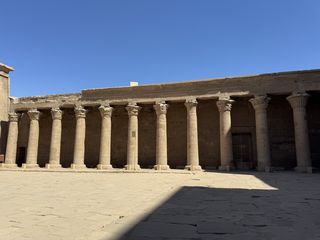
The forecourt is bordered by colonnaded porticoes. These provide shade, circulation space, and visual rhythm while maintaining openness to the sky. The court is large enough for ceremonial gatherings yet enclosed enough to preserve a sense of ordered sacred territory. Walls and column lines frame the façade of the first hypostyle hall ahead.
Columns in the court display varied floral capitals, introducing ornamental diversity without disturbing formal unity. Their shafts support stone architraves that define the porticoes with strong horizontal lines. Vertical supports and heavy lintels create a measured cadence around the courtyard perimeter.
Doorways leading inward are treated as emphatic transitions. Thick jambs, elevated lintels, and recessed thresholds distinguish each spatial layer. Movement through the temple is therefore segmented by architecturally marked passages.
Hypostyle Halls, Sanctuary Core, and Internal Distribution
Beyond the court lies the first hypostyle hall, a roofed chamber carried by multiple columns arranged in regular rows. The dense column grid reduces span lengths, allowing heavy stone architraves and roofing slabs to be used securely. The result is an interior of great mass and reduced light, contrasting with the brightness of the court.
The second hypostyle hall continues the process of contraction. Spaces become smaller, darker, and more selective in access. Ceiling heights and visual openness diminish gradually, reinforcing movement toward the sacred nucleus.
At the rear stands the sanctuary, the most enclosed chamber of the complex. Its walls are thick, openings limited, and lighting minimal. The room originally housed the divine cult image and associated ritual furnishings. Architecturally, it forms the stable center around which the remainder of the inner temple is organized.
Around the sanctuary lies a ring of subsidiary rooms. These include storage chambers for offerings, preparation rooms, ritual service spaces, and circulation passages. Their arrangement allowed essential temple operations to occur around the central shrine without interrupting the principal axis.
Stairways integrated into the side sectors gave access to roof areas used in ceremonies and maintenance. These stairs are inserted efficiently into the wall mass, revealing careful use of structural thickness. Corridors and narrow passages likewise exploit wall depth, turning solid masonry into usable internal infrastructure.
Materials, Construction Methods, and Decorative Structure
The temple is built primarily of sandstone, selected for strength, workable texture, and durability. Its use allowed both monumental construction and extensive carved decoration. Large blocks were laid in regular courses with carefully fitted joints, indicating advanced quarrying, transport, and stone-setting techniques.
Load-bearing walls and columns carry the structure through compression. Exterior walls are exceptionally thick, enabling them to support roofing elements and resist lateral stress. The column-and-lintel system relies on substantial architraves spanning between supports, while broad roofing slabs distribute weight downward through the column grid.
Ceilings were designed as integral structural planes. Their stone slabs required accurate leveling and stable support geometry. In enclosed halls, ceiling height and column spacing were calibrated to preserve monumentality while maintaining feasible spans.
Light was introduced sparingly. Controlled apertures admitted limited illumination into selected spaces. This strategy accentuated relief carving, enhanced directional movement, and preserved the increasing darkness of inner chambers.
Decoration is inseparable from the architecture. Wall surfaces, column shafts, door frames, and cornices are covered with inscriptions and carved scenes. These are not superficial additions but programmed surfaces integrated into the monument’s geometry. The cavetto cornice along upper walls provides both shadow line and formal termination. Capitals shaped as vegetal forms transform structural supports into symbolic elements without reducing their load-bearing function.
Traces of original paint indicate that the visual effect once combined carved stone with vivid color. Architecture, sculpture, and polychromy formed a unified system.
Proportion, Preservation, and Architectural Legibility
The temple’s proportions depend on progressive modulation rather than isolated spectacle. The towering pylon establishes maximum vertical emphasis at the entrance. Beyond it, spaces broaden in the court, then compress through roofed halls before culminating in the compact sanctuary. This measured sequence creates coherence across a large monument.
The survival of substantial elevations makes Edfu exceptionally valuable for architectural study. Pylon towers, columns, roofing systems, halls, inner chambers, and enclosure relationships remain readable in three dimensions. Few Egyptian temples preserve this degree of volumetric continuity.
Modern conservation has focused on debris removal, structural stabilization, surface cleaning, and mitigation of salt damage, erosion, and visitor impact. These interventions preserve both material fabric and the legibility of the building’s spatial sequence and carved surfaces.
The Temple of Horus at Edfu is distinguished by the completeness of its planning, the clarity of its axial progression, and the close union of structure with symbolic decoration. Its significance lies in the sustained discipline of the entire composition.