

 Français (France)
  Nederlands (nl-NL)
 The Citadel of Qaitbay in Alexandria, Egypt, is a military fortress built in the 15th century by Mamluk Sultan Al-Ashraf Sayf al-Din Qa'it Bay. Erected on the site of the ancient Lighthouse of Alexandria, one of the Seven Wonders of the Ancient World, the citadel was designed to defend Egypt's Mediterranean coast from invasions. This Islamic monument stands as a symbol of Mamluk military architecture and reflects Alexandria’s strategic significance. Today, the citadel attracts numerous visitors interested in its historical and cultural heritage due to its prominent location on the coast.

Alexandria • Citadel of Qaitbay
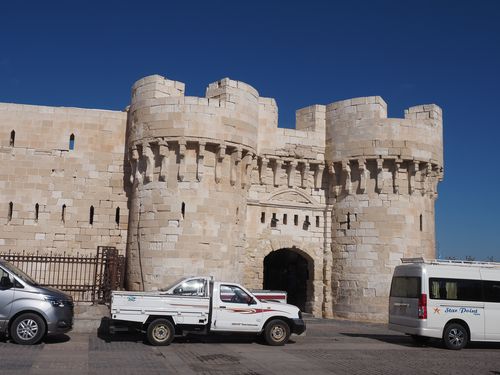
Alexandria • Citadel of Qaitbay
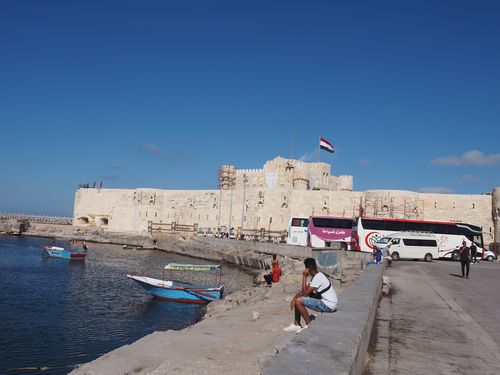
Alexandria • Citadel of Qaitbay
Monument profile
Citadel of Qaitbay
Monument category: Citadel
Monument family: Fort, Fortifications or Citadel
Monument genre: Military
Cultural heritage: Islamic
Geographic location: Alexandria • Egypt
Construction period: 15th century AD
• Links to •
• List of videos about Alexandria on this site •
Alexandria, City of All Paradoxes
The Citadel of Qaitbay in Alexandria: Political and Social Motivations, Historical Transformations, and Preservation Challenges
The Citadel of Qaitbay in Alexandria, Egypt, is a renowned military fortification built in the 15th century, embodying the political and social aspirations of the Mamluk Sultanate. Constructed by Sultan Al-Ashraf Sayf al-Din Qa’it Bay between 1477 and 1479, the citadel served as a defense mechanism against Ottoman incursions and symbolized the resilience of the Mamluk rule in Egypt. Over centuries, the citadel has undergone significant transformations, each mirroring shifts in political authority and cultural influences. This article explores the motivations behind its construction, the key historical events that shaped its legacy, and the current preservation challenges it faces.
Political and Social Motivations Behind the Construction
The primary motivation for constructing the Citadel of Qaitbay was political. Sultan Qa’it Bay, recognizing Alexandria’s strategic importance along the Mediterranean, sought to fortify the city to protect Egypt from the expanding Ottoman Empire. Positioned on the site of the ancient Lighthouse of Alexandria, the citadel was designed to oversee the Mediterranean Sea and safeguard the Mamluk Sultanate’s northern border.
Socially, the citadel symbolized security and stability for the local population. It represented the strength of the Mamluk government, serving as a refuge during attacks and reinforcing Alexandria’s role as a vital trade hub. This fortification was not only a military defense but also a means of reinforcing Mamluk authority by showing that Egypt was capable of defending its coastal territories.
Major Historical Events and Regional Influence
The Citadel of Qaitbay played a pivotal role in several historical events that left a lasting impact on the region. Following the Ottoman conquest of Egypt in 1517, the citadel fell under Ottoman control and underwent modifications to suit Ottoman military needs. It became a garrison and a naval observation point, underscoring its ongoing strategic importance. This period of Ottoman rule contributed to a cultural exchange between Egyptian and Ottoman architectural styles, which is evident in the citadel’s design.
The citadel also suffered damage during Napoleon’s Egyptian campaign at the end of the 18th century, reflecting Alexandria’s vulnerability in regional conflicts. In the early 19th century, under the reign of Muhammad Ali Pasha, the citadel was restored as part of Egypt’s modernization efforts. Muhammad Ali’s renovations reinforced the citadel’s structure, preserving its importance as a symbol of Egyptian autonomy and military strength during a period of resurgence.
Global Context and Comparison with Other Regions
Globally, the late 15th and early 16th centuries marked an era of geopolitical shifts, with European kingdoms, such as Spain and Portugal, expanding their empires overseas, and the Ottoman Empire consolidating its influence over the Mediterranean. Similar coastal fortresses emerged throughout Europe and North Africa to defend strategic ports, paralleling the construction of Qaitbay in Egypt. Spain and Italy, for example, developed coastal defenses to counter Ottoman and Barbary pirate raids, while the Ming dynasty in China reinforced coastal fortifications against Japanese pirates and other threats.
Thus, the Citadel of Qaitbay reflects a global trend in military architecture aimed at protecting critical trade hubs and asserting political control over strategic regions.
Significant Transformations Reflecting Power Shifts
Over the centuries, the Citadel of Qaitbay experienced numerous modifications that corresponded to Egypt’s changing political landscape. During Ottoman rule, the structure was fortified to accommodate new defensive strategies, reflecting the Ottoman Empire’s military adaptations. Later, under French occupation, the citadel sustained considerable damage, highlighting Alexandria’s role in the global conflicts of the era. Muhammad Ali Pasha’s 19th-century renovations aimed to modernize and restore the citadel’s integrity, symbolizing Egypt’s resurgence as a regional power.
In the 20th century, the Egyptian government initiated conservation efforts to preserve the site’s historical significance. The citadel became a prominent tourist and educational site, and restoration projects were undertaken to stabilize its aging structures and showcase its architectural and cultural legacy.
Cultural Importance and Current State of Conservation
Today, the Citadel of Qaitbay stands as a testament to Alexandria’s military and cultural heritage, attracting scholars and visitors interested in Mamluk and Ottoman history. It is not a UNESCO World Heritage site, but the Egyptian government has classified it as a national monument, providing protections to maintain its integrity. Its prominent coastal position contributes to its status as an iconic landmark and offers a historical connection to the ancient Lighthouse of Alexandria.
The citadel’s preservation is relatively stable but faces threats from the Mediterranean’s harsh marine environment, which accelerates salt erosion and damages the stone walls. Periodic restoration and conservation efforts are critical to counteracting these effects and preserving the site’s historical and architectural value.
Preservation Challenges and Modern Threats
The Citadel of Qaitbay faces several preservation challenges, particularly from natural factors. Its location by the sea exposes it to high humidity, salt erosion, and weathering, which degrade the limestone and other materials used in its construction. Additionally, increased tourism requires careful management to prevent wear on the site’s more fragile sections. Egyptian conservation teams, in collaboration with international experts, have implemented modern preservation techniques, including climate control measures and protective treatments to mitigate the effects of moisture and salt.
Conclusion
The Citadel of Qaitbay remains a powerful symbol of Alexandria’s resilience and its strategic importance in the Mediterranean. Its architectural complexity, innovative design, and rich historical legacy offer insight into Egypt’s political and social evolution from the Mamluk era to the present. As a heritage site, the citadel faces ongoing preservation challenges, but it continues to captivate and inspire as a vital link to Alexandria’s multifaceted past and its role as a crossroads of cultural and military history.
Architectural Innovation and Technological Advancements in the Citadel of Qaitbay: A Fusion of Regional and Foreign Influences
The Citadel of Qaitbay, located in Alexandria, Egypt, is an impressive example of 15th-century military architecture that showcases the technological advancements and cultural synthesis of the Mamluk era. Constructed by Sultan Al-Ashraf Sayf al-Din Qa’it Bay between 1477 and 1479, this fortress was designed to protect Egypt from Ottoman invasions and highlights the architectural grandeur and innovative engineering of the period. This article explores the materials and techniques used in its construction, the unique blend of regional and foreign influences in its design, and the historical significance of its architectural elements.
Technological Advancements and Construction Techniques
The Citadel of Qaitbay illustrates the advanced understanding of defensive architecture that characterized the Mamluk period. Built on the site of the ancient Lighthouse of Alexandria, one of the Seven Wonders of the Ancient World, the citadel used large limestone blocks sourced from the remains of this ancient monument. This choice of material was strategic, as limestone is both durable and resilient against coastal weathering, essential for a fortification meant to withstand attacks from the sea.
One of the citadel’s most notable features is its thick walls and cylindrical corner towers. Designed to absorb and deflect cannon fire, these walls represent a sophisticated approach to fortification, reflecting the challenges posed by the artillery technology of the time. The walls are punctuated with narrow slits and arrow loops that provided defenders with clear lines of sight while remaining protected from incoming fire. This layout, which enhanced the defensive capabilities of the structure, required careful planning and was a considerable technical achievement for the era.
Specific Materials and the Grandeur of Mamluk Architecture
In addition to limestone, the citadel features marble and granite accents in certain interior sections, particularly in decorative arches and columns. These materials, which were often imported or salvaged from other sites, added an element of grandeur and symbolized the wealth and influence of the Mamluk Sultanate. This careful selection of materials not only fortified the structure but also added a dignified aesthetic, aligning with the Mamluks’ desire to display their power and status.
The central courtyard, a hallmark of Mamluk architecture, allowed for large gatherings of troops and added functionality to the citadel’s design. This open space, surrounded by high walls, served as both a defensive measure and a place of organization and training, showcasing the Mamluks’ attention to both form and functionality.
Architectural Design and Cultural Synthesis
The Citadel of Qaitbay is a striking blend of regional Egyptian and Mamluk styles with influences from Crusader and Islamic architecture. Its arched doorways, geometric decorative patterns, and carved inscriptions are emblematic of Mamluk artistry, blending functionality with aesthetic detail. This architectural fusion reflects the cosmopolitan nature of Alexandria, where interactions with foreign traders, artists, and soldiers led to a rich blend of artistic traditions.
The layout of the citadel, with its concentric layers and multi-functional spaces, bears a resemblance to Crusader fortresses, reflecting the impact of centuries of cultural exchanges along the Mediterranean. The mosque at the center of the citadel, an unusual feature for a military structure, further exemplifies the integration of religious and military functions, underscoring the Mamluks’ commitment to Islam as both a cultural and political foundation.
Notable Structure and Layout
The Citadel of Qaitbay is built on a square layout, with walls that are reinforced by four large cylindrical corner towers. The structure’s central mosque is located in the innermost area, underscoring its role as a place of worship as well as defense. The strategic placement of the towers provided defenders with panoramic views of the sea, making it easier to monitor and repel any approaching forces. The compact and efficient use of space within the walls allowed the citadel to function as a fully self-contained military base, with storage facilities, soldier quarters, and armories.
The structure’s design also includes a carefully engineered drainage system, a necessary innovation given its coastal location. This feature ensured that rainwater and sea spray did not accumulate within the walls, protecting the structural integrity of the citadel.
Anecdotes and Historical Significance
A well-known fact about the Citadel of Qaitbay is that it was constructed using stones from the ancient Lighthouse of Alexandria, blending a significant part of the city’s history into its foundation. The re-use of these materials was both practical and symbolic, linking the citadel to Alexandria’s legacy as a city of great maritime importance. Over the centuries, the citadel witnessed many historical transformations: it was reinforced under Ottoman rule, damaged during Napoleon’s campaign in Egypt, and restored under Muhammad Ali Pasha in the early 19th century as part of his efforts to modernize Egypt.
The combination of these materials and design elements has earned the citadel recognition as a historical monument, although it is not listed as a UNESCO World Heritage site. Its unique architectural blend and historical significance have made it a popular destination, contributing to Alexandria’s international cultural reputation.
Preservation Challenges and Modern Conservation Efforts
Preserving the Citadel of Qaitbay poses significant challenges. The coastal environment exposes the structure to high humidity and salt erosion, which gradually deteriorate the limestone walls. These environmental threats are compounded by the increase in visitor traffic, requiring a careful balance between tourism and conservation. Restoration efforts focus on reinforcing the citadel’s structural integrity and protecting it from moisture and salt damage.
Egyptian authorities, supported by international preservation organizations, have implemented climate control measures and preventive conservation strategies to address these issues. These initiatives aim to ensure that the citadel remains accessible to future generations, preserving its legacy as a symbol of Alexandria’s historical and architectural significance.
Conclusion
The Citadel of Qaitbay exemplifies the advanced military architecture and cultural richness of the Mamluk era. With its innovative design, strategic use of materials, and integration of diverse cultural influences, the citadel stands as a testament to Alexandria’s role as a center of trade, cultural exchange, and military strength. Despite facing modern preservation challenges, the citadel continues to captivate visitors and researchers alike, embodying Egypt’s architectural ingenuity and historical resilience.