

 Français (France)
  Nederlands (nl-NL)
 Pompey's Pillar, located in Alexandria, Egypt, is a commemorative monument dating back to the 3rd century AD. Erected in honor of the Roman Emperor Diocletian, this red Aswan granite column is one of the largest of its kind outside Rome. It reflects the influence and presence of Roman authority in Egypt, as well as Alexandria's significance within the Roman Empire. Today, the monument stands as a prominent symbol of ancient heritage, drawing researchers and visitors from around the world.
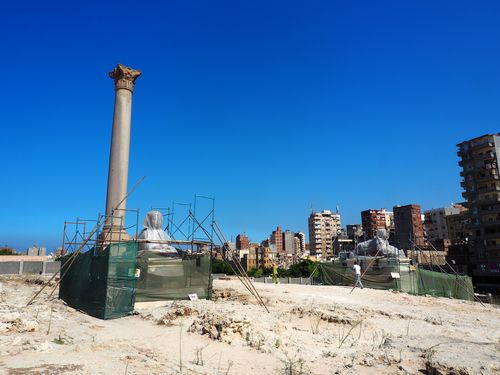
Alexandria • Pompey’s Pillar
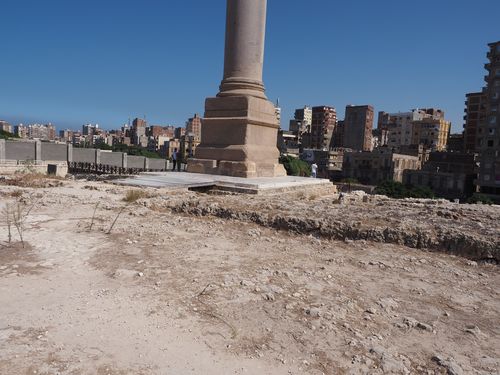
Alexandria • Pompey’s Pillar
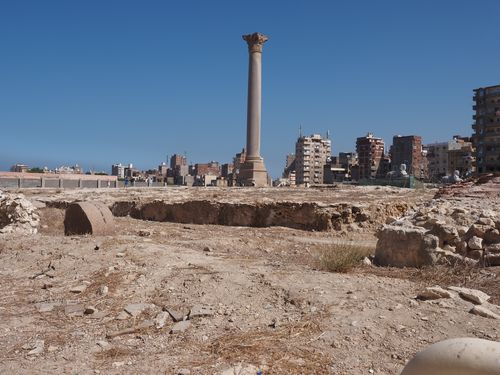
Alexandria • Pompey’s Pillar
Pompey’s Pillar

Pompey's Pillar in Alexandria: Political Motives, Historical Transformations, and Modern Preservation Challenges
Pompey's Pillar in Alexandria, Egypt, stands as one of the most significant commemorative monuments of the Roman Empire outside Italy. Erected in the late 3rd century AD, the monument honors Emperor Diocletian, who restored order in Alexandria following a rebellion. This article explores the political and social motives behind its construction, major historical events that have shaped the monument, and its current state of preservation.
Political and Social Motives Behind Pompey's Pillar
The construction of Pompey's Pillar was driven by Diocletian’s need to affirm Roman authority in Alexandria after quelling the rebellion of Achilleus, a local usurper who challenged the empire’s power. By dedicating this column to Diocletian, the Romans aimed to convey a message of strength, control, and imperial stability to both Alexandria’s diverse populace and potential adversaries. Alexandria was a major cultural and economic center, crucial for trade across the Mediterranean and the sustenance of Rome itself. Hence, maintaining authority over Alexandria was essential to the empire.
From a social perspective, the pillar symbolized the stability offered by Roman rule to the local population. The Romans sought to reassure the people of Alexandria, an ethnically mixed city, that the empire valued and protected their city. The monument thus served as a reminder of Roman order, illustrating how Alexandria was essential to the empire’s larger strategy and identity.
Key Historical Events and Regional Influence
Over the centuries, Pompey's Pillar became a witness to numerous significant events. The Muslim conquest of Egypt in the 7th century marked a shift in the cultural and political landscape, as Alexandria fell under Islamic rule. Despite this, the pillar remained a historical landmark. It was seen less as a Roman victory symbol and more as a relic of a previous era, drawing attention from both Arabic and European travelers.
Globally, this period was marked by substantial change. The Roman Empire in the West collapsed in the 5th century, while the Eastern Roman (Byzantine) Empire and various other powers, including the Sassanid and Gupta Empires, maintained influence. Diocletian’s reinforcement of Roman presence in Alexandria aligns with similar acts of consolidation by other rulers of the time, who used monuments and architecture to assert dominance and stability within their territories.
Major Transformations Over the Centuries
The pillar’s transformation has primarily involved shifts in its cultural and symbolic value. Although its physical form has remained largely unaltered, its significance evolved as Alexandria changed hands. Under the Ottoman and later colonial periods, the monument became an icon of Alexandria’s ancient heritage, garnering attention from historians and European explorers in the 19th century, who saw it as a remarkable testament to Roman influence in Egypt.
The monument’s symbolic meaning expanded during these periods. Its continued prominence underscores the global appeal of classical architecture and the way Roman sites in Egypt attracted curiosity and respect, particularly as archaeology gained momentum. As Alexandria developed, the pillar’s importance as a historical site was reinforced, adapting to new cultural and educational purposes.
Cultural Significance Today and Current Conservation Status
Today, Pompey's Pillar is a prominent landmark in Alexandria and an invaluable example of Roman architecture in Egypt. It draws international researchers and tourists, contributing to Alexandria’s cultural identity as a city where Egyptian and Greco-Roman histories intersect. The pillar’s preservation remains relatively sound despite natural erosion, with local and international organizations working to maintain its structure.
While not a UNESCO World Heritage site, the pillar is safeguarded by Egyptian heritage authorities and is widely recognized for its cultural value. As one of the few remaining Roman monuments in the region, it holds immense cultural importance and remains a symbol of Alexandria’s historical layers.
Preservation Challenges in the Modern Era
Pompey's Pillar faces several preservation challenges due to Alexandria’s environment and urban expansion. The site is exposed to the Mediterranean climate, with moisture and occasional sandstorms that gradually wear down the granite surface. Additionally, urban growth has increased the risk of pollution and potential damage from nearby development.
Efforts are ongoing to manage these threats, involving treatments for erosion and methods to stabilize the monument. Careful visitor management and education are also key to protecting the monument from tourism-related wear. Collaboration between Egyptian authorities and international experts has fostered new preservation techniques, making it possible to maintain the monument’s integrity.
Conclusion
Pompey’s Pillar remains a powerful emblem of Roman presence in Egypt, symbolizing both the architectural prowess of the Roman Empire and the historical significance of Alexandria. Over centuries, its role has evolved from a symbol of imperial power to a treasured part of Alexandria’s heritage. Despite modern conservation challenges, the pillar continues to capture interest, serving as a testament to Alexandria’s unique role as a cultural crossroads in the ancient world.
Pompey's Pillar in Alexandria: Architectural Innovation, Materials, and Cultural Fusion
Pompey’s Pillar, standing majestically in Alexandria, Egypt, is an exceptional example of Roman engineering prowess from the 3rd century AD. Built in honor of Emperor Diocletian, this monumental granite column highlights the technical innovation and cultural syncretism of the Roman Empire. This article examines the architectural significance, construction materials, and artistic influences that make Pompey’s Pillar a unique symbol of the era.
Technological Advancements and Innovative Architecture
At approximately 27 meters in height, Pompey's Pillar was a monumental feat for its time, representing both an engineering marvel and a statement of imperial grandeur. Constructed from a single, massive block of red granite quarried in Aswan, located over 1,000 kilometers away, the transport and erection of this column required advanced logistical skills and technological knowledge. Romans employed innovative lifting and balancing techniques to position the column on its stone base, underscoring their expertise in large-scale construction.
The sheer size and weight of the column—estimated to be over 285 tons—demonstrate a mastery of structural stability that was remarkable for the period. Romans used careful precision to prevent the column from tipping, embedding it in a foundational block reinforced with other granite layers, which distributed the weight effectively and ensured the structure's endurance.
Use of Specific Materials Reflecting Imperial Grandeur
The choice of red Aswan granite for Pompey's Pillar reflects the material's symbolic and practical value. Granite was known for its durability and resistance to weathering, ensuring that the pillar would withstand the test of time. The rich, reddish hue of the Aswan granite also symbolized strength and status, qualities that were intended to honor Diocletian and the restoration of Roman order in Alexandria. This granite was particularly prized in Roman architecture, seen in many monuments and temples across the empire, due to its ability to retain carvings and withstand natural erosion.
Cultural Fusion in Architectural Elements
Pompey’s Pillar not only exemplifies Roman engineering but also serves as a fusion of Roman and Egyptian cultural elements. Positioned on a hill where the ancient Serapeum of Alexandria once stood, the pillar was a deliberate integration of Roman and local Egyptian traditions. While the column itself is a distinctly Roman form, its connection to the Serapeum—a major Egyptian temple—reflects an awareness of and respect for the local cultural heritage.
The simplicity of the column, with minimal decorative carvings, diverges from the elaborate embellishments typical of many Roman triumphal monuments. This design choice may reflect Alexandria’s unique role as a cultural crossroads, suggesting an intentional balance between Roman grandeur and the more restrained local traditions. The minimalism of the design allowed the column to harmonize with the surrounding architectural styles of Alexandria, which combined Greek, Egyptian, and Roman elements.
Notable Structure and Design
Pompey's Pillar is renowned for its monolithic structure, a rarity even among Roman columns. Its design is simple but grandiose, featuring a polished shaft with a Corinthian capital at its top. While Corinthian capitals are typically decorated with ornate acanthus leaves, this one is restrained, in line with the overall minimalism of the monument. The base of the pillar, supported by a rectangular stone platform, allows visitors to admire its full height and reinforces the sense of stability.
A fascinating aspect of Pompey's Pillar is the misconception regarding its association with Pompey. Named mistakenly by medieval Crusaders who believed it commemorated the Roman general Pompey, it was later recognized as a tribute to Diocletian. This anecdote adds a layer of historical intrigue, contributing to the monument's mystique and international appeal.
Contribution to International Recognition
Pompey's Pillar, though not currently listed as a UNESCO World Heritage site, has gained global recognition for its cultural and historical importance. It represents one of the most well-preserved and tallest Roman monolithic columns outside of Rome, drawing attention from scholars and visitors worldwide. Its location in Alexandria, a city that once rivaled Rome in terms of cultural and intellectual prominence, adds to its allure as an international heritage site.
Current State of Conservation and Preservation Challenges
Today, Pompey's Pillar faces several preservation challenges due to natural and urban factors. Alexandria’s humid, coastal climate and the effects of air pollution contribute to the gradual weathering of the granite surface. Additionally, urban development around the site has increased environmental stresses, including the risk of structural destabilization.
Efforts by Egyptian authorities focus on stabilizing the monument and protecting it from further erosion. Conservation specialists periodically assess the column, implementing protective measures against pollutants and moisture. Increased awareness and visitor education initiatives also aim to preserve the monument's integrity for future generations.
Conclusion
Pompey's Pillar in Alexandria stands as a testament to the technological advancements, architectural refinement, and cultural integration that characterized the Roman Empire at its height. Through its impressive scale, innovative construction, and subtle blending of Roman and Egyptian traditions, the monument embodies Alexandria’s unique historical significance. Today, it continues to captivate the world as a symbol of the ingenuity and multicultural legacy of ancient Alexandria, reminding visitors of the architectural brilliance and resilience of the Roman era.