

 Français (France)
  Nederlands (nl-NL)
 The Temple of Kom Ombo, located in Kom Ombo, Egypt, is a unique example of religious architecture from the Greco-Roman period. The temple is distinguished by its dual dedication to two separate deities: Sobek, the crocodile god associated with fertility and the Nile’s strength, and Horus the Elder, a symbol of protection and kingship. This duality highlights the central role of religious beliefs in structuring ancient Egyptian society. Today, the temple stands as a significant cultural landmark, drawing numerous visitors intrigued by its remarkable heritage.
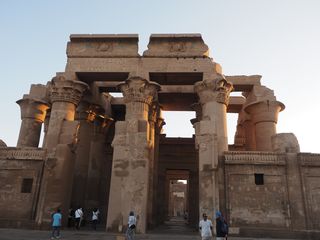
Kom Ombo • Kom Ombo temple: entrance of the temple

Kom Ombo • Kom Ombo temple: nilometer

Kom Ombo • Kom Ombo temple: bas relief
Monument profile
Kom Ombo temple
Monument category: Egyptian temple
Monument family: Temple
Monument genre: Religious
Cultural heritage: Ancient Egypt
Geographic location: Kom Ombo • Egypt
Construction period: 2nd century BC
• Links to •
• Dynasties that contributed to the construction of the monument •

• List of videos about Kom Ombo on this site •
Kom Ombo • Temple and Crocodile Museum in Egypt
The Temple of Kom Ombo: Political Motivations, Historical Transformations, and Cultural Significance
The Temple of Kom Ombo, located in Upper Egypt along the Nile River, is a remarkable example of ancient Egyptian architecture from the Greco-Roman period. Constructed during the reign of the Ptolemaic dynasty, its unique dual dedication to Sobek and Horus the Elder reflects not only religious innovation but also the political and social dynamics of the time. Over centuries, the temple has undergone significant transformations, making it a symbol of historical resilience and cultural exchange.
Political and Social Motivations for Its Construction
Built during the reign of Ptolemy VI Philometor (180–145 BCE) and expanded by subsequent rulers, the Temple of Kom Ombo was strategically designed to serve multiple purposes. Politically, it was a tool to consolidate Ptolemaic authority in Upper Egypt, a region critical for controlling trade routes along the Nile and beyond. By erecting such a significant structure, the Ptolemies sought to assert their legitimacy as rulers of both Greek and Egyptian populations.
Socially, the temple symbolized harmony between two contrasting forces represented by Sobek, the crocodile god associated with fertility and the Nile’s might, and Horus the Elder, a protector and symbol of divine kingship. The dual dedication to these gods was a strategic effort to unite diverse communities, incorporating local beliefs while appealing to the Hellenistic elite.
Historical Context and Global Comparisons
The construction of the Temple of Kom Ombo coincided with a period of global transformation. In the Mediterranean, the Roman Republic was expanding its influence, laying the groundwork for the Roman Empire. The Ptolemaic rulers in Egypt were striving to maintain their sovereignty while navigating Roman encroachment. Meanwhile, in Asia, the Han Dynasty in China was solidifying its control and developing the Silk Road, facilitating cultural and economic exchanges.
The dual-purpose nature of the temple—religious and political—can be compared to other monumental projects of the time, such as the construction of the Parthenon in Athens or the Great Stupa at Sanchi in India. These structures similarly served to reinforce authority while fostering cultural identity and unity.
Major Historical Events and Transformations
Over the centuries, the Temple of Kom Ombo has witnessed numerous historical shifts. During the Roman period, the temple continued to function as a religious site, with modifications reflecting Roman influences. Reliefs and inscriptions were added to honor the Roman emperors, who positioned themselves as successors to the Ptolemies in maintaining Egyptian religious traditions.
With the advent of Christianity in Egypt, parts of the temple were repurposed for Christian worship, while other sections fell into disuse. During the Islamic period, stones from the temple were reused for local construction projects, reflecting the changing needs of the community.
Modern archaeological efforts in the 19th and 20th centuries uncovered much of the temple, restoring its place as a cultural and historical landmark.
Cultural Significance and Current State of Conservation
The Temple of Kom Ombo is unique for its dual dedication and symmetrical design, which continues to fascinate scholars and visitors alike. The detailed reliefs, including depictions of medical instruments and rituals, provide valuable insights into ancient Egyptian science and religion.
Today, the temple remains a major tourist attraction, though it faces challenges from environmental and human factors. The proximity of the Nile has exposed the structure to water erosion, while temperature fluctuations and wind contribute to wear and tear on the stone surfaces.
Challenges to Preservation
The preservation of the Temple of Kom Ombo is an ongoing challenge. Modern threats include rising groundwater levels due to agricultural activity and increased tourism, which accelerates physical degradation. Efforts to mitigate these threats involve advanced technologies, such as laser cleaning and 3D modeling, as well as international collaboration on restoration projects.
Despite these challenges, the Egyptian government and global heritage organizations continue to prioritize the temple’s conservation, ensuring its legacy for future generations.
Conclusion
The Temple of Kom Ombo stands as a testament to the interplay of politics, religion, and culture in ancient Egypt. Its construction, transformations, and enduring significance reflect the resilience of human creativity and adaptability. While modern threats pose challenges to its preservation, the temple remains a vital link to understanding the complex history of the region and its connections to the broader ancient world.
Architectural Marvels of the Temple of Kom Ombo: Technological Advancements and Cultural Fusion
The Temple of Kom Ombo, located along the Nile River in Upper Egypt, stands as a testament to the technological innovation and cultural integration of the Greco-Roman era. Constructed during the reign of the Ptolemaic dynasty, the temple’s unique dual dedication to Sobek and Horus the Elder reflects not only its religious significance but also the advanced architectural techniques and design principles of its time.
Technological Innovations and Materials Used
The construction of the Temple of Kom Ombo highlights the technological prowess of ancient Egyptian builders. The temple was primarily built using sandstone, sourced from nearby quarries. This material was chosen for its durability and workability, allowing artisans to carve intricate reliefs and precise architectural elements.
One of the most notable technological advancements is the symmetry in its design, which required meticulous planning and execution. The temple’s two identical halves—each dedicated to one of its primary deities—demonstrate the use of advanced measurement techniques to ensure balance and harmony.
The use of relief carving techniques allowed artisans to depict detailed scenes of rituals, mythology, and daily life. These reliefs, often carved deeply into the sandstone, have withstood centuries of erosion, highlighting the builders’ foresight in choosing durable methods of decoration.
A Unique Blend of Regional and Foreign Influences
The temple’s architecture embodies a fusion of Egyptian and Hellenistic styles, reflecting the cultural interactions of the Ptolemaic period. Traditional Egyptian elements, such as the columned courtyards and pylons, coexist with Greek-inspired features, including the proportional symmetry and decorative motifs.
The temple walls are adorned with scenes depicting offerings to the gods, but these figures exhibit a blend of traditional Egyptian forms and Hellenistic artistic ideals, such as more naturalistic proportions and detailed facial expressions. This synthesis underscores the temple’s role as a cultural bridge between Egypt and the Mediterranean world.
Notable Structure and Layout
The Temple of Kom Ombo is unique in its symmetrical design. It features two parallel sanctuaries, each with its own set of chapels, corridors, and hypostyle halls. This dual structure is symbolic of the duality represented by Sobek and Horus, embodying the balance between chaos and order.
One of the temple’s most remarkable features is the Nilometer, an ancient tool used to measure the river’s water levels. This device underscores the temple’s connection to the Nile and its role in the agricultural and religious life of ancient Egypt.
Additionally, the temple includes carvings of medical instruments, providing insights into the advanced medical practices of the time. These depictions highlight the temple’s significance not only as a religious center but also as a hub for scientific knowledge.
Statistics and Anecdotes
The temple spans approximately 45 meters in width and 25 meters in length, making it a modest-sized but highly intricate structure. It was constructed over several decades, beginning under Ptolemy VI Philometor (180–145 BCE) and completed under Ptolemy XIII (circa 47 BCE).
A fascinating anecdote involves the discovery of crocodile mummies in the area, linking the site directly to the worship of Sobek. These mummies are now housed in the nearby Crocodile Museum, further enriching the cultural narrative of Kom Ombo.
International Recognition and UNESCO
While the Temple of Kom Ombo is not currently listed as a UNESCO World Heritage Site, it holds significant cultural and historical value on a global scale. Its unique design and rich artistic heritage attract scholars and tourists alike, contributing to its international reputation.
Recognition of its importance has spurred conservation efforts, including advanced techniques such as laser cleaning of reliefs and digital documentation to protect the temple from environmental threats. These initiatives ensure that the temple remains a vital link to understanding ancient Egyptian civilization.
Conclusion
The Temple of Kom Ombo exemplifies the architectural brilliance and cultural depth of ancient Egypt during the Ptolemaic period. Its innovative design, blending regional and foreign influences, and its intricate reliefs continue to captivate and educate. While not officially part of UNESCO’s heritage list, the temple stands as a testament to the enduring legacy of Egyptian craftsmanship and its impact on the world’s cultural history.