

 Français (France)
  Nederlands (nl-NL)
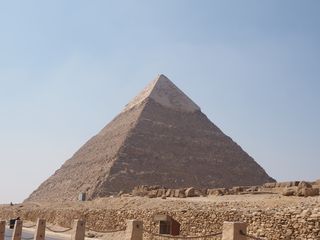
 The Pyramid of Khafre is one of the major monuments of the plateau of Giza and the second great pyramid of the site. Often perceived as the tallest because it stands on higher ground, it still preserves part of its original casing near the summit. Associated with Pharaoh Khafre, it belongs to a large funerary complex including temples and subsidiary structures. Its powerful profile is central to the monumental image of Giza. It remains a key landmark of Egyptian heritage and an important subject of archaeological study.


Monument profile
Pyramid of Khafre
Monument category: Pyramide
Monument family: Tomb, Necropolis, Mausoleum or Cenotaph
Monument genre: Funerary
Cultural heritage: Ancient Egypt
Geographic location: Giza • Egypt
Construction period: before the 6th century BC
This monument in Giza is inscribed on the UNESCO World Heritage List since 1979 and is part of the serial property "Memphis and its Necropolis – the Pyramid Fields from Giza to Dahshur".See the UNESCO monuments featured on this site
• Links to •
• Dynasties that contributed to the construction of the monument •

• List of videos about Giza on this site •
Giza, Royal Necropolis of the Old Kingdom • Egypt
The Pyramid of Khafre: Historical Development of the Second Great Monument at Giza
Foundation under Khafre and Dynastic Position
The Pyramid of Khafre was erected during the Fourth Dynasty of the Old Kingdom in the twenty-sixth century BCE under the reign of Khafre, generally regarded as a son or close successor of Khufu. It became the second major royal pyramid on the plateau of Giza and formed part of the continuing dynastic investment in this funerary landscape.
Its placement on naturally higher ground gave the monument exceptional visual prominence. Although slightly smaller in absolute dimensions than the Great Pyramid of Khufu, it often appears equally large or even taller from certain viewpoints. This deliberate use of topography suggests that monumental visibility remained an important component of royal architectural planning.
The pyramid stood at the center of a complete funerary complex composed of a mortuary temple, a causeway, a valley temple, subsidiary structures, and associated burial zones. The arrangement was intended to sustain the king’s posthumous cult while expressing the permanence of kingship. The reign of Khafre is especially notable for the close spatial relationship between his pyramid complex and the nearby Great Sphinx of Giza.
Construction, Administration, and Funerary Role
The building of the Pyramid of Khafre required a centralized administrative system similar to that seen elsewhere on the Giza plateau. Large quantities of limestone were quarried locally for the main mass of the structure, while finer stone and harder materials were reserved for selected architectural components. The precision of the pyramid’s orientation and masonry indicates sustained technical oversight.
Construction teams likely included quarry workers, haulers, stone dressers, carpenters, scribes, and supervisors. Seasonal coordination with Nile transport cycles would have facilitated the movement of materials and provisions. Such organization reflects a state apparatus capable of long-term planning rather than an isolated building campaign.
After the burial of Khafre, the pyramid became the focal point of his mortuary cult. Priests served the adjacent temples and maintained offerings intended to preserve the king’s afterlife status. The causeway connecting valley temple and pyramid established a formal ceremonial route between lower reception spaces and the elevated funerary zone.
The surrounding tombs of officials demonstrate that proximity to the royal monument remained socially significant. Burial near the king’s pyramid conveyed prestige and symbolic closeness to royal authority. The pyramid therefore continued to shape elite funerary geography after completion.
Ancient Alterations, Reuse, and Archaeological Rediscovery
Like other royal tombs, the funerary chambers were probably entered and plundered in antiquity. Valuable grave goods had disappeared long before modern investigation. Internal passages were affected by ancient intrusion and later exploration, altering the original conditions of access.
One of the monument’s most important surviving features is the partial preservation of casing stones near the summit. This remnant provides direct evidence of the smooth outer surface once characteristic of the great pyramids of Giza. Elsewhere, casing blocks were gradually removed over centuries for reuse in later construction, exposing the stepped core masonry visible today.
During the Greek, Roman, and medieval periods, the pyramid remained a major landmark in descriptions of Egypt. Travelers and scholars frequently mentioned its size, commanding position, and association with the neighboring Sphinx. Its elevated setting reinforced its role within the iconic silhouette of Giza.
From the nineteenth century onward, systematic surveys and excavations transformed knowledge of the Khafre complex. Study of the valley temple, where notable royal statues were discovered, and analysis of the causeway and pyramid alignment clarified the scale and coherence of Khafre’s architectural program. Modern archaeology increasingly interpreted the pyramid not as an isolated structure but as one element within an integrated ceremonial landscape.
Global Historical Context at the Time of Construction
When the Pyramid of Khafre was built, Old Kingdom Egypt remained one of the most centralized states of its age. In Mesopotamia, powerful urban centers controlled fertile alluvial territories. In the Indus Valley, major planned cities were active. In western Europe, megalithic building traditions were already established in several regions. Early Bronze Age state formation in China would develop later.
UNESCO Status, Modern Role, and Preservation
Today the Pyramid of Khafre is one of the most recognizable monuments of Egypt and a principal component of the monumental image of Giza. It forms part of the UNESCO World Heritage property inscribed in 1979 under the official name “Memphis and its Necropolis – the Pyramid Fields from Giza to Dahshur.” This designation recognizes the wider funerary landscape to which the pyramid belongs.
The monument retains particular scholarly value because of the surviving summit casing and the relatively well-preserved associated temples. Research continues on construction methods, ceremonial movement through the complex, and the symbolic relationship between pyramid, temples, and the Sphinx. The valley temple especially provides crucial evidence for royal stone architecture of the Fourth Dynasty.
Preservation requires continuous management. Natural erosion, tourism pressure, atmospheric pollution, and the expanding urban environment of nearby Cairo all affect the site. Modern conservation emphasizes structural monitoring, controlled visitor access, and careful documentation of masonry conditions.
The Pyramid of Khafre therefore remains both a major testimony to the political maturity of the Fourth Dynasty and a living heritage monument facing contemporary conservation challenges.
Monumental Form and Architectural Organization of the Pyramid of Khafre
Position on the Giza Plateau and Overall Spatial Composition
The Pyramid of Khafre occupies the central zone of the plateau of Giza, southwest of the Great Pyramid of Khufu and north of the pyramid of Menkaure. Its placement on naturally elevated bedrock gives the monument exceptional visual authority. Although slightly smaller in absolute dimensions than Khufu’s pyramid, the higher terrain often causes it to appear taller from many viewpoints. This effect results from deliberate site selection rather than accidental topography.
The monument stands within a carefully ordered funerary landscape. To the east lay the mortuary temple, linked by a long causeway to the valley temple below near the ancient cultivation zone. Subsidiary structures, enclosure areas, and service zones completed the complex. Movement through the site followed a hierarchical sequence from lower reception spaces to the elevated royal pyramid.
The close relationship between the pyramid, the valley temple, and the nearby Great Sphinx of Giza distinguishes the Khafre complex from other royal ensembles. Sculpture, processional architecture, and pyramid massing were coordinated as parts of one visual and ceremonial system.
The foundation platform was partly cut from natural rock and partly regularized with masonry. This adaptation to the terrain reduced unnecessary excavation while creating a level base capable of carrying the immense weight of the structure.
Materials, Masonry, and Construction Logic
The main mass of the pyramid was built from locally quarried limestone taken from the Giza plateau. Nearby extraction minimized transport for the bulk of the construction. Core blocks vary in size and finish, with rougher stones often used internally and more carefully dressed units in visible or structurally sensitive zones.
Fine casing limestone was applied externally to produce smooth faces and sharply defined edges. Unlike most pyramids at Giza, the Pyramid of Khafre still preserves sections of this original casing near the summit. These surviving courses provide direct evidence of the monument’s former appearance as a continuous geometric surface rather than the stepped core seen today.
Granite was used selectively in internal chambers and in associated temples, especially the valley temple, where massive granite architectural elements and polished surfaces have been documented. This contrast between limestone bulk construction and granite prestige elements reflects functional and symbolic material hierarchy.
The construction process almost certainly advanced in horizontal stages. Each course had to maintain the planned slope of the four faces while preserving alignment at the corners. Temporary ramps, hauling sledges, ropes, and coordinated labor teams are widely considered the most plausible means of lifting and positioning blocks, though the exact configuration of ramps remains debated.
The precision of the final geometry indicates continuous surveying during construction. Errors at lower levels would have multiplied upward, so the accuracy visible today implies repeated checking of angles, levels, and edge lines throughout the building campaign.
Dimensions, Slopes, and External Profile
The pyramid originally rose to approximately 143.5 meters and had a base of about 215 meters on each side. It is therefore the second largest pyramid at Giza, though still monumental in absolute scale. The faces rise at a steeper angle than those of Khufu’s pyramid, giving the structure a more compact and forceful profile.
Its apparent dominance comes from the combination of high platform and steep slope. From certain positions on the plateau or from the Nile-side approaches, the monument rivals or exceeds the visual height of the Great Pyramid despite smaller measurements. Architectural perception here depends on terrain, silhouette, and viewing angle as much as on raw dimensions.
Where casing has disappeared, the stepped internal courses are visible. Near the top, surviving casing stones reveal the original transition from rough structural core to refined outer skin. These remnants are especially valuable because they demonstrate how tightly the finished surface was fitted over the masonry beneath.
The summit has lost its pyramidion or capstone. Without this terminal element, the present apex is flattened. Even so, the monument retains a coherent pyramidal outline with strong edge definition and legible massing.
Weathering has softened some corners and displaced minor stones, yet the overall geometry remains remarkably stable. The survival of the profile is a testimony to the effectiveness of its original load distribution.
Internal Arrangement: Entrances, Passages, and Burial Chamber
The internal plan of the Pyramid of Khafre is more restrained than that of Khufu’s pyramid but remains technically sophisticated. The principal entrance lies on the north face above ground level. A lower entrance and additional descending route are also associated with the internal system, reflecting adjustments in planning or access strategy.
Descending corridors lead toward the burial chamber located near the central axis of the monument. Parts of this chamber are cut directly into the bedrock while other portions are completed in masonry. This mixed solution exploited the natural rock mass for stability while reducing the volume of built stone required.
The burial chamber is rectangular and roofed with large limestone or granite slabs arranged to span the space securely. A stone sarcophagus was placed within. The room is notable for its severe simplicity: plain surfaces, clear lines, and absence of surviving decorative treatment. Structural function appears to have taken precedence over ornamental display.
Compared with Khufu’s pyramid, circulation routes are shorter and the number of internal spaces is smaller. This suggests a degree of rationalization while preserving the essential symbolic requirements of a royal tomb. The monument favors compact efficiency rather than multiplication of chambers.
Architectural Alteration and Conservation Challenges
The current appearance of the pyramid reflects long-term transformation. Removal of lower casing stones exposed the stepped core masonry. Ancient intrusion and later exploration altered entrances and internal conditions. Surface erosion has widened joints and rounded some exposed edges.
The associated temples have lost their upper superstructures but retain important ground plans and major stone elements. The valley temple of Khafre remains one of the most impressive surviving examples of Old Kingdom royal stone architecture, with its massive blocks and carefully finished materials.
Modern conservation focuses on monitoring loose masonry, managing visitor circulation, and limiting the effects of atmospheric pollution and environmental stress. The proximity of expanding Cairo adds concerns related to air quality, vibration, and tourism pressure.
The Pyramid of Khafre therefore survives not merely as a large tomb, but as a highly controlled architectural composition in which topography, geometry, masonry technology, and ceremonial planning were integrated with unusual clarity.