

 Français (France)
  Nederlands (nl-NL)
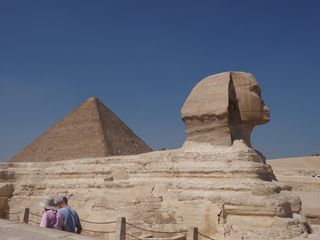
 The Great Sphinx of Giza is one of the most famous monuments of the ancient world. Located on the plateau of Giza near the pyramids, it combines a lion’s body with a human head, a traditional symbol of strength and authority. Because of its impressive scale and great age, it holds a major place in Egyptian and global heritage. The monument attracts researchers, visitors, and history enthusiasts. It remains one of the most recognizable images of ancient Egypt and a key landmark within the country’s archaeological landscape.
Monument profile
Great Sphinx of Giza
Monument category: Giant Statues
Monument family: Giant statues or set of statues
Monument genre: Religious
Cultural heritage: Ancient Egypt
Geographic location: Giza • Egypt
Construction period: before the 6th century BC
This monument in Giza is inscribed on the UNESCO World Heritage List since 1979 and is part of the serial property "Memphis and its Necropolis – the Pyramid Fields from Giza to Dahshur".See the UNESCO monuments featured on this site
• Links to •
• Dynasties that contributed to the construction of the monument •

• List of videos about Giza on this site •
Giza, Royal Necropolis of the Old Kingdom • Egypt
The Great Sphinx of Giza: Historical Development of a Royal Monument of the Old Kingdom
Creation of the Monument and Dynastic Attribution
The Great Sphinx of Giza was carved directly from a limestone outcrop on the plateau of Giza during the Old Kingdom, most probably in the Fourth Dynasty, around the mid-third millennium BCE. The attribution most widely accepted by Egyptologists connects the monument with the reign of Khafre, builder of the second great pyramid at the site. This interpretation rests on the statue’s position within Khafre’s funerary complex, its close relationship to the causeway leading from the valley temple, and stylistic similarities between the face of the Sphinx and royal portraits associated with his reign.
The monument was conceived as a hybrid figure combining a lion’s body with a royal human head wearing the nemes headdress. This imagery expressed sovereign strength, vigilance, and the protective authority of kingship. Its placement formed part of a coordinated monumental program linking temples, processional routes, pyramids, and ritual spaces. The Sphinx therefore functioned not as an isolated sculpture but as an active component in the ceremonial landscape of Khafre’s complex.
Alternative theories have occasionally assigned the monument to Khufu or Djedefre. These proposals remain debated, but none has displaced the prevailing attribution to Khafre.
Cultic Role and Reuse in Ancient Egypt
The Great Sphinx acquired a religious significance beyond its original dynastic function. Over time, desert sands repeatedly buried large portions of the monument, prompting several clearance campaigns. The best documented intervention belongs to the future pharaoh Thutmose IV in the fourteenth century BCE. According to the Dream Stela erected between the paws, the prince fell asleep beside the buried statue and received a divine promise of kingship if he freed it from the sand.
After ascending the throne, Thutmose IV ordered excavation around the monument and renewed its cult. By this period the Sphinx was associated with Horemakhet, “Horus in the Horizon,” a solarized divine form linked to royal legitimacy. The statue thus entered the religious framework of the New Kingdom as both an ancient royal image and a living sacred presence. Stelae, chapels, and commemorative elements were installed nearby.
During the Late Period and under Greek and Roman rule, the Sphinx continued to attract visitors and retain symbolic prestige. Inscriptions left by pilgrims and officials indicate that the monument remained a place of memory and reverence. Its meaning had evolved, but it was still understood as a relic of profound antiquity and royal wisdom.
Damage, Rediscovery, and Modern Interventions
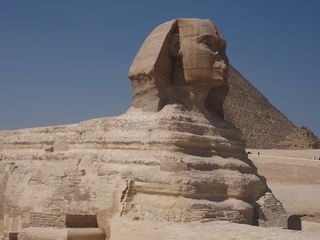
The monument’s history has been shaped by environmental deterioration. Wind erosion, salt action, moisture fluctuations, and long episodes of burial under sand progressively altered the limestone body. The missing nose has generated many legends, but reliable evidence does not support a single definitive explanation for its loss. It had already disappeared before the modern era. The ceremonial beard, originally attached in part to the chin, also broke away; fragments survive in museum collections.
From the nineteenth century onward, renewed scholarly and political interest in ancient Egypt transformed the site into a focus of archaeological work. Excavations by Auguste Mariette and later by Émile Baraize helped remove accumulated sand and expose the full body more extensively than at any previous time.
Restoration campaigns multiplied in the twentieth century. Some early repairs used cement or replacement stones poorly suited to the original limestone, creating structural tensions or accelerated decay. Later conservation policies adopted more selective methods based on geological study, careful stone replacement, and monitoring of cracks, humidity, and air pollution. Because the monument is carved from layered natural bedrock rather than assembled masonry, preservation remains technically complex.
Global Historical Context at the Time of Construction
When the Great Sphinx was probably created, Old Kingdom Egypt was at a peak of centralized royal power and monumental building. In Mesopotamia, urban states and later imperial formations were reshaping political control over large territories. In the Indus Valley, major planned cities were developing. In western Europe, megalithic building traditions were already established or still active. In East Asia, early Bronze Age state formation would emerge later.
Modern Symbolism, UNESCO Status, and Preservation
Today the Great Sphinx is one of the principal symbols of Egypt and among the most recognizable monuments in the world. It forms part of the UNESCO World Heritage property inscribed in 1979 under the official name “Memphis and its Necropolis – the Pyramid Fields from Giza to Dahshur.” This designation recognizes the universal significance of the wider archaeological landscape to which the Sphinx belongs.
The monument now serves several parallel roles: national emblem, major research subject, and central component of the tourism economy of the Giza plateau. Scholars continue to debate aspects of its dating, original surface treatment, ritual use, and phases of restoration. Scientific imaging and geological analysis have refined understanding of how the statue was carved and how it has weathered.
Its future depends on constant management. Urban expansion from nearby Cairo, atmospheric pollution, visitor pressure, and natural stone decay all pose continuing risks. Conservation therefore requires a balance between public access, archaeological investigation, and long-term structural protection. The Great Sphinx remains not only an ancient royal monument, but also a living heritage site whose historical meaning continues to evolve.
Monumental Form and Structural Configuration of the Great Sphinx of Giza
Position on the Giza Plateau and Spatial Integration
The Great Sphinx of Giza occupies a carefully selected position on the eastern margin of the limestone plateau of Giza. It stands below the higher ground of the pyramid fields and close to the valley sector of the funerary complex commonly attributed to Khafre. This placement establishes a transitional zone between the cultivated Nile plain and the elevated necropolis. The monument faces east, toward the horizon, making orientation an essential component of its visual and symbolic design.
Its location was determined not only by ceremonial logic but also by geology. The Sphinx was carved from a natural ridge of bedrock left between quarry cuts. Instead of transporting large quantities of stone to create an independent structure, builders transformed an existing mass into a monumental figure. The result is inseparable from the terrain itself. The body emerges from the plateau rather than being set upon it.
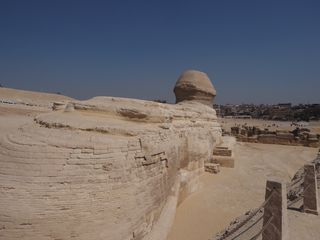
A large trench cut around the statue isolates the form and creates a sunken enclosure. This excavated court defines the perimeter of the monument, heightens the apparent scale of the body, and channels movement toward the eastern forecourt and temple area. The depression also reveals the layered geological strata from which the sculpture was carved. The surrounding void is therefore an architectural element in its own right.
Seen from the lower plain, the head rises prominently above the enclosure walls. Seen from the plateau, the monument marks the ceremonial threshold of the Khafre complex. These dual viewpoints demonstrate that the spatial planning considered distant and close-range perception simultaneously.
Carving Methods, Engineering, and Material Logic
The Great Sphinx is primarily a monolithic rock-cut monument. Its core was produced by subtractive carving directly into limestone bedrock rather than additive masonry construction. Builders first detached the mass by quarrying channels around it, then progressively shaped the head, torso, paws, and rear sections. Stone removed during excavation was likely reused in adjacent temples, especially in the nearby Sphinx Temple and valley structures.
The limestone at Giza is stratified in horizontal beds of differing hardness. This geological variability strongly influenced the finished form. Harder layers were more suitable for projecting or load-sensitive areas, while softer beds weathered more rapidly and were easier to carve. The head, cut from denser stone, has survived in better condition than much of the body. By contrast, the torso and flanks include softer strata that have eroded unevenly, creating recessed bands and fissures visible today.
Tool marks identified on portions of the enclosure and body indicate the use of copper chisels, stone pounders, and abrasion techniques. Large-scale shaping was followed by finer finishing on the facial features and headdress. The contrast between broad quarry-cut surfaces and more refined sculptural modeling remains legible.
Not every visible component belongs to the original rock mass. Ancient builders supplemented vulnerable zones with masonry blocks, especially around the paws, chest, and lower body. These additions corrected irregularities in the natural stone, reinforced damaged sections, and refined forms that the bedrock alone could not fully express.
Formal Composition, Dimensions, and Sculptural Detailing
The monument measures approximately 73 meters in length and around 20 meters in height, making it one of the largest surviving monolithic sculptures of the ancient world. Its composition combines a recumbent lion body with a royal human head. The front paws extend symmetrically forward, creating a strong axial emphasis. The rear body narrows toward the haunches, while the tail runs along one flank.
The proportions between head and body have long attracted scholarly attention. The head appears relatively small compared with the mass of the torso. Explanations include adaptation to the available rock core, later reworking of the head, or design choices prioritizing stability and recognizability. Regardless of cause, the disproportion is central to the monument’s present visual character.
The face preserves its essential volumetric scheme: brow ridge, eyes, cheeks, mouth, and chin zone, although the nose is lost and surface detail has been reduced by erosion. The nemes headdress frames the head with descending side lappets and a rear mass integrated into the neck. The ears project distinctly and are comparatively large, increasing legibility at distance.
The chest rises above the forelegs in a compact vertical block, while the paws form a horizontal platform that anchors the frontal view. Between them stands the Dream Stela installed under Thutmose IV, a later insertion that now functions as part of the monument’s spatial composition.
Traces of ancient pigment have been reported on some surfaces, suggesting that the statue once possessed painted elements. If so, color would have enhanced contours now read only through stone form.
The Sphinx Temple and Immediate Architectural Ensemble
Directly east of the statue lies the Sphinx Temple, built with large limestone blocks quarried locally. Its rectilinear geometry contrasts with the organic mass of the sculpture. The temple’s plan consisted of courts and halls organized around heavy piers rather than slender columns, emphasizing solidity and controlled light.
The alignment between temple and statue is deliberate. The central axis of the temple corresponds to the frontal orientation of the Sphinx, creating a processional relationship between built sanctuary and carved guardian figure. The open space between them operated as a forecourt, transforming the monument into the western focal point of a ritual approach.
The blocks used in the temple are exceptionally large and carefully fitted. Their scale mirrors the monumental ambition of the adjacent statue. Together, enclosure trench, temple platform, access routes, and causeway connections create a compound in which sculpture and architecture are interdependent rather than separate categories.
Architectural Alteration, Restoration, and Conservation Challenges
The Great Sphinx is also a palimpsest of repairs. Wind-blown sand repeatedly buried the lower body, at times protecting surfaces and at other times accelerating abrasion. Water infiltration, salt crystallization, thermal stress, and atmospheric pollution have progressively weakened softer strata.
Ancient restoration campaigns inserted stone casing blocks and patching masonry. Modern interventions, especially during the nineteenth and twentieth centuries, added mortars and replacement stones of uneven compatibility. Some repairs trapped moisture or transferred stress to adjacent original limestone, causing further detachment.
Recent conservation has become more selective. Engineers and conservators monitor cracks, bedding planes, and surface scaling. Replacement blocks are matched more carefully to original stone behavior, and drainage control is treated as a structural priority. Because the monument combines natural bedrock, ancient masonry supplements, and modern repairs, each intervention must account for multiple materials reacting differently over time.
The principal architectural challenge is that the Sphinx cannot be dismantled or structurally isolated like a built monument. Its foundation is the plateau itself, and its deterioration is tied to geological processes within that plateau. Preservation therefore depends on continuous management of stone decay, visitor circulation, environmental exposure, and the integrity of earlier repairs.