

 Français (France)
  Nederlands (nl-NL)
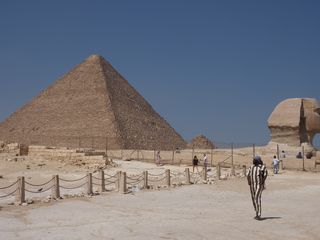
 The Great Pyramid of Khufu is the most famous monument on the plateau of Giza and one of the major achievements of the ancient world. Also known as the Great Pyramid, it is renowned for its exceptional scale and precise design. As the last surviving Wonder of the Ancient World, it represents the power of pharaonic Egypt and the technical expertise of its era. For centuries, it has attracted travelers, scholars, and visitors from across the globe. It remains one of the best-known and most studied heritage landmarks worldwide.

Monument profile
Pyramid of Khufu
Monument category: Pyramide
Monument family: Tomb, Necropolis, Mausoleum or Cenotaph
Monument genre: Funerary
Cultural heritage: Ancient Egypt
Geographic location: Giza • Egypt
Construction period: before the 6th century BC
This monument in Giza is inscribed on the UNESCO World Heritage List since 1979 and is part of the serial property "Memphis and its Necropolis – the Pyramid Fields from Giza to Dahshur".See the UNESCO monuments featured on this site
• Links to •
• Dynasties that contributed to the construction of the monument •

• List of videos about Giza on this site •
Giza, Royal Necropolis of the Old Kingdom • Egypt
The Great Pyramid of Khufu: Historical Development of the Principal Monument at Giza
Foundation under Khufu and Royal Purpose
The Great Pyramid of Khufu was erected during the Fourth Dynasty of the Old Kingdom, around the twenty-sixth century BCE, under the reign of Khufu, known in Greek tradition as Cheops. It became the central structure of the royal funerary complex established on the plateau of Giza. The selection of this elevated limestone plateau near Memphis combined practical, political, and symbolic considerations.
The monument formed part of the architectural evolution of royal tombs. Earlier dynasties had developed mastabas and step pyramids, while the reign of Sneferu, Khufu’s probable father, saw the creation of true smooth-sided pyramids. Khufu’s project expanded these precedents on an unprecedented scale. The pyramid was intended to affirm dynastic continuity, royal authority, and the state’s ability to mobilize labor and resources.
The pyramid was only one component of a larger funerary ensemble. It was linked to a mortuary temple on its eastern side, a causeway descending toward a valley temple, subsidiary pyramids associated with queens, boat pits, and surrounding mastaba cemeteries for relatives and officials. The monument therefore operated within a complete ritual landscape centered on the deceased king.
Construction, Administration, and Funerary Use
The building of the Great Pyramid required a highly organized administrative system. Quarrying, transport, placement of stone, food supply, tool production, and workforce management had to be coordinated over many years. Inscriptions discovered in relieving chambers above the king’s chamber preserve names of labor crews connected to the king, providing direct evidence of organized teams rather than anonymous mass labor.
Archaeological remains of workers’ settlements near Giza indicate that the labor force included skilled craftsmen, seasonal workers, supervisors, and support personnel. Bread production, brewing, livestock supply, and medical care formed part of the logistical infrastructure. The monument thus reflects not only engineering ambition but also a sophisticated capacity for state planning.
After Khufu’s burial, the pyramid became the focus of his mortuary cult. Priests maintained offerings and rituals intended to sustain the king’s afterlife status. Administrative estates elsewhere in Egypt may have supported these ceremonies. The nearby tombs of courtiers and officials show that proximity to the king’s pyramid retained prestige long after construction ended.
The internal spaces were not designed for public visitation. Corridors, chambers, and blocking systems were primarily funerary in purpose, serving burial, symbolic transition, and protection of the royal remains.
Alterations, Reuse, and Rediscovery
Like many royal tombs, the pyramid was entered and plundered in antiquity. Whatever funerary goods originally accompanied the burial had disappeared long before medieval or modern exploration. The granite sarcophagus remained, but portable treasures did not survive in place.
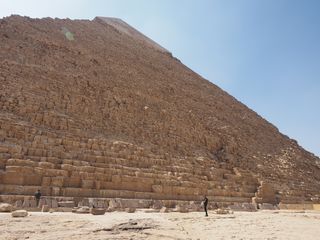
The outer casing stones, once forming smooth white faces, were gradually removed over centuries, especially for reuse in later building projects. Their loss transformed the monument’s appearance from a sharply finished geometric mass into the stepped core visible today. The summit also lost its original capstone or pyramidion.
Ancient Greek and Roman visitors regarded the pyramid as one of the marvels of the world. Their accounts mixed measurement, admiration, and speculation. During the medieval Islamic period, the monument continued to attract attention. The tunnel commonly associated with the caliph Al-Ma’mun in the ninth century CE created an intrusive passage that became the principal modern access route.
From the nineteenth century onward, scientific survey transformed understanding of the pyramid. Precise measurements, clearance of debris, study of surrounding cemeteries, and reading of quarry marks replaced many legendary interpretations. Twentieth- and twenty-first-century research has continued through architectural analysis, geological study, and non-invasive imaging techniques.
Global Historical Context at the Time of Construction
When the Great Pyramid was built, Old Kingdom Egypt stood at a high point of centralized royal authority. In Mesopotamia, powerful city-states and expanding political entities dominated fertile river plains. In the Indus Valley, large urban centers were developing. In western Europe, megalithic traditions were already established in several regions. Early Bronze Age state formation in China would emerge later.
UNESCO Status, Modern Meaning, and Preservation
Today the Great Pyramid of Khufu is the most iconic monument of Egypt and the only surviving Wonder of the Ancient World. It forms part of the UNESCO World Heritage property inscribed in 1979 under the official name “Memphis and its Necropolis – the Pyramid Fields from Giza to Dahshur.” This status recognizes the exceptional universal value of the wider funerary landscape.
The monument has become a global symbol of ancient engineering, royal power, and archaeological continuity. It is simultaneously a national emblem, a major tourism destination, and an active field of scholarly investigation. Questions concerning construction logistics, internal voids, planning methods, and ritual meaning continue to generate research.
Preservation remains a permanent concern. Visitor pressure, atmospheric pollution, urban expansion from nearby Cairo, and natural stone weathering all affect the site. Conservation measures focus on structural monitoring, controlled access, documentation, and management of the surrounding plateau. The Great Pyramid therefore survives not merely as an ancient tomb, but as a living heritage monument requiring continuous stewardship.
Monumental Design and Internal Configuration of the Great Pyramid of Khufu
Setting on the Giza Plateau and Overall Site Planning
The Great Pyramid of Khufu occupies the northeastern sector of the limestone plateau of Giza. Its position on elevated ground above the Nile floodplain provided both structural stability and commanding visibility. The builders selected bedrock capable of supporting an immense concentrated load while ensuring that the monument dominated the surrounding landscape. From the valley approaches, the pyramid would have appeared as the principal element of the royal necropolis.
The base was laid out as an almost exact square, with each side originally measuring about 230 meters. The four faces are aligned with remarkable precision to the cardinal directions. Deviations from true north are extremely small, especially considering the scale of the project. Such accuracy implies advanced surveying methods and careful control during every construction phase.
The pyramid did not stand alone. It formed the center of a larger funerary complex that included a mortuary temple on the eastern side, a causeway descending toward a valley temple, subsidiary pyramids for royal women, boat pits, enclosure walls, and surrounding mastaba cemeteries. This arrangement organized space hierarchically: the king’s monument at the core, ritual buildings attached to it, and elite burials distributed nearby.
Preparation of the foundation platform was an engineering operation of high precision. The bedrock was cut and leveled so that the corners differed only minimally in height. This flatness was essential for the regular rise of the masonry courses above.
Building Materials and Construction Methods
The main body of the pyramid consists primarily of local limestone quarried on the Giza plateau. Using nearby stone reduced transport distances for the enormous bulk of the structure. Harder and more refined materials were reserved for specific functions. Granite from Aswan was employed in the King’s Chamber, relieving spaces, portcullis systems, and other structurally sensitive areas where compressive resistance was required.
Core blocks vary in size and finish depending on their position. Lower courses often contain larger stones, while upper levels include more manageable units. The structure rises through successive horizontal courses, each carefully adjusted to maintain slope and geometry. Internal packing stones and smaller fills were used to stabilize gaps between larger blocks.
The outer casing, now almost entirely lost, was made of fine white limestone, probably from Tourah quarries east of the Nile. These casing stones were cut with high precision and polished to create smooth planar surfaces. Their presence would have transformed the monument into a sharply defined geometric volume rather than the stepped profile visible today.
The exact lifting system remains debated, but the masonry itself indicates progressive elevation through ramps, hauling teams, and staged placement methods. The regularity of the courses suggests continuous measurement and correction throughout construction rather than rough accumulation followed by later adjustment.
Dimensions, Geometry, and External Form
Originally the pyramid rose to about 146.6 meters, making it the tallest human-made structure for many centuries. Its present height is lower because the summit and casing have been lost. The angle of the faces, approximately 51 to 52 degrees, produces a balance between vertical emphasis and structural security.
This slope is neither arbitrary nor purely symbolic. A flatter angle would have required a larger footprint and greater material volume, while a steeper profile would have increased stresses and construction difficulty. The chosen inclination reflects a sophisticated compromise between mass, height, and stability.
Each face appears broadly planar, yet close study suggests slight concavity along the central vertical axes. This subtle inward curvature may have improved visual regularity, helped align casing courses, or contributed to structural cohesion. The effect is difficult to perceive from ground level but becomes clearer under specific lighting or aerial observation.
The summit likely carried a pyramidion, perhaps polished or sheathed. Although lost, this final element completed the continuous lines of the monument. Without it, the present silhouette remains truncated but still overwhelmingly coherent.
The sharp edges originally created by casing stones would have emphasized the intersection of the four faces. Their erosion and removal have softened these lines, changing the visual reading of the building from precise crystal-like geometry to stepped mass.
Internal Layout: Passages, Chambers, and Load Management
The interior of the Great Pyramid is unusually complex. The original entrance lies on the north face at a significant height above ground level. From it descends a corridor leading through masonry and then into bedrock toward an unfinished subterranean chamber. This lower space may represent an abandoned phase or a symbolic component incorporated into the final plan.
An ascending passage branches upward from the descending corridor. It leads eventually to the Grand Gallery, one of the most distinctive spaces in ancient architecture. This tall corridor employs corbelled side walls that narrow upward through successive projecting courses. The gallery combines ceremonial scale with technical function, probably assisting movement of blocking devices or materials during construction and closure.
Beyond it lies the so-called King’s Chamber, a rectangular granite room containing a granite sarcophagus. Above this chamber are multiple relieving chambers capped by gabled granite and limestone arrangements designed to divert vertical pressure away from the flat ceiling slabs below. This system demonstrates explicit awareness of load transfer and structural risk.
Below the King’s Chamber level is the so-called Queen’s Chamber, located on the central axis. Its exact purpose remains debated. Narrow shafts extend from upper chambers toward the exterior faces. Whether intended for ventilation, symbolic stellar alignment, or multiple functions, they were integrated into the original design rather than added later.
The internal arrangement does not follow simple symmetry. Instead, it combines axial order with multiple levels and directional changes, indicating that functional, ritual, and engineering concerns were addressed simultaneously.
Alteration, Exposure, and Conservation
The pyramid’s present appearance differs greatly from its original state. Removal of casing stones exposed the stepped core. Medieval tunneling created the entrance route most visitors use today, separate from the original access. Weathering has affected exposed edges, while internal surfaces have darkened through time and human presence.
Modern conservation focuses on structural monitoring, visitor management, and stabilization of vulnerable masonry. Temperature variation, humidity introduced by tourism, and mechanical wear within passages are persistent concerns. External stone faces are also affected by wind erosion and atmospheric pollution.
The monument must additionally be managed within the expanding urban environment of nearby Cairo. Vibrations, environmental change, and large visitor numbers require coordinated site policies. Even in altered condition, the Great Pyramid remains an extraordinary synthesis of geometry, material control, internal planning, and large-scale construction management.