Français (France)
  Nederlands (nl-NL)
 00:00 • intro | 00:55 • the entrance to the pagoda | 01:56 • the biggest book in the world | 02:12 • return to the pagoda and the bell
Personal creation from visual material collected during my trip Myanmar • Burma (2016)
Map of places or practices in Mandalay on this site
• Use the markers to explore the content •
Kuthodaw Pagoda and the “World’s Largest Book” in Mandalay
A Religious Complex Dedicated to Buddhist Knowledge
Kuthodaw Pagoda occupies a distinctive place among the major religious monuments of Mandalay. Located at the foot of Mandalay Hill, the complex combines shrines, pagodas, ceremonial spaces and marble inscriptions within an architectural ensemble designed both for worship and for the preservation of Buddhist teachings. The site is especially famous for housing what is often described as the “world’s largest book,” a vast collection of marble slabs engraved with the canonical texts of Theravāda Buddhism.
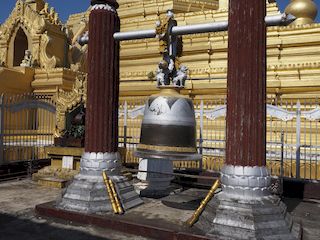
The video presents several dimensions of this important religious site. The approach through the entrance area introduces the organisation of the complex and the role of its ceremonial spaces. The sequences devoted to the engraved marble inscriptions highlight the monument’s most remarkable feature, while the later views of the pagoda and the large bell place these elements within the broader religious environment of the sanctuary.
Marble Inscriptions and Sacred Spaces
The most striking feature of Kuthodaw is the large number of small white structures arranged in orderly rows around the central pagoda. Each of these miniature shrines shelters a marble slab engraved with part of the Tipitaka, the sacred canon of Theravāda Buddhism. Together, the inscriptions form a monumental textual archive intended to preserve Buddhist doctrine in a durable form.
The video makes the scale of this undertaking particularly visible. The repeated alignment of the white pavilions creates a highly structured architectural landscape organised around pathways and open spaces. Rather than functioning only as decorative elements, these structures form an integral part of the religious identity of the complex.
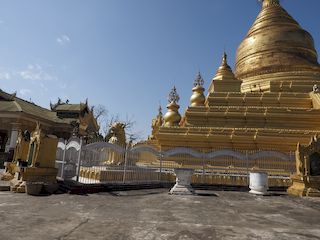
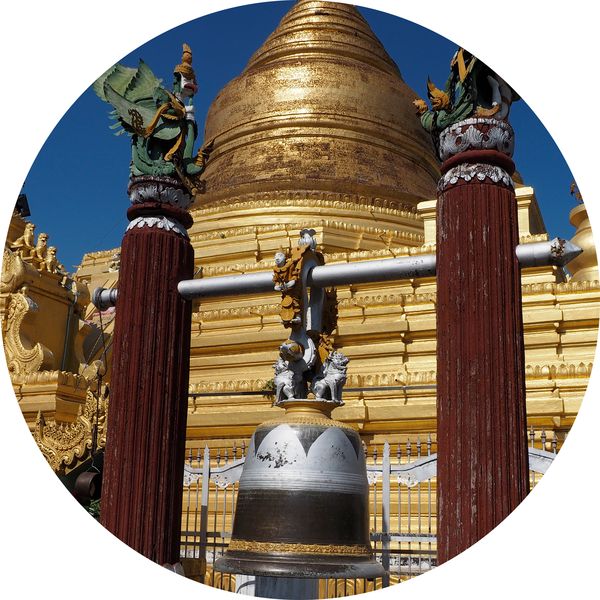
The central pagoda remains the visual and symbolic focus of the site. Its gilded surfaces, elevated form and surrounding ritual spaces reflect the architectural traditions of Burmese Buddhist monuments from the royal period of Mandalay. The large bell visible within the complex also illustrates the continuing ceremonial role of the site. In Burmese Buddhist practice, bells are associated with acts of merit, prayer and ritual devotion, reinforcing the living religious function of the pagoda.
The combination of sacred architecture and engraved texts gives Kuthodaw a unique character among Buddhist monuments in Myanmar. The site functions simultaneously as a pilgrimage centre, a ritual space and a monumental repository of religious knowledge.
Royal Patronage and Religious Preservation
Kuthodaw Pagoda was constructed during the reign of King Mindon in the nineteenth century, when Mandalay became the final royal capital of the Burmese kingdom before British colonisation. The king sought to establish Mandalay as an important religious and intellectual centre of Theravāda Buddhism.
The marble inscriptions were produced following a major Buddhist council organised under royal patronage. Their purpose was to preserve the canonical texts permanently at a time when traditional manuscripts written on palm leaves remained vulnerable to climate, decay and political instability. The project therefore combined religious devotion with a broader effort to strengthen royal legitimacy through the protection of Buddhist doctrine.
The architecture of the complex reflects the artistic traditions of late Burmese royal monuments. White marble structures, gilded stupas and ceremonial pathways are arranged according to a carefully ordered spatial composition designed for ritual circulation and religious contemplation.
Despite the transformations of modern Mandalay, Kuthodaw continues to serve as an active religious site visited by monks, pilgrims and local worshippers. The monument remains closely associated with the cultural and spiritual history of Myanmar.
What the Videos on This Site Make Especially Clear
The videos on travel-video.info make it possible to observe the spatial organisation of Kuthodaw with unusual clarity. The animated photographic sequences highlight the repetitive geometry of the marble pavilions, the alignment of the pathways and the relationship between the inscriptions and the central pagoda.
Close framing also makes architectural and decorative details easier to study. The texture of the carved marble, the contrast between white structures and gilded surfaces, and the gradual transitions between ceremonial areas become more legible through the visual construction of the video.
Because the site is explored through carefully selected still photographs animated progressively, viewers can better understand how the monument functions as both an architectural complex and a vast sacred manuscript preserved in stone.
A Monument of Buddhist Scholarship in Myanmar
Through its engraved texts, ritual spaces and monumental organisation, Kuthodaw Pagoda illustrates the close relationship between religion, royal authority and the preservation of knowledge in nineteenth-century Myanmar. The detailed pages dedicated to the monument allow visitors to continue exploring the history, symbolism and architecture of one of Mandalay’s most distinctive Buddhist sites.
Links to related pages












Audio Commentary Transcript
This pagoda with its 729 white stupas each housing an engraved marble stele is in fact a large book. The biggest book in the world.
King Mindon had this building constructed in 1859 in preparation for the 5th Buddhist Council which took place in 1871. The king had the entire Buddhist canon (Tipikata) engraved on these stelae and the council validated the inscriptions.
Each of the 729 "inscription caves" sheltered by the white stupas contains a chapter from the Buddhist canon.
The beginning of the British occupation was synonymous with destruction and degradation of the places that were used for a time as barracks for the soldiers.
A restoration of the premises was ordered in 1892.
The golden stupa in the center was built on the model of Shwezigon Pagoda.
Music:
- - YouTube video library - Collapsing All Around
- - YouTube video library - Court and Page
Disclaimer: Despite its appropriateness, copyright issues prevent the use of burmese traditional music in "Mandalay, Kuthodaw Pagoda • Myanmar", hence the use of royalty-free music. Despite our careful selection, some might regret this decision, which is necessary to avoid potential lawsuits. Although difficult, this decision is the only viable solution.