Français (France)
  Nederlands (nl-NL)
 00:00 • intro | 00:10 • Saint George church | 00:52 • the map of Palestine
Personal creation from visual material collected during my trip Jordan (2017)
Map of places or practices in Madaba on this site
• Use the markers to explore the content •
Madaba, the Map of the Holy Land: Byzantine memory in mosaic
A city shaped by Christian heritage and ancient traditions
Located south of Amman, Madaba is one of Jordan’s most significant cultural centres, renowned for its remarkable collection of ancient mosaics. The city occupies a distinctive place in the history of the Near East, particularly for its role in preserving visual representations of the Holy Land. Its heritage reflects the vitality of Christian communities during the Byzantine period, when artistic production and religious expression were closely intertwined.
The video focuses on one of Madaba’s most emblematic features, while placing it within its architectural and historical context. It presents a dialogue between a still-active place of worship and an exceptional work of early cartography, offering insight into both the spatial and symbolic dimensions of the site.
Saint George’s Church and a unique cartographic vision
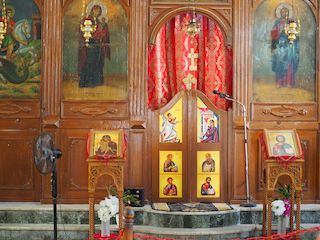
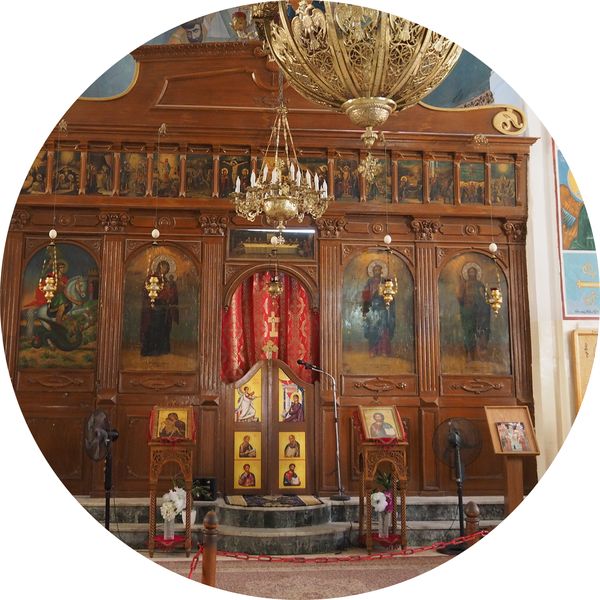
Saint George’s Church forms the central point of this exploration. Built in the late nineteenth century on the remains of a Byzantine structure, the present building serves primarily as a protective setting for a much older and historically significant element. Its relatively simple architecture contrasts with the importance of the work preserved within.
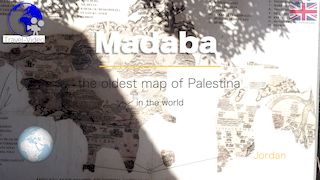
The mosaic map of Palestine, created in the sixth century, is the key feature of the site. It depicts a broad area of the Near East, including Jerusalem, the Jordan River and the Dead Sea. More than a geographical representation, this mosaic reflects a structured vision of the region shaped by religious meaning. Cities, roads and natural features are rendered with notable precision, making the map a valuable source for historians and archaeologists.
The relationship between the church and the mosaic illustrates a continuity across time. A modern religious building now shelters and highlights a work created more than a millennium earlier, reinforcing the enduring significance of the site.
Historical context and cultural meaning
The Madaba map belongs to the Byzantine period, when Christianity had become firmly established across the region. Mosaics played an important role in religious architecture, serving not only decorative purposes but also educational ones. Through imagery, they conveyed narratives and knowledge to communities that often relied more on visual communication than written texts.
Within this framework, the map can be understood as a guide to sacred geography. It helped identify key locations associated with biblical traditions and may have been intended for pilgrims and worshippers. Jerusalem occupies a central and highly detailed position, reflecting its importance in Christian belief and reinforcing the spiritual orientation of the composition.
Madaba itself was an active centre of artistic production during this period, as demonstrated by the numerous mosaics discovered in the surrounding area. The city’s heritage reflects a sustained tradition that has endured despite successive political and cultural transformations.
A visual approach that reveals detail and structure
The videos on this site are largely based on carefully selected photographs, combined through smooth transitions and controlled framing. This approach allows for a precise examination of works that require close attention to detail.
In the case of the Madaba map, this method proves particularly effective. It enables the viewer to observe the arrangement of tesserae, the composition of the map and the representation of individual locations. The gradual progression from one section to another clarifies the overall structure and highlights the coherence of the design.
The inclusion of the architectural setting further enhances this understanding. By situating the mosaic within the space of the church, the video emphasizes the relationship between the artwork and its environment, allowing the viewer to perceive it as part of a living cultural and religious context.
An exceptional testimony to early cartography
The mosaic map of the Holy Land preserved in Madaba remains one of the most important examples of early cartographic representation. Through a careful and structured visual exploration, the video offers an accessible introduction to a site where art, history and religion intersect. For those wishing to explore further, the dedicated pages on the church and the mosaic provide additional insight into their historical background and significance.
Links to related pages





Audio Commentary Transcript
In Madaba, there is a basilica which houses an ancient mosaic map, the map of the Holy Land.
Madaba is a city of 60,000 inhabitants in central Jordan. The city is famous for its Umayyad mosaics, one of the most remarkable of which is a detailed map of the Holy Land. This mosaic is currently in the Orthodox Basilica of Saint George.
Music:
- - YouTube video library - People Watching
Disclaimer: Despite its appropriateness, copyright issues prevent the use of jordanian traditional music in "Madaba, map of Holy Land • Jordan", hence the use of royalty-free music. Despite our careful selection, some might regret this decision, which is necessary to avoid potential lawsuits. Although difficult, this decision is the only viable solution.