

 Français (France)
  Nederlands (nl-NL)
 00:00 • intro | 00:08 • Arulmigu Meenkashi Sunareswarar Thirukovil (Meenakshi Amman Temple) | 08:53 • Thirumalai Nayakar Mandir
Personal creation from visual material collected during my trip India • South India • Tamil Nadu and Kerala (2018)
Map of places or practices in Madurai on this site
• Use the markers to explore the content •
Madurai, Religious Heritage and Nayak Architecture in Tamil Nadu
A Historic City Shaped by Religion and Dynastic Power
Madurai is one of the oldest continuously inhabited cities in southern India and remains a major cultural center of Tamil Nadu. Over many centuries, the city developed as an important religious, commercial, and political hub whose urban organization was strongly influenced by temple institutions and royal patronage. The historic center still reflects this long evolution through its ceremonial streets, dense urban fabric, and monumental religious architecture.
The video focuses on two of the most significant monuments associated with Madurai’s historical identity: the Meenakshi Temple complex and the palace of Thirumalai Nayak. Together, these structures illustrate the dual role played by the city as both a sacred center of Tamil Hinduism and a regional capital shaped by the Nayak rulers during the sixteenth and seventeenth centuries.
Through architectural perspectives, monumental spaces, and carefully framed details, the video presents Madurai not simply as a collection of isolated monuments, but as an urban environment where religious traditions, royal authority, and everyday city life remain closely interconnected.
The Meenakshi Temple and the Sacred Organization of the City
The principal monument shown in the video is the Meenakshi Temple, also known as the Arulmigu Meenakshi Sundareswarar Thirukovil. This vast religious complex is one of the most important temple centers of Tamil Nadu and occupies a central position in the urban organization of Madurai.
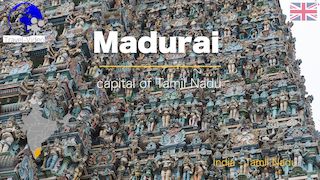
The monumental gopurams covered with dense sculptural decoration dominate the skyline of the historic city. These towers function not only as gateways to the sacred enclosure, but also as visual landmarks that structure the surrounding streets and ceremonial routes. The video allows viewers to observe the complexity of these sculpted surfaces as well as the spatial organization created by successive enclosures, halls, and courtyards.
Much of the present architectural form of the temple dates from the Nayak period, when major expansions transformed the complex into one of the largest temple ensembles in southern India. Large pillared halls, processional corridors, sacred tanks, and ceremonial spaces reflect the importance of ritual movement within the religious life of the city.
The temple also remains deeply connected to Madurai’s ceremonial calendar. Religious festivals associated with Meenakshi and Sundareshwarar continue to influence the rhythm of urban life, particularly through processions and gatherings that extend beyond the temple enclosure into the surrounding streets.
The Thirumalai Nayak Palace and Royal Representation
The second major site presented in the video is the Thirumalai Nayak Palace, built during the seventeenth century under the rule of King Thirumalai Nayak. The surviving sections of the palace provide one of the most important examples of secular monumental architecture associated with the Nayak dynasty.
Unlike the dense sculptural surfaces and vertical emphasis of the Meenakshi Temple, the palace is characterized by broad ceremonial halls, large courtyards, massive columns, and long arcaded galleries. These spaces were designed for royal audiences, official ceremonies, and court functions linked to dynastic authority.
The video highlights the architectural contrast between the two monuments while also showing their historical relationship. The Nayak rulers of Madurai supported major temple institutions while simultaneously using monumental palace architecture to reinforce political legitimacy and royal prestige.
Architectural details visible in the palace reveal a combination of southern Indian and Indo-Islamic influences. Arches, vaulted sections, domed forms, and large open halls demonstrate the synthesis of multiple traditions within the palace design. Even though only part of the original complex survives, the remaining structures retain a strong monumental presence within the city.
Understanding Monumental Spaces Through Animated Photography
The videos presented on travel-video.info are largely constructed from carefully selected and animated photographs rather than relying exclusively on moving footage. This approach allows a slower and more detailed reading of architectural spaces that are often difficult to observe during a brief visit.
In the case of Madurai, the gradual transitions between images help clarify the organization of large temple courtyards, ceremonial axes, and palace halls. Details such as sculptural programs on the gopurams, column rhythms inside pillared halls, and the proportions of monumental arches become easier to study through controlled framing and progressive visual movement.
The method also emphasizes relationships between monuments and the surrounding urban environment. Perspectives across courtyards, gateways, and processional streets reveal how religious and political architecture shaped the structure of the historic city.
For the Thirumalai Nayak Palace, the photographic sequences make the scale of the columns and arcades particularly legible. Within the Meenakshi Temple complex, animated transitions between towers, halls, and gateways help viewers understand the layered composition of the sacred enclosure.
The use of still photography additionally encourages attention to textures, materials, painted surfaces, and decorative details that can be overlooked in rapidly edited video footage.
Madurai Between Sacred Continuity and Dynastic Memory
Madurai continues to preserve a strong connection between its historical monuments and its contemporary urban identity. The Meenakshi Temple remains an active religious center visited daily by pilgrims and worshippers, while the Thirumalai Nayak Palace preserves the memory of the regional dynasties that transformed the city during the Nayak period.
By bringing these monuments together, the video offers a broader understanding of Madurai as both a religious capital and a center of political authority in southern India. The detailed pages linked to the monuments presented here provide additional historical and architectural context for viewers wishing to explore these major sites of Tamil Nadu in greater depth.





Music:
- - YouTube video library - A Fallen Cowboy
- - YouTube video library - At Odds
- - Suresh Prajapati (Inde) - Indian Classical Instrumental - Flute Tabla Raga 1, Suresh Prajapati
- - YouTube video library - People Watching
- - YouTube video library - Saving the World
- - YouTube video library - Vacation Casual
Disclaimer: Despite its appropriateness, copyright issues prevent the use of indian traditional music in "Madurai, cultural capital • Tamil Nadu, India", hence the use of royalty-free music. Despite our careful selection, some might regret this decision, which is necessary to avoid potential lawsuits. Although difficult, this decision is the only viable solution.


