

 Français (France)
  Nederlands (nl-NL)
 The Meenakshi Temple, located in Madurai in the Indian state of Tamil Nadu, is one of the major religious centers of South India. Dedicated to the goddess Meenakshi and to Shiva in the form of Sundareshwarar, the complex plays an important role in the spiritual and cultural life of the region. The temple attracts pilgrims, worshippers, and visitors throughout the year for daily rituals and major Hindu festivals. It also represents a key element of Madurai’s historical identity as an ancient commercial and religious city. The continuous religious activity within the complex reflects the enduring importance of major Hindu temples in contemporary Tamil society.


Monument profile
Meenakshi Temple
Monument categories: Hindu Temple, Polychrome temple, Dravidian temple
Monument family: Temple
Monument genre: Religious
Cultural heritage: Hindu
Geographic location: Madurai • Tamil Nadu • India
Construction period: 6th century BC
• Links to •
• Dynasties that contributed to the construction of the monument •


• List of videos about Madurai on this site •
Madurai, cultural capital • Tamil Nadu, India
The Meenakshi Temple of Madurai: Historical Development of a Major Tamil Sanctuary
Early Sanctuary and Religious Foundations
The Meenakshi Temple stands at the historic center of Madurai, one of the principal urban and religious centers of southern India. The sanctuary is dedicated to the goddess Meenakshi, regarded as a local form of Parvati, and to Shiva under the name Sundareshwarar. The temple’s religious identity is closely linked to the mythological marriage of these two deities, a narrative that became central to the ritual and ceremonial life of Madurai.
The existence of an important shrine at this location predates the seventh century. Early Tamil Shaivite devotional hymns, especially those composed by the Nayanmar saints, already refer to a significant temple in Madurai associated with Shiva worship. These references indicate that the sanctuary was already integrated into the religious networks of Tamil Shaivism during the early medieval period.
The first large-scale architectural developments were probably undertaken under the Pandya dynasty between the twelfth and thirteenth centuries. Madurai functioned at that time as an active political capital and commercial center connected to maritime trade routes across the Indian Ocean. The Pandya rulers supported the temple through land grants, ritual patronage, and administrative privileges. The sanctuary also became an important institutional center linked to the economic and ceremonial life of the city.
The temple suffered major disruption during the early fourteenth century when armies associated with the Delhi Sultanate entered the region. Historical accounts and later traditions indicate that parts of the complex were damaged or looted during this period of political instability, which contributed to the decline of Pandya authority in Madurai.
Reconstruction and Expansion under the Nayaks
Most of the present temple complex was constructed during the sixteenth and seventeenth centuries under the Nayak rulers of Madurai. After the decline of Pandya power and the reorganization of southern India under the influence of the Vijayanagara Empire, the Nayaks established Madurai as a regional capital and transformed the Meenakshi Temple into the principal religious institution of their kingdom.
The reign of Tirumalai Nayak in the seventeenth century marked an important phase in the expansion of the complex. Major construction campaigns added monumental gateway towers, large ceremonial halls, enclosed courtyards, and expanded processional spaces. These architectural developments were directly linked to the ceremonial functions of the temple and to the political ambitions of the Nayak rulers.
The sanctuary became closely associated with royal legitimacy. By sponsoring the reconstruction and enlargement of the temple, the Nayaks reinforced their authority through visible support of Tamil Shaivite traditions. The temple also served as an economic institution controlling agricultural lands, donations, craft activities, and ritual services connected to the pilgrimage economy of Madurai.
Religious festivals gained increasing importance during this period. Ceremonies linked to the divine marriage of Meenakshi and Sundareshwarar developed into major public events involving processions through the streets surrounding the temple complex. These rituals strengthened the relationship between royal authority, religious institutions, and the urban population.
The Temple under Colonial Administration and Modern Urban Change
During the nineteenth century, Madurai came under British colonial administration, but the Meenakshi Temple retained its religious role and institutional continuity. Colonial authorities were primarily concerned with the management of temple revenues, legal supervision of religious endowments, and urban administration around the sanctuary.
Several restoration efforts were undertaken during the colonial period, especially to stabilize architectural structures and maintain sculptural elements damaged by weathering or age. European officials, scholars, and travelers also documented the temple extensively during the nineteenth century, contributing to wider international awareness of the monument.
Urban growth progressively transformed the environment surrounding the temple. Expanding commercial districts and increasing population density altered the historic urban fabric of central Madurai while maintaining the temple as the symbolic and spatial center of the city. Processional streets and market areas continued to function in close relation to the ceremonial calendar of the sanctuary.
During the twentieth century, additional restoration campaigns focused on preserving gateway towers, painted sculptures, and ritual infrastructure. Temple administration increasingly required coordination between religious authorities, public agencies, and conservation specialists due to the growing number of pilgrims and visitors.
The temple continues to function as one of the principal religious centers of Tamil Nadu. Daily worship, annual festivals, and pilgrimage activities remain central to the life of the complex. Religious ceremonies linked to Meenakshi continue to structure important aspects of Madurai’s cultural identity and urban rhythm.
The Meenakshi Temple in Global Historical Context
The principal phase of reconstruction and enlargement of the Meenakshi Temple took place during the sixteenth and seventeenth centuries. During the same period, the Ottoman Empire controlled large territories across the eastern Mediterranean and the Middle East. The Mughal Empire consolidated its authority in northern India under Akbar and his successors. European maritime powers, including Portugal and Spain, expanded commercial networks across the Indian Ocean. In Southeast Asia, regional kingdoms maintained active trade relations with ports along the Tamil coast.
Preservation and Contemporary Religious Function
The Meenakshi Temple remains an active religious institution rather than a purely historical monument. Ritual worship is conducted continuously throughout the day, and large annual festivals still attract major pilgrim gatherings from across southern India.
Architectural preservation has become increasingly important because of heavy daily usage, environmental pollution, and the maintenance requirements of the monumental gateway towers and sculpted surfaces. Repainting campaigns, structural stabilization, and restoration of stone elements are carried out periodically to preserve the complex while maintaining uninterrupted religious activity.
The temple also remains deeply integrated into the economic and social life of Madurai. Commercial activity surrounding the sanctuary continues to depend heavily on pilgrimage traffic and ritual events. The coexistence of religious function, urban density, and large-scale tourism creates ongoing challenges for conservation and spatial management within the historic center of the city.
Spatial Organization and Monumental Architecture of the Meenakshi Temple in Madurai
Urban Setting and Overall Layout of the Complex
The Meenakshi Temple occupies the historic center of Madurai and functions as the principal organizing element of the old urban plan. The surrounding street network follows a concentric arrangement structured around the temple compound, with successive rectangular streets corresponding to ritual and ceremonial circulation routes. The principal streets surrounding the complex were designed to accommodate temple chariots and large religious processions linked to the annual festival calendar.
The temple complex extends across approximately 6 hectares and is organized around two major sanctuaries dedicated respectively to Meenakshi and Sundareshwarar. The dual configuration is architecturally significant because the shrine of Meenakshi occupies a position of exceptional prominence within the compound. Rather than functioning as a secondary structure, the goddess’s sanctuary plays a central role in the ceremonial and spatial organization of the site.
High enclosure walls define the outer perimeter of the temple. Monumental gateways penetrate these walls on the principal cardinal axes and regulate movement into progressively restricted sacred zones. The internal spaces consist of interconnected courtyards, columned halls, circumambulatory passages, shrines, ritual tanks, and transitional corridors. The complex therefore operates as a dense architectural ensemble rather than a single isolated monument.
The Potramarai Kulam, or sacred temple tank, occupies a central position within the internal arrangement. Arcaded corridors surrounding the tank create transitional spaces between circulation areas and shrine sectors. The basin also introduces a large open void within the otherwise compact architectural composition.
Gopurams and Monumental Vertical Structures
The most visually dominant elements of the Meenakshi Temple are its monumental gopurams. The complex contains fourteen gateway towers of varying scale, several rising above 45 meters. These towers define the skyline of central Madurai and serve simultaneously as ritual thresholds, urban landmarks, and markers of sacred territory.
The southern gopuram is the tallest structure within the compound, reaching approximately 52 meters. Its composition follows a pyramidal arrangement formed by progressively diminishing horizontal tiers. The lower section consists of a heavy granite base supporting an upper structure built primarily of brick coated with stucco. This combination reduces structural weight while permitting extensive sculptural decoration.
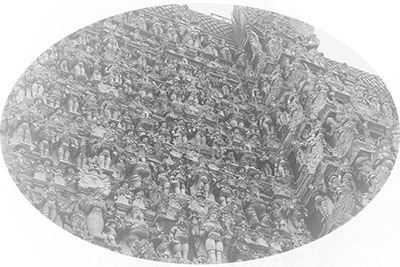
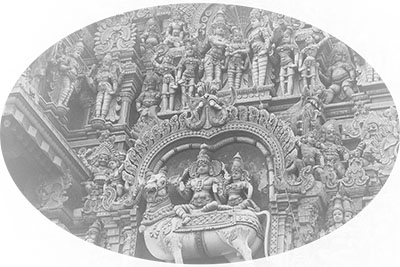
The façades of the gopurams are entirely covered with painted sculptural programs. Thousands of figures occupy nearly every surface, including deities, guardians, animals, musicians, demons, and scenes derived from Hindu mythology. The density of decoration creates highly articulated surfaces in which structural and sculptural functions appear visually merged.
Horizontal cornices divide the towers into stacked levels, while projecting niches and miniature shrine forms generate pronounced shadow effects across the façades. The towers narrow progressively toward the summit, where barrel-shaped roof forms and finials complete the vertical composition.
Passageways through the gateway bases are framed by massive stone piers and vaulted ceilings. These corridors compress movement before opening into larger internal courtyards, reinforcing the spatial contrast between enclosure and expansion throughout the complex.
Sanctuaries, Mandapas, and Interior Spatial Structure
The central sanctuaries dedicated to Meenakshi and Sundareshwarar are constructed primarily from granite and occupy the most restricted sacred zones of the complex. These core structures are surrounded by concentric layers of halls, corridors, and subsidiary shrines regulating ritual movement and visual access.
The innermost shrine spaces are deliberately compact and relatively dark. Limited openings reduce natural light penetration and focus attention toward the cult images. This spatial compression contrasts strongly with the larger surrounding halls and courtyards.
Mandapas, or pillared halls, form some of the most elaborate architectural components of the temple. The most famous is the so-called Hall of a Thousand Pillars, although the actual number is smaller. The hall is organized through a dense orthogonal grid of granite columns producing long axial perspectives across the interior. The regular spacing of the supports creates a strong structural rhythm while allowing individualized sculptural treatment of the pillars.
Many columns incorporate projecting sculptural groups carved from single granite blocks. Riders mounted on rearing horses, composite mythical animals, guardians, and divine figures emerge from the shafts with considerable depth and technical precision. In many cases, the sculptural treatment partially obscures the structural simplicity of the supports.
Ceilings within the mandapas contain painted geometric and iconographic compositions arranged around symmetrical patterns. Circular medallions, floral motifs, and mythological imagery are integrated into organized ceiling grids corresponding to the underlying column arrangements.
Long covered corridors connect the principal ritual sectors of the temple. Their dimensions vary according to ceremonial function, with broader passages reserved for processional circulation and narrower galleries serving subsidiary devotional areas. Secondary shrines occupy transitional spaces between the principal axes and peripheral sectors of the complex.
Materials, Construction Techniques, and Sculptural Programs
Granite constitutes the primary structural material throughout the Meenakshi Temple. It is used extensively for foundations, columns, walls, platforms, floors, and sanctuary cores. The hardness of the stone permitted deep carving while ensuring durability under conditions of heavy ritual usage.
Upper portions of the gopurams rely on brick masonry coated with stucco. This technique allowed builders to create very tall towers without the excessive structural loads associated with solid stone superstructures. Stucco also facilitated the production and renewal of the extensive sculptural decoration covering the towers.
Stone joints within the principal structural components are precisely fitted, particularly in the sanctuary sectors and major halls. Large monolithic blocks were employed for columns, beams, and stair elements. Some pillars demonstrate advanced carving techniques in which deeply projecting forms remain structurally integrated with the central shaft.
Sculptural decoration extends across nearly all architectural surfaces. Pillars, cornices, ceilings, lintels, and tower façades are densely ornamented with narrative and symbolic imagery. Yali figures, combining leonine, equine, and reptilian features, appear frequently on brackets and column capitals, creating strong diagonal movement within otherwise rectilinear spaces.
Painted surfaces play a major role in the visual identity of the monument. Repeated repainting campaigns have maintained the vivid coloration of the gopurams, where bright blues, reds, greens, yellows, and whites emphasize the sculptural density of the towers and reinforce their visibility across the city.
Doorways leading into major sanctuaries are framed by heavy granite moldings and reinforced with decorated metal doors. Threshold stones and floor slabs display significant wear caused by centuries of continuous ritual circulation.
Architectural Modifications and Preservation Challenges
The present appearance of the Meenakshi Temple results from multiple construction phases concentrated mainly between the sixteenth and seventeenth centuries under the Nayak rulers of Madurai. Earlier structures were incorporated into later expansions, producing a layered architectural composition in which different periods remain partially embedded within the larger complex.
Successive restoration campaigns altered portions of the sculptural surfaces and painted decoration. Modern conservation efforts focus on stabilizing the gopurams, protecting stone surfaces from pollution and weathering, and maintaining drainage systems affected by monsoon conditions.
Heavy daily visitation presents major preservation challenges. Constant pedestrian circulation has produced visible erosion on granite floors, staircases, and threshold areas. Temple authorities must also integrate modern infrastructure, including electrical systems, lighting installations, and crowd management measures, within an active ritual environment.
Despite repeated interventions and periodic repainting, the architectural coherence of the complex remains remarkably strong. The interaction between monumental gateway towers, compact sanctuary cores, vast pillared halls, and articulated circulation spaces continues to define the distinctive spatial character of the Meenakshi Temple within the historic center of Madurai.