

 Français (France)
  Nederlands (nl-NL)
 00:00 • intro | 01:11 • the temple's blessing elephant | 01:50 • an 'old Franc'e impression | 02:26 • Our Lady of the Angels | 03:25 • a mosque
Personal creation from visual material collected during my trip India • South India • Tamil Nadu and Kerala (2018)
Map of places or practices in Pondicherry on this site
• Use the markers to explore the content •
Pondicherry, Between French Heritage and Tamil Traditions
A Coastal City Shaped by Multiple Influences
Located on the southeastern coast of India along the Bay of Bengal, Pondicherry preserves a distinctive identity shaped by both its French colonial past and its Tamil cultural environment. Formerly an important French trading post in India, the city still displays an urban landscape where European, Hindu and Muslim influences coexist.
The video explores several dimensions of this former colonial enclave. Streets lined with colorful façades, religious monuments and scenes of everyday life reveal a city where different historical and cultural traditions continue to overlap. The atmosphere reflects both the legacy of French colonial administration and the realities of contemporary Tamil Nadu.
The images also highlight the contrast between neighborhoods influenced by French urban planning and areas more directly connected to local Tamil traditions. This coexistence contributes greatly to the unique character of Pondicherry.
Temples, Churches and Religious Diversity
The Manakula Vinayagar Temple occupies an important place in the film. Dedicated to the Hindu deity Ganesha, the temple is especially known for its blessing elephant, which has become one of the recognizable symbols of Pondicherry. The scenes showing interactions between the elephant and visitors illustrate the continuing importance of religious traditions in daily urban life.
The video also captures parts of the city where traces of “old France” remain visible. Straight streets, colonial villas and pastel-colored façades reflect the urban organization introduced during the French colonial period.
The church of Notre-Dame des Anges represents another aspect of Pondicherry’s heritage. Its European-inspired architecture and location near the seafront recall the role played by Christian missions and colonial communities in the city’s history.
The presence of a mosque further illustrates the multicultural nature of this coastal town. Like many ports along the Coromandel Coast, Pondicherry developed through commercial exchanges and contacts with different regions of the Indian Ocean world.
Between Colonial History and Tamil Culture
For several centuries, Pondicherry served as one of the principal French settlements in India. Despite colonial conflicts with the British Empire, the town remained under French administration until the mid-twentieth century, before becoming part of independent India.
Some districts still preserve urban forms inherited from this period. Rectilinear streets, colonial residences and administrative buildings contrast with older Tamil neighborhoods organized according to different architectural and social traditions.
The coexistence of Hindu temples, Christian churches and mosques also reflects the commercial and cultural role played by Pondicherry throughout its history. Today, the city remains a place where several historical layers continue to shape the urban landscape.
What These Videos Make Easier to Observe
The videos on travel-video.info rely heavily on animated photographs that allow viewers to observe architectural details, urban atmospheres and color variations with greater precision. This approach encourages a gradual understanding of the city’s different districts and monuments.
Slow transitions between wide views and close details make the contrasts between colonial architecture, Hindu sanctuaries and religious buildings easier to appreciate. The photographs also help reveal the relationships between streets, public spaces and places of worship.
A City Marked by Multiple Heritages
Pondicherry continues to occupy a distinctive place within the Indian cultural landscape. Between French colonial heritage, Tamil traditions and religious diversity, the city offers an original perspective on the multiple historical influences that shaped the southeastern coast of India. The detailed pages dedicated to the associated monuments provide further insight into the architectural and cultural heritage of Pondicherry.
Links to related pages


Audio Commentary Transcript
While India was known as the British Indian Empire from 1858 to 1947, other Western powers settled in the subcontinent during the Mongol era.
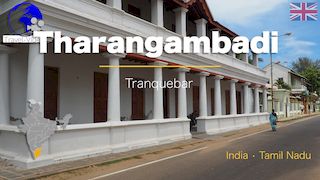
If the Portuguese founded Goa, the Dutch settled in Kochi, while Pondicherry was to be founded by the French and Tranquebar by the Danes.
Buildings attest to these presences. Goa, Tranquebar and Kochi are each the subject of a film in this series and here are some images of Pondicherry (Puducherry after the new name of Indian cities).
An elephant who blesses you for 10 rupees

Music:
- - Suresh Prajapati (Inde) - Indian Classical Instrumental - Flute Tabla Raga 1, Suresh Prajapati
- - Miles Davis - Ascenseur pour l'Échaffaud - Nuit sur les Champs Elysées


