Français (France)
  Nederlands (nl-NL)
 00:00 • intro | 00:41 • Padmanabhapuram palace
Personal creation from visual material collected during my trip India • South India • Tamil Nadu and Kerala (2018)
Map of places or practices in Thuckalay on this site
• Use the markers to explore the content •
Padmanabhapuram, a Wooden Royal Palace of Southern India
A Former Royal Residence Between Kerala and Tamil Nadu
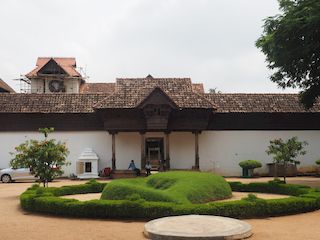
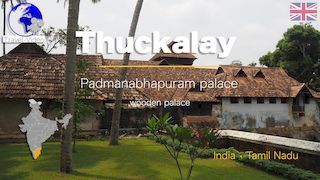
Located near Thuckalay in the southernmost part of the Indian subcontinent, the palace of Padmanabhapuram is one of the most remarkable surviving royal complexes of southern India. Once the capital of the Kingdom of Travancore before the royal court moved to Thiruvananthapuram, the site preserves an important architectural heritage linked to the cultural traditions of both Kerala and Tamil Nadu.
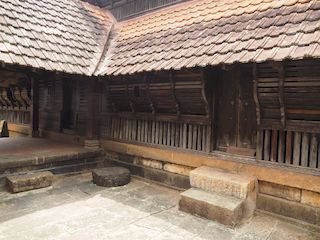
The video explores a palace complex built largely in wood and organized around courtyards, covered corridors and interconnected pavilions. Unlike many stone palaces associated with northern Indian kingdoms, Padmanabhapuram reflects an architectural tradition closely adapted to the tropical climate of southwestern India. Sloping roofs, ventilated halls and shaded galleries demonstrate construction techniques designed to respond to humidity, heavy rainfall and heat.
The images also reveal the distinctive atmosphere of the site. Wooden pillars, carved ceilings and polished surfaces create an environment where refinement and functionality remain closely connected. Rather than presenting itself as a massive fortified structure, the palace appears as a harmonious succession of residential and ceremonial spaces integrated into their natural surroundings.
The Palace Complex and Its Architectural Features
Padmanabhapuram Palace consists of several buildings constructed during different periods of the history of Travancore. Audience halls, royal apartments, ceremonial areas and inner courtyards illustrate the organization of a princely residence in southern India, combining administrative, domestic and ceremonial functions.
The video places particular emphasis on the architectural details that characterize the complex. Long wooden galleries, staircases, carved ceilings and filtered light entering through openings reveal the importance of craftsmanship in royal architecture of the region. Some sections of the palace also preserve polished floors produced using traditional mixtures of natural materials, techniques still admired today for their durability and appearance.
Teak structures and sophisticated timber joinery demonstrate the high level of skill achieved by local artisans. Decorative elements are often more restrained than those found in Mughal or Rajput palaces of northern India, yet the balance of proportions and the quality of materials give Padmanabhapuram a very distinctive architectural identity.
Travancore and the Architectural Traditions of Kerala
Although the palace is now located within the modern state of Tamil Nadu, it remains historically associated with the Kingdom of Travancore and the architectural traditions of neighboring Kerala. This geographical and cultural context explains many features visible throughout the complex, including steep roofs, open circulation spaces and the emphasis placed on natural ventilation.
Travancore played an important political and economic role in southern India between the seventeenth and nineteenth centuries. Its rulers supported architecture, religious institutions and artistic traditions while maintaining commercial relations with maritime powers active along the Indian Ocean coast.
Padmanabhapuram today represents a rare example of traditional secular architecture from historical Kerala. Because many royal residences from this period disappeared or were extensively transformed, the palace has become particularly valuable for understanding the evolution of courtly architecture in southern India.
What These Videos Make Easier to Observe
The videos on travel-video.info rely heavily on carefully animated photographs that allow viewers to observe architectural details and spatial organization with greater precision. This approach is especially effective for a site such as Padmanabhapuram, where much of the visual interest lies in textures, proportions and the relationship between interior and exterior spaces.
Gradual transitions between wide views and close details make wooden structures, carved ceilings and open galleries easier to understand. The photographs also help reveal how the various courtyards and pavilions are connected within the larger palace complex.
This visual construction encourages a slower and more attentive reading of a palace whose architectural qualities depend less on monumental scale than on craftsmanship, ventilation and spatial harmony.
A Rare Example of Southern Indian Royal Architecture
Padmanabhapuram Palace remains one of the most important surviving examples of traditional palace architecture in southern India. Through its wooden pavilions, ceremonial halls and climate-adapted construction techniques, the complex offers a different vision of Indian royal architecture from the monumental stone palaces more commonly associated with northern India. The detailed pages dedicated to the monument provide further insight into the history, architecture and cultural traditions of the former Kingdom of Travancore.
Links to related pages







Audio Commentary Transcript
The Maharajah of Travancore built this magnificent wooden palace in the 16th century. The palace is known as the Padmanabhapuram palace. It was the power center of the Kings of Travancore until 1790, when the capital was transferred to Thiruvananthapuram (Trivandrum).
Music:
- - YouTube video library - Carol of the Bells
- - YouTube video library - Clouds
Disclaimer: Despite its appropriateness, copyright issues prevent the use of indian traditional music in "Thuckalay, Padmanabhapuram • Tamil Nadu, India", hence the use of royalty-free music. Despite our careful selection, some might regret this decision, which is necessary to avoid potential lawsuits. Although difficult, this decision is the only viable solution.