Français (France)
  Nederlands (nl-NL)
 00:00 • intro | 01:06 • New Jerusalem Church | 01:44 • the beach | 02:16 • a walk in town
ersonal creation from visual material collected during my trips:
Map of places or practices in Tharangambadi (Tranquebar) on this site
• Use the markers to explore the content •
Tranquebar and the Danish Presence on the Coromandel Coast
A Former Danish Trading Settlement in Tamil Nadu
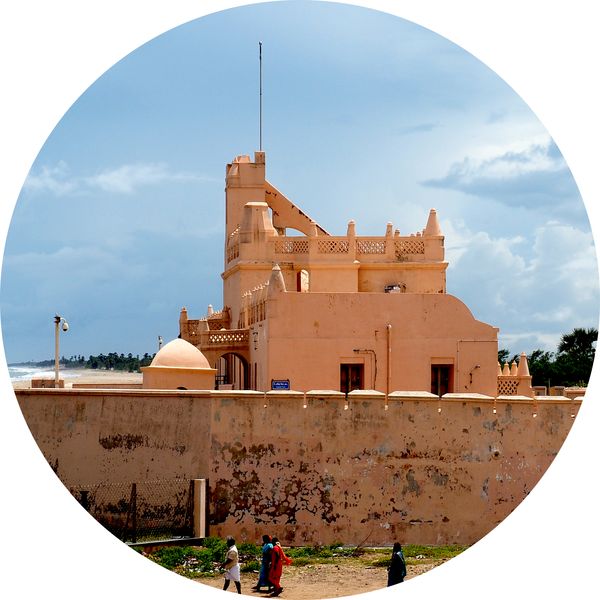
Tharangambadi, historically known as Tranquebar, occupies a distinctive place in the history of the Coromandel Coast. Established as a Danish trading settlement during the seventeenth century, the town preserves an architectural and urban heritage rarely associated with South India. Colonial religious buildings, maritime structures, coastal landscapes, and quiet streets still reflect the period when Tranquebar functioned as an active commercial centre connected with European maritime networks in the Indian Ocean.
The video explores several aspects of this historic coastal town, including Protestant religious heritage, the shoreline facing the Bay of Bengal, and the urban atmosphere of the former Danish quarter. The images reveal how European colonial influences became integrated into a Tamil coastal environment shaped by trade, religion, and maritime activity.
Religious Heritage and Coastal Landscapes
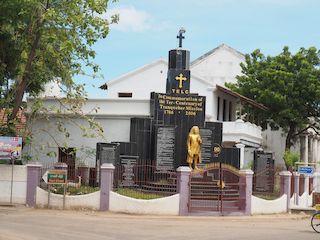
One of the main monuments visible in the video is the New Jerusalem Church, an important Lutheran church linked to the earliest Protestant missions established in India. Built during the early eighteenth century, the church reflects the development of the Danish Lutheran mission in Tranquebar and the role played by missionaries such as Bartholomäus Ziegenbalg in the cultural and religious history of the region.
The sequences highlight the church’s restrained architectural forms, white-plastered façades, and carefully organised openings designed to improve ventilation in the tropical coastal climate. The building remains one of the principal surviving symbols of the Danish colonial presence on the Coromandel Coast.
The shoreline and beach shown in the video illustrate another essential aspect of Tranquebar’s identity. The town developed directly beside the sea, and its historical importance depended largely on maritime trade routes connecting South India with Europe and other regions of Asia. The coastal setting continues to shape the appearance of the town, where colonial buildings stand only a short distance from the Bay of Bengal.
Urban Organisation and Colonial Legacy
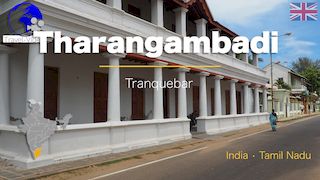
Walking through the streets of Tharangambadi reveals an urban layout different from that of many historic Tamil towns. Straight streets, colonial administrative buildings, old residences, and religious structures reflect the planned organisation introduced during the Danish colonial period. Several parts of the town still preserve the atmosphere of a small maritime settlement shaped by both European and Tamil influences.
The town also retains strong connections with its maritime past. The detailed pages dedicated to the Maritime Museum and the New Jerusalem Church provide additional information about colonial trade, Protestant missions, and the preservation of Tranquebar’s architectural heritage.
The video also indirectly reflects the transformations that have affected the town over time, including restoration campaigns, coastal erosion, and the consequences of the 2004 tsunami, which damaged parts of the historic waterfront and reinforced awareness of the need to preserve the remaining colonial structures.
What the Videos on This Site Make Easier to Observe
The videos published on travel-video.info often rely on carefully animated photographs and progressive transitions that make architectural and urban details easier to study. This approach is particularly effective in Tranquebar, where the relationship between colonial buildings, streets, and the coastline plays a central role in understanding the town.
The movements within the images help reveal the proportions of the New Jerusalem Church, the perspectives of the rectilinear streets, and the contrast between European architectural forms and the tropical coastal landscape. The gradual transitions also make it easier to follow the organisation of the former Danish settlement and the spatial links between monuments and the seafront.
A Rare Colonial Heritage on the Indian Coast
Through its churches, maritime atmosphere, and preserved colonial streets, Tharangambadi offers a rare insight into the history of the Danish presence in India. The video presents a visual exploration of a coastal town where Protestant heritage, maritime history, and the landscapes of the Coromandel Coast remain closely interconnected.
Links to related pages


Audio Commentary Transcript
Tranquebar, currently called Tharangambadi, is a city founded in the 18th century by Denmark on the east coast of southern India, present-day Tamil Nadu. This city also gave its name to a suburb of Port-Louis in Mauritius.
Little is known, but the Portuguese, English and Dutch were not the only ones to establish trading posts in India.
Tranquebar, renamed in Tharangambadi is an excellent example.
The city was founded by King Christian 4 of Denmark who leased the site to the Rajah of Tanjore until it was sold to the English through the British India Company in 1845.
Music:
- - YouTube video library - Clouds
Disclaimer: Despite its appropriateness, copyright issues prevent the use of indian traditional music in "Tranquebar (Tharangambadi), former Danish trading post • Tamil Nadu, India", hence the use of royalty-free music. Despite our careful selection, some might regret this decision, which is necessary to avoid potential lawsuits. Although difficult, this decision is the only viable solution.