Français (France)
  Nederlands (nl-NL)
 00:00 • intro | 00:34 • Tutankhamun | 05:11 • Some great pharaons | 05:19 • Khufu | 05:48 • Khafre | 06:53 • Menkaure | 07:54 • Djoser | 08:26 • Amenemhat III | 09:01 • Hor (Awibre) | 09:37 • Hatshepsut | 11:01 • Nefertiti | 12:07 • Akhenaten | 12:36 • Amenhotep III / Amenophis III | 13:18 • Mentuhotep II | 16:55 • Some Important Figures | 19:09 • Mummies and Sarcophagi
Personal creation from visual material collected during my trip Egypt (2024)
Map of places or practices in Cairo on this site
• Use the markers to explore the content •
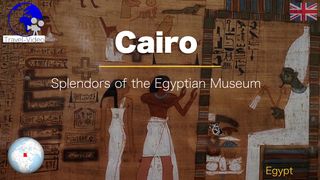
Cairo and the Splendours of the Egyptian Museum
A landmark collection of ancient Egypt
In central Cairo, the Egyptian Museum long stood as one of the world’s great gateways to the civilization of the Nile Valley. Opened in the early twentieth century, it brought together an extraordinary concentration of objects discovered across Egypt: royal statues, funerary equipment, inscriptions, jewellery, mummies and masterpieces of sculpture. For generations, it served not only as a museum but as a visual summary of more than three thousand years of pharaonic history.
The video devoted to its splendours follows some of the best-known rulers and personalities represented in its collections. Through kings, queens, officials and funerary remains, viewers encounter political power, religious belief, artistic ideals and the long continuity of Egyptian culture. Rather than presenting a single monument, this page explores a place where many monuments and archaeological sites are symbolically reunited.
Major rulers and masterpieces visible in the video
One of the central names is Tutankhamun, whose fame rests largely on the discovery of his nearly intact tomb in 1922. The treasures associated with him transformed public interest in ancient Egypt. Gold objects, ceremonial furniture, royal insignia and the famous funerary mask made the young king one of archaeology’s most recognizable figures. His presence within the museum became one of its defining attractions.
The video also turns to several pharaohs whose reigns shaped major phases of Egyptian history. Khufu, Khafre and Menkaure evoke the pyramid age of the Old Kingdom and the monumental ambitions of Giza. Their statues and portraits express royal authority through formal balance, controlled posture and idealized features.
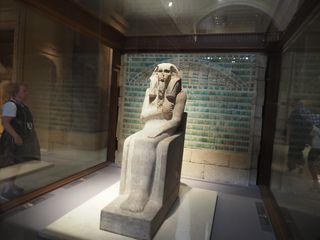
Djoser represents an earlier turning point through the development of large-scale stone architecture at Saqqara. Amenemhat III belongs to the Middle Kingdom, often associated with administrative strength, irrigation works and refined royal portraiture. Mentuhotep II recalls the reunification of Egypt after political fragmentation and the restoration of centralized rule.
The New Kingdom appears through Hatshepsut, one of the most significant female rulers of ancient history, Amenhotep III, whose reign is linked with prosperity and artistic refinement, and Akhenaten with Nefertiti, figures associated with a remarkable religious reform centered on the Aten. Their images often differ sharply from earlier royal conventions, revealing how political change could reshape artistic language.
The mention of Hor (Au-ib-Re) and other lesser-known rulers reminds viewers that museum collections preserve not only the most famous names but also more complex and sometimes transitional chapters of Egyptian chronology.
Important individuals, mummies and funerary culture
The museum’s significance extends beyond kings. Statues of scribes, priests, nobles and administrators reveal the human structure of the pharaonic state. Egypt was governed through a vast hierarchy, and many private monuments were designed to preserve memory, rank and ritual presence after death.
These works often show a different artistic tone from royal sculpture. Private figures may appear seated, attentive, holding scrolls or offering objects. Their inscriptions record titles, family relationships and appeals to the gods. They help reconstruct everyday administration, literacy and social ambition within ancient Egypt.
Mummies and sarcophagi form another major theme of the video. They illustrate beliefs about death in which bodily preservation, ritual texts and symbolic protection were essential for rebirth in the afterlife. Painted coffins, gilded masks and nested burial containers were not decorative luxuries alone. They formed part of a carefully structured spiritual system.
The royal mummies are especially powerful historical witnesses. They provide a rare physical link to rulers otherwise known through temples and inscriptions. Combined with sarcophagi and funerary objects, they make visible the Egyptian effort to defeat oblivion through preservation and ceremony.
Historical, architectural and museum context
The Egyptian Museum was created during a period when archaeology in Egypt was becoming increasingly systematic. Excavations in the nineteenth and twentieth centuries produced vast quantities of material that required cataloguing, conservation and scholarly access. The Cairo museum answered that need by gathering collections from sites such as Giza, Saqqara, Thebes, Amarna and Tanis.
Its building, conceived in the museum traditions of its time, used large galleries and high rooms suited to monumental sculpture and dense displays. For decades, it functioned as a central institution of national heritage, where objects from distant regions could be studied side by side.
The museum also reflects changing attitudes toward preservation. As new institutions emerged and collections were redistributed, the role of the historic Cairo museum evolved. Yet its symbolic importance remained immense: it was the place where countless visitors first encountered the scale and sophistication of ancient Egyptian civilization.
Within the urban setting of Cairo, the museum represented a meeting point between modern Egypt and its deep past. Located in a major capital city shaped by Islamic, Ottoman, colonial and contemporary layers, it offered direct access to a much older historical horizon.
What the videos of this site make especially clear
Videos largely built from carefully selected and animated photographs are particularly effective for museum subjects. They allow viewers to linger on details that are often missed during a crowded or rapid visit. A face in polished stone, the texture of carved hair, the precision of hieroglyphs or the surface of painted wood becomes easier to appreciate.
Slow visual movement across statues helps reveal volume, proportion and posture. The difference between Old Kingdom formality and Amarna experimentation, for example, can be understood more clearly when images are presented in sequence.
For sarcophagi and funerary equipment, this format also clarifies layered decoration, symbolic motifs and inscriptions arranged across curved surfaces. Instead of isolated objects in display cases, the pieces become part of a coherent historical narrative.
Because these videos build progressively from still imagery, they are well suited to explaining chronology. The viewer can move from pyramid builders to Middle Kingdom rulers, then to New Kingdom queens and reforming kings, while maintaining visual continuity.
A concentrated history of the pharaonic world
The Egyptian Museum of Cairo remains one of the great repositories of ancient Egypt. Through Tutankhamun, famous pharaohs, officials, mummies and funerary art, it condenses millennia of political ambition, religious belief and artistic achievement into a single place. This video offers a clear introduction to that richness and invites further exploration through the detailed page devoted to the museum and the historical figures it preserves.
Music:
- - YouTube video library - Dreamy Flashback, (© Dreamy Flashback by Kevin MacLeod is licensed under a Creative Commons Attribution 4.0 license. https://creativecommons.org/licenses/by/4.0/
- Source: http://incompetech.com/music/royalty-free/index.html?isrc=USUAN1100532
- Artist: http://incompetech.com/)
- - YouTube video library - House on the Hill - Everet Almond
- - YouTube video library - I knew a Guy - Kevin McLeod, (© I Knew a Guy by Kevin MacLeod is licensed under a Creative Commons Attribution 4.0 license. https://creativecommons.org/licenses/by/4.0/
- Source: http://incompetech.com/music/royalty-free/index.html?isrc=USUAN1100199
- Artist: http://incompetech.com/
- )
- - YouTube video library - Nail biter - Riot
- - YouTube video library - The Sax of Ancient Terror - Jimena Contreras
Disclaimer: Despite its appropriateness, copyright issues prevent the use of egyptian traditional music in "Cairo, Splendors of the Egyptian Museum • Egypt", hence the use of royalty-free music. Despite our careful selection, some might regret this decision, which is necessary to avoid potential lawsuits. Although difficult, this decision is the only viable solution.
Links to related pages
Audio Commentary Transcript
This video showcases items on display at the Egyptian Museum in Cairo, with particular attention given to photographic challenges in a museum environment, such as reflections and the presence of visitors, while trying to present the objects as clearly as possible.
Tutankhamun
Tutankhamun, though a relatively minor pharaoh in Egyptian history who died young, is undoubtedly the most famous today. His treasure is displayed in the museum in a room where photography is strictly prohibited, but fortunately, some of his items are freely accessible elsewhere in the museum.
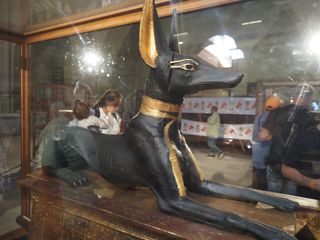
The chests watched over by Anubis are traditionally used to house the canopic jars, protected by the heads of Horus's sons. However, Tutankhamun's tomb reveals a unique practice: while canopic jars were found, they were accompanied by a large alabaster vessel, not contained in a similar chest due to its exceptional dimensions. Interestingly, the usual heads of Horus's sons on the canopic jars are replaced by those of the pharaoh, marking a significant deviation from Egyptian ritual conventions.
Tutankhamun, the son of Akhenaten, inherited a reign marked by the religious upheavals initiated by his father. Although the young pharaoh restored the worship of Amun and other deities sidelined during the Amarna period, certain elements of Tutankhamun's tomb, such as the large alabaster canopic vessel, suggest that his father's influence might subtly persist. This vessel, while stylistically different from the characteristic art of Akhenaten’s Amarna period, could represent a personal adaptation or interpretation of his father’s religious ideas, integrating traditional practices while marking a continuity with the past.
In the canopic chest shown here, only three canopic jars are visible. The absence of one jar can be explained by its loan to international institutions for temporary exhibitions, similar to one displayed in Paris in 2019. Such loans allow Egyptian history to be shared with a broader audience worldwide.
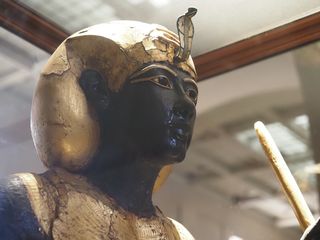
This statue represents Tutankhamun, the young pharaoh of ancient Egypt, holding the traditional symbols of power, the scepter and flail. Found in his tomb (KV62) by Howard Carter in 1922, this work was not a unique example. Several similar statues, intended to protect the pharaoh in the afterlife and to symbolize his eternal authority, were discovered in the same tomb. Each presents stylistic or material variations, reflecting the artistic and cultural richness of the era.
This statuette depicts Khufu, known for constructing the Great Pyramid of Giza, one of the ancient world’s wonders. Remarkably, it is likely the only surviving representation of Khufu. Just a few centimeters tall, this piece, displayed at the Egyptian Museum in Cairo, starkly contrasts the grandeur of his architectural achievement with the scarcity of his image in ancient Egyptian artifacts.
Pharoahs
Khafre, the son of Khufu and builder of the second pyramid at Giza, is represented by statues significantly larger than those of his father. This particular statue, notable for its imposing size, symbolizes the power and continuation of the royal cult under his dynasty. It stands in stark contrast to the modest statuette of Khufu, reflecting an era when artistic and monumental expression was increasingly emphasized.
The triad statues of King Menkaure, discovered in his valley temple at Giza, illustrate the sacred union between the pharaoh and the protective deities of Egypt. Each statue depicts Menkaure flanked by the goddess Hathor, recognizable by her solar disk framed by two cow horns, and a god or goddess symbolizing a specific nome of Egypt. To the left of Menkaure, the figures vary, bearing the symbols of the Theban nome, the jackal nome, and the bat nome, thus highlighting the importance of the different provinces in supporting the reign and the afterlife of the king. These works, m.ade of grauwacke, dating from the 4th dynasty around 2490 to 2472 BC, reflect the complexity of the religious beliefs and political system of ancient Egypt.
In the hall dedicated to Akhenaton, an enigmatic colossus bears the inscription "Akhenaton or Nefertiti". This statue, potentially depicting Nefertiti with pharaonic attributes, highlights her influential status and role in the religious and artistic reforms of the period. Beside it, the statue of Akhenaton captivates with its revolutionary style: elongated features and an androgynous silhouette, embodying the radical ideas of the pharaoh that marked a turning point in Egyptian art.
Amenhotep III, also known as Amenophis III, was a significant pharaoh of the 18th dynasty, during which Egypt reached a peak of prosperity and artistic power.
Important figures
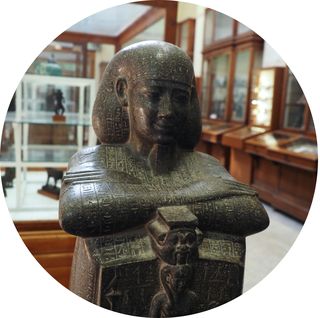
This statue of Djed-Hor illustrates the vital role of priests in religious and cultural practices. Seated with crossed arms holding ritual objects and surrounded by hieroglyphs, Djed-Hor symbolizes wisdom and piety. The basin at his feet, used for offerings, attests to the importance of offering rituals in Egyptian religion.
Scribes were crucial in ancient Egypt, responsible for writing texts and official documents with their mastery of hieroglyphic and hieratic scripts. They played a key role in administration, education, and cultural preservation, maintaining state and temple records. Their advanced education and high social status distinguished them as an intellectual elite.
The wooden statue of Niankhpepikem, dating from the 6th Dynasty, depicts an ancient Egyptian porter. Featuring attributes such as a backpack and a basket, this piece highlights the roles and social status of servants in their daily lives. Preserved at the Egyptian Museum in Cairo, it provides valuable insight into the labor practices and social structure of the time.
The statue of Kaaper, known as the 'Chief of the King's Readers', is an iconic work of the Old Kingdom Egyptian art, dating from the 5th Dynasty. Made of wood, this life-size statue depicts Kaaper in a striding posture, realistically capturing the features and expression of this high-ranking priest.
Dwarfs were highly valued in ancient Egypt for their unique roles in religion and the royal court, often enjoying elevated social status. An illustrative example is Seneb, a dwarf who held prestigious positions including that of director of royal fabrics. His statue in the museum, depicting him with his family, attests to his respected integration into Egyptian society and acknowledgment of his significant contributions, despite physical challenges.
Funeral masks
In ancient Egypt, funeral masks were much more than mere adornments. Serving as a bridge between the world of the living and the dead, these masks were designed to secure the protection and regeneration of the deceased's soul. Carefully carved and often gilded, they aimed to immortalize the features of the deceased while invoking the presence of a deity to guide and protect the soul in the hereafter.
Mummies and Sarcophagi
Mummification, essential in ancient Egypt for ensuring the soul's eternal life, was a complex ritual aimed at preserving the body. Yuya and his wife Thuya, prominent figures of the 18th Dynasty under the reign of Amenhotep III, exemplify this practice. Dying around 1370 BC, their mummies, found in the Valley of the Kings, demonstrate the sophistication of the mummification art at the time and embody the deep religious beliefs in life after death. Their burials reflect the high status they held in Egyptian society.
The mummies from the Greek Ptolemaic dynasty, often found in poorer condition than those from earlier periods, suggest an evolution in mummification practices. This period may reflect less rigor in preservation methods or variations in rituals and materials used, reflecting cultural and economic changes within Hellenistic Egypt.
Sarcophagi, from the Greek 'sarkophagos' meaning 'flesh-eater', were containers designed to protect mummified bodies in ancient Egypt. Beyond their physical protective role, they held significant symbolic value, serving as the earthly final resting place that facilitated the soul's transition to the afterlife. Richly decorated, they reflected the deceased's social status and religious beliefs, with every detail contributing to secure their journey to immortality.
Papyrus
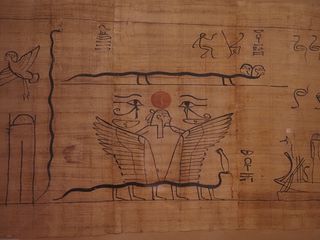
The museum's papyrus collection showcases ancient Egyptian literature, providing a valuable glimpse into the daily, religious, and administrative aspects of life in ancient Egypt. These documents, written in hieroglyphic, hieratic, and sometimes demotic script, include a variety of texts such as magical spells, religious hymns, medical texts, as well as personal correspondence and legal contracts. Their exceptional preservation allows researchers and visitors to delve into the intellectual and cultural past of this ancient civilization.