Français (France)
  Nederlands (nl-NL)
 00:23 • Bukhara, 2,500 Years of History | 01:02 • Mausoleum of the Samanids | 02:15 • Chashma Ayub • Mausoleum and Shrine | 03:25 • Bakhouddin Naqshband Memorial | 05:17 • Bobo Khaouz Mosque | 07:13 • Po-i-Kalyan complex | 07:42 • Mir-i-Arab Madrasa | 09:01 • Kalyan Mosque | 11:50 • Kalyan Minaret | 13:09 • Abdelaziz Khan Madrasa | 14:50 • Magok-i-Attari Mosque | 15:52 • Ark Citadel | 16:57 • Juma Mosque | 18:00 • Kurinish Khana (Throne Hall) | 18:52 • Sitori-i Mokhi Khosa Palace
Personal creation from visual material collected during my trip Uzbekistan and Kyrgyzstan (2019)
Map of places or practices in Bukhara on this site
• Use the markers to explore the content •
Bukhara, a Historic Oasis on the Silk Road
A City Shaped by Trade, Faith and Scholarship
For more than two and a half millennia, Bukhara has stood as one of Central Asia’s most important urban centres. Located in an oasis on the edge of the Kyzylkum Desert, the city developed along the great trade routes that connected China, India, Persia and the Mediterranean world. Merchants, scholars, pilgrims and rulers all contributed to its growth, transforming Bukhara into a renowned centre of commerce, religion and learning.
The monuments featured in this video reflect the many layers of that history. Religious sanctuaries, royal residences, defensive structures and educational institutions illustrate how the city evolved through successive political and cultural periods. Together, they reveal a remarkable urban landscape where architecture, spirituality and power were closely intertwined.
Today, Bukhara remains one of the best-preserved historic cities of the Islamic world. Its monuments provide valuable insight into the civilizations that flourished along the Silk Road and into the traditions that shaped Central Asia over many centuries.
The Major Monuments and Historic Spaces
Among the oldest landmarks presented in the video is the Samanid Mausoleum, one of the masterpieces of early Islamic architecture. Built during the Samanid period between the ninth and tenth centuries, it reflects a moment when Bukhara served as the capital of a powerful dynasty that played a crucial role in the cultural development of the region. Its sophisticated brickwork demonstrates the high level of architectural craftsmanship achieved during this era.
Another important site is Chashma Ayub, a sanctuary associated with a sacred spring and local religious traditions. The monument combines elements from different historical periods and illustrates the importance of pilgrimage and devotion in the spiritual life of Bukhara.
The memorial complex dedicated to Bahauddin Naqshband highlights another dimension of the city’s heritage. Bahauddin Naqshband was a fourteenth-century Sufi master whose teachings gave rise to one of the most influential Sufi orders in the Islamic world. His shrine remains an important place of pilgrimage and provides insight into the role of mysticism in Central Asian religious life.
The monumental heart of Bukhara is represented by the Po-i-Kalyan complex. Dominated by the famous Kalyan Minaret, this ensemble also includes the vast Kalyan Mosque and the Mir-i-Arab Madrasa. Together, these structures form one of the most iconic architectural compositions in Uzbekistan. Their scale, proportions and decorative richness illustrate the importance of Bukhara as a centre of Islamic scholarship and religious authority.
The video also explores the Abdulaziz Khan Madrasa, known for its elaborate decoration and refined ornamentation. Its richly decorated façades demonstrate the artistic evolution of Central Asian architecture during the seventeenth century.
Another remarkable monument is the Magok-i-Attari Mosque, one of the oldest surviving religious sites in the city. Built on a location with a history that predates the arrival of Islam, it reflects the continuity of sacred spaces within the urban landscape of Bukhara.
The Ark Citadel offers a different perspective on the city’s history. For centuries it served as the political centre of the Emirate of Bukhara. Behind its massive walls stood administrative buildings, royal residences, reception halls and religious spaces reserved for the ruling elite. The Kurinish Khana, or throne hall, illustrates the ceremonial functions of the citadel, while the Sitori-i Mokhi Khosa Palace reveals how the later emirs adapted traditional forms to changing tastes and influences.
Historical and Architectural Context
The history of Bukhara extends far beyond the monuments themselves. The city developed over more than twenty-five centuries and experienced the influence of numerous civilizations, including Iranian cultures, Arab conquerors, Turkic dynasties, Mongol rulers, Timurid princes and the khans and emirs who governed Central Asia in later centuries.
Following the Arab conquest of Transoxiana in the eighth century, Islam gradually became the dominant religion. Bukhara emerged as one of the leading intellectual centres of the Islamic world, attracting theologians, jurists, philosophers and scholars. Its reputation for learning extended across a vast geographical area and contributed significantly to the city’s prestige.
The urban fabric of Bukhara reflects this long historical development. Religious institutions occupied a central position in the city’s organization, while markets, caravan routes and administrative quarters supported commercial and political activity. The close relationship between economic prosperity and religious patronage can be observed throughout the city’s architectural heritage.
Brick became the principal building material of Bukhara’s monuments. Early structures demonstrate extraordinary mastery of decorative brickwork, while later periods introduced colourful glazed tiles, geometric patterns and intricate calligraphic ornamentation. Monumental portals, domes, courtyards and minarets became defining elements of the local architectural vocabulary.
The Kalyan Minaret, for example, served not only as a religious structure but also as a visual landmark visible from great distances across the surrounding landscape. Madrasas functioned as centres of education, while mosques provided spaces for communal worship. Mausoleums preserved the memory of rulers, saints and influential religious figures, reinforcing the connection between architecture and collective identity.
The city’s palaces and ceremonial halls reveal another aspect of Bukhara’s history. They illustrate the authority of the emirs and the administrative mechanisms through which the state was governed. These structures help explain how political power operated alongside religious institutions within the urban environment.
Understanding the City Through Images
The photographic approach used in these videos offers particular advantages when exploring historic architecture. Carefully selected images allow viewers to focus on details that might otherwise go unnoticed during a brief visit. Slow transitions and animated movements guide the eye through façades, courtyards, domes and decorative elements while preserving a clear sense of scale.
This method is especially effective in Bukhara, where many monuments contain highly detailed brickwork, carved decoration and glazed ceramic ornamentation. Architectural features such as muqarnas vaulting, monumental portals and geometric patterns become easier to appreciate when viewed through a sequence of carefully framed images.
The use of photographs also helps reveal the relationships between individual buildings and their wider surroundings. Courtyards, public squares, defensive walls and religious complexes can be understood as parts of a coherent urban landscape rather than as isolated monuments. This gradual visual exploration contributes to a deeper understanding of how the city developed over time.
Different viewpoints further highlight the volumes and proportions of the buildings. The towering silhouette of the Kalyan Minaret, the symmetry of madrasa courtyards and the massive walls of the Ark Citadel become particularly clear when examined through a carefully structured visual narrative.
Discovering One of Central Asia’s Great Historic Cities
Bukhara brings together more than two thousand years of history, architecture and cultural traditions within a remarkably preserved urban setting. Its mosques, madrasas, mausoleums, palaces and fortifications illustrate the many influences that shaped Central Asia and the Silk Road world. Beyond the images presented in the video, the detailed pages dedicated to individual monuments provide an opportunity to explore the history, architecture and significance of these exceptional sites in greater depth.
Original music – personal creation
Disclaimer: Despite its appropriateness, copyright issues prevent the use of uzbekistani traditional music in "Bukhara • Historic City and Silk Road Monuments", hence the use of royalty-free music. Despite our careful selection, some might regret this decision, which is necessary to avoid potential lawsuits. Although difficult, this decision is the only viable solution.
Links to related pages


Audio Commentary Transcript
Bukhara’s Place in History
More than 2,500 years old, Bukhara is one of the great historic cities of the Silk Road. Long before the arrival of Islam, its inhabitants practised, among other beliefs, Zoroastrianism, one of the world's oldest religions. Over the centuries, merchants, scholars and rulers helped shape the exceptional heritage that still defines the city today.
The Samanid Mausoleum
The Samanid Mausoleum is one of the oldest and most remarkable monuments in Bukhara. Built in the late ninth or early tenth century, it contains the tomb of Ismail Samani, ruler of the Samanid dynasty and one of the most influential figures in the history of Central Asia.
Constructed entirely of baked brick, the mausoleum is renowned for the extraordinary richness of its geometric patterns. The carefully arranged brickwork creates subtle effects of light and shadow across the façades, without the use of glazed tiles or sculptural decoration.
Its architecture reflects the meeting of several cultural traditions. Although built for a Muslim dynasty, the monument preserves influences inherited from the pre-Islamic civilizations of Central Asia. Some historians see echoes of forms associated with Zoroastrian architecture, while its dome and overall design foreshadow the great mausoleums that would later spread throughout the Islamic world.
Preserved for more than a thousand years, the Samanid Mausoleum is today regarded as a masterpiece of medieval Central Asian architecture and one of the most iconic landmarks of Bukhara.
Chashma Ayub
Chashma Ayub means "Job's Spring". According to local tradition, the prophet Job, known in Jewish, Christian and Muslim traditions, caused a spring to emerge here during a time of drought.
The present sanctuary was built in the twelfth century under the Karakhanids and was expanded and restored several times over the centuries. Its elegant conical dome, unusual in Central Asia, makes it one of Bukhara's most recognizable landmarks.
Inside are the well associated with this legend and several revered tombs. More than a simple mausoleum, Chashma Ayub remains a place of pilgrimage where history, faith and local traditions come together.
The Bahauddin Naqshband Complex
The Bahauddin Naqshband Complex is one of the most important pilgrimage sites in Uzbekistan. It is dedicated to Bahauddin Naqshband, a fourteenth-century Sufi master and founder of the Naqshbandi order, whose influence spread far beyond Central Asia.
After his death in 1389, his tomb became a place of prayer and pilgrimage. Over the centuries, mosques, courtyards and religious buildings were added around the sanctuary to accommodate the growing number of visitors.
Even today, pilgrims from across the Muslim world come to this site to honour the memory of the Sufi master and to visit one of the most important spiritual centres of Bukhara.
Bolo Haouz mosque
The columns of the Bolo Haouz Mosque are reflected in the waters of the pool that gave the monument its name. This harmonious setting is one of the most recognizable views in Bukhara.
Built in 1712 opposite the Ark, the former citadel of the emirs, the mosque served as a place of worship for the rulers of the emirate. Its large portico is supported by tall carved wooden columns, while painted ceilings and colorful mosaics showcase the craftsmanship of local artisans.
The interior of the mosque is distinguished by its peaceful atmosphere and refined decoration. The walls and ceilings are adorned with geometric and floral motifs created in the artistic traditions of Central Asia.
Natural light highlights the details of the ornamentation and enhances the intimate character of the prayer hall. More modest than the region’s great monumental mosques, Bolo Haouz is admired for its harmonious proportions and the delicacy of its craftsmanship.
Po-i-Kalyan complex
The Po-i-Kalyan complex brings together three major monuments of Bukhara’s historic centre: the Kalyan Minaret, the Kalyan Mosque and the Mir-i-Arab Madrasa. Built during different periods, they form an architectural ensemble that still dominates the skyline of the old city.
Mir-i-Arab Madrasa
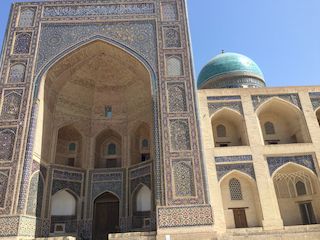
The Mir-i-Arab Madrasa was built in the sixteenth century during the reign of the Uzbek ruler Ubaydullah Khan. For nearly five centuries, it has played an important role in the religious life of Bukhara and remains one of the most recognizable buildings of the Po-i-Kalyan complex.
Its monumental façade is framed by two blue-tiled domes. The geometric and calligraphic decorations covering the portal reflect the skill of Central Asian craftsmen during the period of the Uzbek khanates.
The two turquoise domes are among the most distinctive features of Bukhara’s skyline. Their glazed tile covering reflects a decorative tradition that influenced Central Asian architecture for centuries.
Kalyan Mosque
The Kalyan Mosque is the main place of worship within the Po-i-Kalyan complex, in the heart of Bukhara’s historic centre. Rebuilt in the sixteenth century under the Shaybanid dynasty, it ranks among the largest mosques in Central Asia.
The main portal is decorated with muqarnas, tiered niches resembling stalactites that are among the most distinctive features of Islamic architecture. Their colours and geometric patterns illustrate the craftsmanship of the artisans who contributed to the embellishment of the city.
Around the mosque's vast inner courtyard extend covered galleries and prayer areas designed to accommodate large numbers of worshippers. For centuries, the mosque played a central role in the spiritual life of Bukhara. Today, it remains one of the most important places of worship in the historic city.
Kalyan Minaret
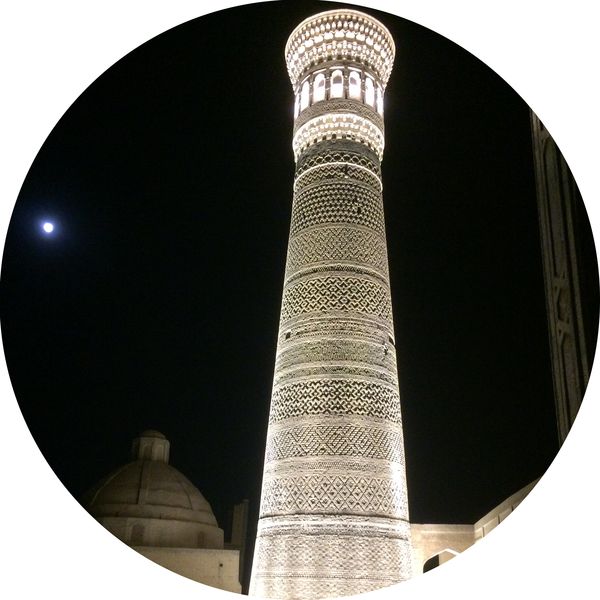
The Kalyan Minaret dominates the historic heart of Bukhara. At its base stands the vast Kalyan Mosque, while the Mir-i-Arab Madrasa faces it across the square. Although these monuments now form a harmonious ensemble, they were not built during the same period.
Visible from afar above the rooftops of Bukhara, the minaret once served as a landmark for travellers and caravans approaching the city. It also marked the religious centre of Bukhara and accompanied the call to prayer.
The minaret was erected in 1127 under the Karakhanid dynasty. It is therefore much older than the monuments that surround it today. The Mir-i-Arab Madrasa dates from the sixteenth century, and the present mosque was rebuilt during the same period under the Shaybanids.
Rising to a height of about forty-five metres, the minaret impresses with the elegance of its proportions. Its decoration is entirely created through carefully arranged brickwork, forming a variety of geometric patterns without relying on the large ceramic surfaces that adorn the neighbouring monuments.
Over the centuries, Bukhara experienced invasions, destruction and reconstruction. Yet the Kalyan Minaret survived these upheavals and remains one of the few major monuments in the city to preserve most of its original structure.
Abdelaziz Khan Madrasa
The Abdulaziz Khan Madrasa was built in the seventeenth century to accommodate students of Islamic theology. Behind this partially restored façade survive colourful mosaics and muqarnas that rank among the finest architectural decorations in Bukhara.
The marks of time remain clearly visible, but they also reveal the age and authenticity of this historic monument.
Nadir Divan-Begi madrasa
Built in the 17th century near the Lyab-i-Hauz pool, the Nadir Divan-Begi Madrasa was originally designed as a caravanserai for merchants. It was later converted into a religious school and is renowned for its portal decorated with mosaics depicting mythical birds and other motifs that are unusual in Islamic art. Today, it remains one of Bukhara’s most remarkable monuments.
Magok-i-Attari Mosque
The Magok-i-Attari Mosque is one of Bukhara’s oldest monuments. Built in the 12th and 13th centuries on a religious site dating from before the 8th century, when the region was still influenced by Zoroastrian traditions, it reflects the city’s long religious history. Its lower level, now lying below the surrounding streets, bears witness to the many urban transformations Bukhara has undergone over the centuries.
Ark Citadel
The Ark Citadel has dominated Bukhara for centuries. Protected by massive earth and brick walls, it served as the political centre of the Emirate and the seat of the emirs’ authority. Behind these fortifications extended a vast complex where the government and the official affairs of the city were conducted.
Juma Mosque
Inside the Ark Citadel, the Juma Mosque served the religious needs of the emirs’ court of Bukhara. Built in the late seventeenth century, it was used for prayers by the rulers and senior officials of the Emirate.
Today incorporated into the citadel’s museum complex, it preserves Quranic manuscripts, an old carved wooden minbar and several objects connected with the Islamic heritage of the region. Its richly decorated ceilings, adorned with geometric patterns and vibrant colours, reflect the craftsmanship of Bukhara’s artisans and the attention devoted to the decoration of court buildings.
Kurinish Khana (Throne Hall)
The Kurinish Khana was one of the most important ceremonial spaces within the Ark Citadel. It was here that the Emir of Bukhara received ambassadors, foreign dignitaries and representatives of neighbouring states during official ceremonies.
Visitors were welcomed into this large courtyard before being admitted to the covered terrace where formal audiences took place. In this solemn setting, the ruler displayed his authority and maintained the diplomatic relations of the Emirate of Bukhara.
Sitori-i Mokhi Khosa Palace
Sitori-i Mokhi Khosa Palace served as the summer residence of the last Emirs of Bukhara. Built in the late nineteenth and early twentieth centuries, it reflects a period when Russian and European architectural influences blended with the traditions of Central Asia.
Its pavilions, gardens and richly decorated halls illustrate the court’s taste for refinement and prestige. Today, the palace remains one of the most remarkable witnesses to the final years of the Emirate of Bukhara.