Français (France)
  Nederlands (nl-NL)
 00:00 • intro | 00:46 • Some mosques in Konya | 02:17 • Whirling Dervishes
Personal creation from visual material collected during my trip Turkey • Cappadocia (2014)
Map of places or practices in Konya on this site
• Use the markers to explore the content •
Konya: Sufi tradition and architectural heritage in central Anatolia
A city shaped by spirituality and history
Located on the central Anatolian plateau, Konya occupies a distinctive place in the cultural and religious history of Turkey. Once the capital of the Seljuk Sultanate of Rum, it developed into a major intellectual and spiritual center whose influence extends far beyond the region. The city is closely associated with the figure of Jalal al-Din Rumi and the Mevlevi order, whose practices have contributed to shaping Konya’s identity over the centuries.
At the same time, Konya preserves a diverse architectural heritage in which mosques, mausoleums, and funerary spaces reflect successive historical layers. The video presents this dual dimension by bringing together built structures and living traditions, offering a coherent view of the city as both a physical and cultural landscape.
Mosques, memorial spaces, and the presence of Sufi practice
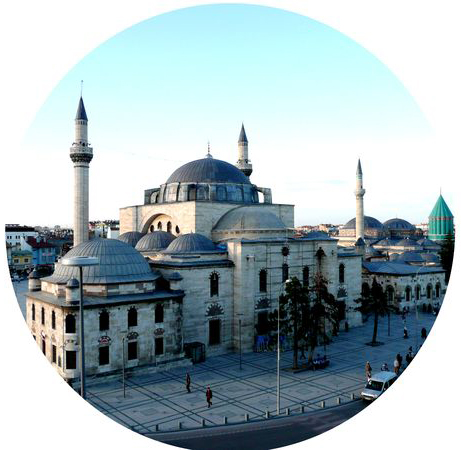
The mosques of Konya provide insight into the evolution of religious architecture across different periods. The Aziziye Mosque, with its later stylistic features, contrasts with more restrained forms found in other buildings, while the Selimiye Mosque reflects the influence of classical Ottoman design. These structures illustrate how architectural forms were adapted and reinterpreted over time, while maintaining a continuity of purpose.
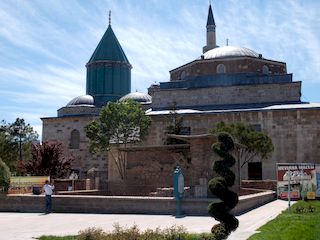
The Mevlana Mausoleum stands at the center of the city’s symbolic geography. As both a shrine and a place of remembrance, it attracts visitors who come to engage with the legacy of Rumi. Its distinctive form, marked by its recognizable dome, emphasizes its importance within the Mevlevi tradition and within the broader cultural context of Konya.
The Ücler Cemetery offers a complementary perspective on local funerary practices and the relationship between memory and space. It reveals how the presence of the past is integrated into the urban fabric, connecting everyday life with commemorative traditions.
The appearance of the whirling dervishes introduces a dynamic dimension that extends beyond architecture. Their practice, based on controlled rotation and accompanied by music, forms part of a structured spiritual discipline. It represents one of the most recognizable expressions of Sufism and links the historical heritage of Konya with a living cultural tradition.
A legacy shaped by Seljuk and Ottoman influences
Konya’s historical importance can be traced back to its role as the capital of the Seljuk Sultanate between the eleventh and thirteenth centuries. During this period, the city became a center of political authority and cultural development, with institutions that combined religious, educational, and social functions. The urban organization that emerged at that time laid the foundations for the city’s later evolution.
With the incorporation of the region into the Ottoman Empire, Konya entered a new phase in which architectural forms and religious practices continued to develop. The coexistence of Seljuk and Ottoman influences is still visible in the city’s built environment, creating a layered architectural landscape.
The Mevlevi order, closely associated with Rumi’s teachings, developed within this historical context. Its emphasis on spiritual experience and inner discipline distinguishes it within the broader spectrum of Islamic practices. This tradition remains a defining element of Konya’s identity and contributes to its enduring cultural significance.
A structured understanding through visual sequences
The videos presented on this site rely largely on carefully selected and animated photographic sequences, offering a gradual and structured approach to complex environments. In the case of Konya, this method allows viewers to understand how architectural spaces and cultural practices are interconnected.
The progression of images moves from built structures to human activity, highlighting the relationship between monuments and traditions. The details of mosques, the forms of mausoleums, and the movements of the dervishes are presented in a way that reinforces their connections rather than isolating them.
This visual approach also clarifies differences in scale and style. It becomes possible to observe the specific characteristics of each building while maintaining an overall understanding of the urban context. The transitions between sequences contribute to a coherent reading of the city and its organization.
A key to understanding Anatolian cultural continuity
Konya offers a valuable perspective on the continuity of cultural and religious traditions in Anatolia. Its historical role as a political and spiritual center, combined with the persistence of living practices, makes it an essential point of reference for understanding the region.
Exploring the city through its monuments and traditions reveals how architecture and culture interact over time. For a more detailed examination of these elements, the dedicated pages linked to the monuments and practices featured in the video provide additional context and analysis.
Links to related pages



Audio Commentary Transcript
Konya, in southern Anatolia in Turkey, is a very important city. Not only is it the seventh in Turkey by the number of its inhabitants, but it is also the cradle of the Muslim mystical brotherhood of the Whirling Dervishes. Founded in the 13th century, the Mevlevi movement (name given to the disciples of Mevlana) has perpetuated its tradition until today, however with a period of interruption, corresponding to the secularization of the country at the fall of the Ottoman Empire.