Français (France)
  Nederlands (nl-NL)
 00:00 • intro | 00:08 • General Overview of the Sun Temple of Konark | 00:45 • The horses | 01:15 • The lions | 02:11 • The elephants | 02:32 • State of Preservation | 03:16 • Teh wheels of the chariot | 04:59 • The facades
Personal creation from visual material collected during my trip India • Amazing East India: Assam, Odisha, West Bengal (2023)
Map of places or practices in Konark on this site
• Use the markers to explore the content •
Konârak, the Sun Temple: a medieval masterpiece of Odisha
A monumental sanctuary shaped by solar symbolism
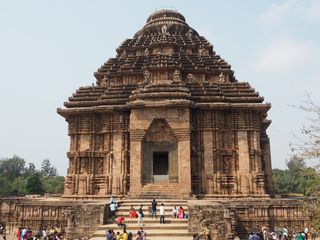
Located on the eastern coast of India in the state of Odisha, the Sun Temple of Konârak stands among the most remarkable architectural achievements of the Indian subcontinent. Built in the 13th century near the Bay of Bengal, it reflects a period of exceptional artistic and technical development, when religious architecture reached a high level of complexity and refinement.
The temple is conceived as a colossal stone chariot dedicated to Surya, the sun god. This symbolic vision structures the entire monument, from its overall composition to its smallest sculptural details. The video offers a coherent reading of this concept by linking the various elements of the temple and highlighting their relationships within a unified architectural program.
Sculpted forms: animals, wheels and narrative façades
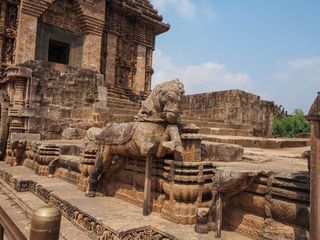
The exploration of the temple reveals the richness of its sculptural decoration, where each element contributes to a broader visual narrative. The horses, carved in dynamic postures, evoke the energy and forward motion of the solar chariot. Their anatomical precision and sense of movement demonstrate a high level of craftsmanship and a deep understanding of form.
The lions, often shown dominating other figures, express themes of power and hierarchy. They are part of a symbolic vocabulary in which strength and authority are conveyed through carefully structured compositions. The elephants introduce a more grounded dimension, associated with royal processions and the material world, balancing the more abstract solar imagery.
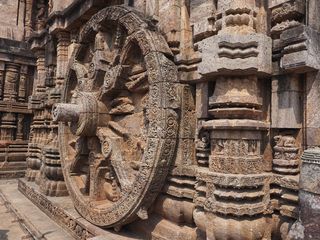
The monumental wheels are among the most distinctive features of the temple. Finely carved with spokes, hubs and intricate motifs, they are both decorative and symbolic. Frequently interpreted as representations of time and cosmic cycles, these wheels reinforce the solar dimension of the monument while showcasing remarkable technical precision.
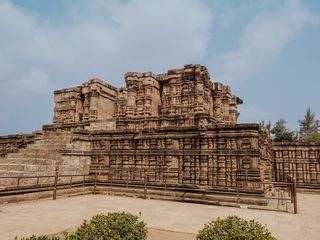
The façades, densely covered with sculptural reliefs, form a continuous visual surface where mythological scenes, human figures and ornamental patterns are interwoven. This richness transforms the temple into a complex narrative space, where religious symbolism, social representation and artistic expression coexist.
Historical context and architectural evolution
The Sun Temple of Konârak was commissioned by King Narasimhadeva I of the Eastern Ganga dynasty. During this period, Odisha was a powerful regional kingdom capable of undertaking large-scale architectural projects. The temple reflects both royal ambition and religious devotion, serving as a statement of political authority as well as a sacred space dedicated to Surya.
The architectural layout follows a structured axial plan, combining massive volumes with highly articulated surfaces. The main sanctuary, now largely in ruins, once formed the central focus of the complex, surrounded by subsidiary structures that supported ritual activities. The integration of sculpture and architecture is particularly notable, as decorative elements are not merely applied but fully integrated into the structural design.
Over time, the temple has undergone significant deterioration. Natural factors such as climate, proximity to the sea and material erosion have contributed to the loss of certain sections. Human interventions and historical changes have also played a role in its current condition. Despite these transformations, the surviving structures continue to provide an exceptional insight into medieval architecture in eastern India.
A visual approach that reveals structure and detail
The videos on this site rely largely on carefully selected photographs, animated through smooth transitions and controlled framing. This method allows for a precise and gradual observation of architectural features that might otherwise remain difficult to grasp.
At Konârak, this approach proves particularly effective. The interplay between large-scale volumes and intricate details becomes clearer, as the viewer is guided from the overall composition of the temple to its finely carved elements. The wheels, animal figures and façade decorations can be examined closely, revealing their complexity without losing sight of their place within the broader structure.
This visual progression also helps clarify spatial relationships. It becomes easier to understand how the different components of the temple interact, and how the concept of the solar chariot is expressed across multiple levels of design.
A major testimony to Indian medieval architecture
The Sun Temple of Konârak remains a striking example of the ability of medieval Indian societies to create monuments that combine symbolic depth with architectural mastery. Through a detailed and structured visual exploration, the video provides an accessible introduction to this complex site. For those wishing to go further, the dedicated pages on the monument offer additional insights into its history, architectural features and cultural significance.
Links to related pages



Audio Commentary Transcript
On the shores of the Bay of Bengal stands the Sun Temple of Konark, a 13th-century masterpiece built under Narasimhadeva I of the Eastern Ganga dynasty. Designed as a colossal stone chariot set on twenty-four wheels and drawn by seven horses symbolising the seven days of the week and the Sun’s journey across the sky, it follows the monumental principles of the Kalinga architectural style, known for its soaring towers and intricate stone carvings. The sanctuary reflects devotion to Surya, royal authority, and the artistic mastery that defined medieval Odisha at its height.
In Hindu mythology, Surya, the Sun god, travels across the sky in a chariot. The seven sculpted horses here pull the temple’s great stone chariot, marking the seven days of the week and the Sun’s passage through time.
From the seven horses pulling the solar chariot, symbolising time and the luminous cycle, to the stone lions dominating elephants and men, the sculpture unfolds a hierarchical bestiary: the lions embody protective power and divine authority, the elephants represent mastered material strength, and the subdued men recall the submission of the earthly world to sacred power. Placed at the foot of the stairways, these guardians mark the transition from the profane realm to the sanctuary. Their choice is significant: in the Middle Ages the Asiatic lion still roamed large parts of India and had long symbolised royalty and divine protection. Though many of these sculptures have been moved or restored over the centuries, their current placement preserves the original intent — to announce, as one approaches the steps, the supremacy of divine forces.
Curiously, these lions meant to embody divine power display almost human faces. In medieval Odishan sculpture, realism mattered less than meaning: such hybrid creatures were designed to signal protective strength rather than depict the true animal.
Beyond the lions triumphing over elephants and men, large standalone elephant statues evoke material strength and royal majesty. One of them lifts a figure in its trunk, a striking image of controlled power and earthly domination that leads toward the solar sanctuary.
Today the Sun Temple of Konârak stands as a majestic ruin. Its great tower collapsed centuries ago due to storms and unstable ground, leaving the structure weakened and partly buried. Nineteenth-century consolidation helped preserve what remained. The inner sanctum, fragile and roofless, was filled in for stability and is now closed to visitors. The monument’s artistic splendour is therefore found mainly on the outside: the great chariot wheels, symbolic reliefs, erotic scenes and other sculpted figures.
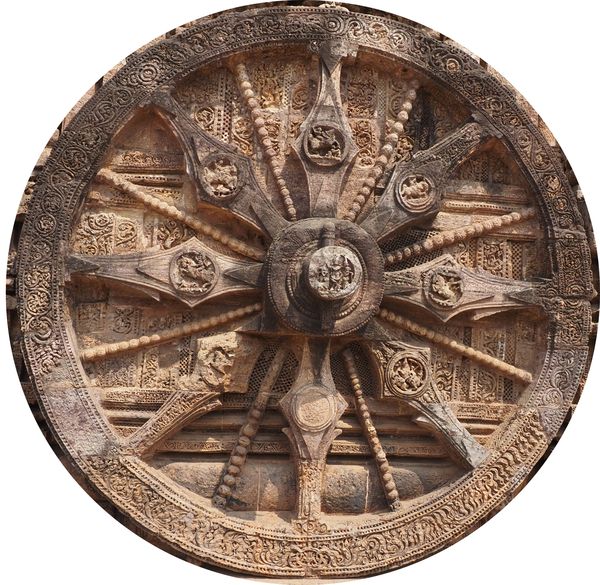
The Sun Temple chariot of Konark originally had twenty-four monumental wheels, most of which are still visible today despite losses and later repairs. All follow the same layout — central hub, carved spokes, decorated rim — but their themes vary: deities, dance, music, erotic scenes and symbolic animals (elephants, lions, horses).
On this wheel, the hub depicts an elephant carrying figures, while the spokes combine dancers, musicians and erotic couples, reflecting the diversity and vitality of Kalinga art.
All around the temple’s base unfolds a profusion of sculptures: nymphs, naginis entwined with serpents, musicians, mythological animals such as yali, makara, and gaja-simha, scenes of motherhood and dance, and numerous openly erotic figures. Far from mere ornament, these images celebrate fertility, the union of masculine and feminine forces, and the solar vitality that animates the whole sanctuary.
Music:
- - YouTube video library - Journey Home - Chris Haugen
- - YouTube video library - Malkauns - Aditya Verma
- - YouTube video library - Raag Yaman - Aalap (Voice, Sarangi) - Sandeep Das,
Disclaimer: Despite its appropriateness, copyright issues prevent the use of indian traditional music in "Konark • Sun Temple, medieval heritage on India’s east coast", hence the use of royalty-free music. Despite our careful selection, some might regret this decision, which is necessary to avoid potential lawsuits. Although difficult, this decision is the only viable solution.