Français (France)
  Nederlands (nl-NL)
 00:00 • intro | 00:56 • the founding myth of the Kumbh Mela | 02:33 • the sadhus | 06:44 • parade of sadus | 07:52 • other sadhus
Personal creation from visual material collected during my trip India - Kumbh Mela • Madhya Pradesh • Maharashtra • Goa (2018)
Map of places or practices in Ujjain on this site
• Use the markers to explore the content •
To watch this video on Kumbh Mela featuring the Naga Sadhus, please log in to YouTube with your account. YouTube has set an age restriction for this video, making it available only on their platform. Thank you for your understanding.
Kumbh Mela in Ujjain: Sadhus and Ritual Processions in Central India
Ujjain and a Major Hindu Pilgrimage Gathering
The city of Ujjain, in the Indian state of Madhya Pradesh, has long occupied an important place within the religious geography of Hinduism. Associated with the worship of Shiva and known historically as a center of astronomy, pilgrimage, and sacred learning, the city is one of the four locations linked to the Kumbh Mela, one of the largest religious gatherings in the world. During the festival, the banks of the Shipra River become the focal point of ritual bathing ceremonies, monastic processions, and large-scale religious assemblies bringing together pilgrims and ascetics from many parts of India.
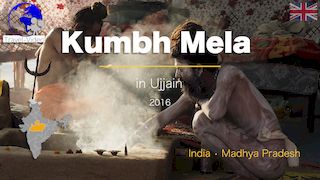
This video focuses primarily on the presence of sadhus during the Kumbh Mela in Ujjain. Through scenes of religious processions, ceremonial gatherings, and temporary camps, it presents some of the most visible aspects of the festival’s ritual life. The images also reveal how religious communities temporarily reshape the urban landscape during the pilgrimage period.
The Mythological Origins of the Kumbh Mela
The Kumbh Mela is rooted in one of the major myths of Hindu tradition: the Samudra Manthan, or “churning of the ocean of milk.” According to this narrative, gods and demons struggled for possession of a vessel containing the nectar of immortality. During the conflict, drops of the sacred liquid were believed to have fallen at several places across India, including Ujjain. This mythological association explains the sacred status of the city and the ritual importance of the bathing ceremonies performed during the festival.
The video introduces this founding narrative in order to place the visible ceremonies within a broader religious framework. The gatherings shown in Ujjain are not limited to a large public event; they are part of a ritual tradition connected to purification, pilgrimage, and astrological cycles that have shaped Hindu religious life for centuries.
The Shipra River appears throughout the video as the central ceremonial space of the festival. Ghats along the riverbanks become major gathering points where pilgrims, priests, and ascetics converge during the most important ritual periods.
Sadhus and Ascetic Traditions
One of the central themes of the video is the presence of sadhus, Hindu ascetics belonging to different monastic traditions and religious orders. These figures occupy a highly visible place during the Kumbh Mela and are closely associated with public ceremonies and processions.
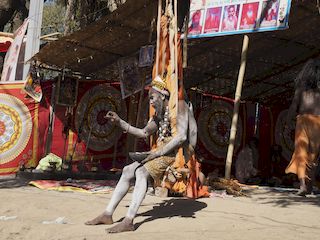
The images show groups of sadhus moving through the streets and ceremonial spaces of Ujjain. Their appearance often reflects their religious affiliation through clothing, ritual markings, hairstyles, and symbolic objects. Ash-covered bodies, long matted hair, rudraksha bead necklaces, staffs, and religious banners are among the elements visible during the processions.
The video also highlights the organization of the akhara, the monastic institutions that structure many ascetic communities within Hinduism. These religious orders follow ceremonial hierarchies that determine the order of participation during processions and ritual bathing events. Public parades involving large groups of sadhus form one of the most recognizable dimensions of the Kumbh Mela.
Different categories of ascetics appear throughout the video, illustrating the diversity of Hindu monastic traditions. Some groups are associated primarily with Shaivite practices linked to Shiva, while others belong to different devotional or philosophical lineages. The visual differences between these communities become easier to identify through the progression of the images and sequences.
Ritual Space and Temporary Urban Transformation
Beyond the religious figures themselves, the video documents the temporary transformation of Ujjain during the Kumbh Mela. Large sectors of the city are reorganized to accommodate pilgrims, religious camps, ceremonial routes, and public infrastructure linked to the gathering.
Temporary settlements appear along major access roads and near the Shipra River. Religious camps, gathering areas, security installations, and circulation corridors create a provisional urban environment that functions alongside the permanent city. The concentration of pilgrims and ascetics gives a different rhythm to public spaces during the festival period.
The video also captures the atmosphere created by the movement of crowds and religious processions. Ceremonial chants, percussion instruments, loudspeaker announcements, and devotional songs accompany many of the scenes observed during the gathering. These elements contribute to the organization of the event as much as to its visual identity.
The relationship between ritual activity and public space becomes particularly visible during processions. Streets and riverbanks are temporarily converted into ceremonial routes structured by religious hierarchies, crowd management systems, and collective movement.
What the Videos on This Site Make Easier to Observe
The visual construction of this video makes many details easier to study than in fast-moving documentary footage alone. The use of carefully selected and animated photographs allows viewers to focus on expressions, ritual gestures, religious symbols, and the organization of the processions.
Gradual transitions between wider scenes and closer views help clarify the spatial structure of the Kumbh Mela. The arrangement of crowds along the ghats, the positioning of religious groups, and the temporary transformation of urban spaces become more understandable through the rhythm of the editing.
This format also improves the visibility of visual distinctions between different ascetic traditions. Clothing, ritual markings, ceremonial objects, and collective formations can be observed with greater precision, helping viewers understand the diversity of religious communities present during the festival.
The photographic approach used on this site also emphasizes the relationship between people and environment. The interaction between the Shipra River, the ceremonial spaces, and the temporary settlements appears progressively throughout the video, creating a clearer reading of the event as both a religious and urban phenomenon.
A Visual Exploration of the Kumbh Mela in Ujjain
Through its focus on sadhus, ritual processions, and collective ceremonies, this video offers an accessible visual introduction to one of the major pilgrimage gatherings of Hindu India. It documents not only religious practices, but also the organization of space, the role of monastic institutions, and the transformation of Ujjain during the festival period. The detailed pages connected to this subject provide additional information about the traditions, history, and religious significance of the Kumbh Mela.
Links to related pages
• Main dynasties that ruled the region •



Audio Commentary Transcript
Naga sadhus, (or naked sadhus), are known to carry weapons, such as tridents, swords, canes and spears. They would once have formed an armed order to protect Hindus from Mughal rulers. Generally nonviolent, at present some sections are known to practice wrestling and martial arts.
Naga sadhus seek to detach themselves completely from material things and pleasures other than spiritual. This is the reason why many of them mutilate their sex by attaching heavy weights among other things.
They are detached from the things of the earth and live naked and the ash which covers the holiest of them comes from cremations.

Music:
- - YouTube video library - At Odds
- - YouTube video library - Big Screen
- - YouTube video library - Epic Battle Speech
- - YouTube video library - Murder Mystery
- - YouTube video library - The Arid Land
Disclaimer: Despite its appropriateness, copyright issues prevent the use of indian traditional music in "Kumbh Mela, the naga Sadhus, Ujjain 2016 • Madhya Pradesh, India ", hence the use of royalty-free music. Despite our careful selection, some might regret this decision, which is necessary to avoid potential lawsuits. Although difficult, this decision is the only viable solution.