

 Français (France)
  Nederlands (nl-NL)
 Of Hindu tradition, (with additional Islamic influence), the Scindia dynasty ruled for approximately 216 years, ± between 1731 and 1947 over all or part of Central India and North India, during the Colonial Period.
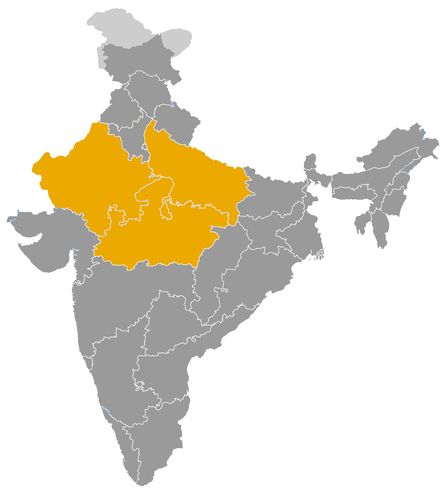
This map illustrates the maximum territory that the Scindia Dynasty had reached at its height, covering the current regions of Madhya Pradesh, Rajasthan and Uttar Pradesh in India. Its main purpose is to provide a visual aid to understand the geographical extent of this dynasty. However, it's important to note that the contemporary borders of these regions may not necessarily coincide with the historical territories.
The Scindia Dynasty in Indian History: Maratha Power, Princely Rule and Regional Transformation
A Maratha house at the centre of political transition
The Scindia dynasty, also known as the Shinde house, played an important role in the political history of India from the eighteenth century to the mid twentieth century. Emerging within the Maratha sphere of power, the Scindias became one of the leading houses of the Maratha Confederacy and later ruled as princes under British paramountcy. Their history reflects several major transformations in India: the decline of Mughal authority, the expansion of Maratha influence, the rise of the British East India Company and the reorganization of princely states before independence.
The Scindias were not emperors in the sense of ruling a unified Indian empire. Their importance lay instead in their role as military commanders, regional power holders, kingmakers and later princely rulers. Their political centre became associated with Gwalior, but their influence extended over wider areas of central and northern India, especially during the height of Maratha expansion.
The rise of Scindia power within the Maratha Confederacy
The foundations of Scindia authority were laid by Ranoji Rao Scindia in the first half of the eighteenth century. Originally linked to the service of the Peshwas, the Scindias gained military and administrative responsibilities in northern and central India. Their rise was closely connected to the structure of the Maratha Confederacy, which was not a single centralized empire but a network of powerful houses, including the Scindias, Holkars, Bhonsles and Gaekwads.
This system allowed ambitious military families to build territorial bases while still operating within a broader Maratha political framework. The Scindias established themselves in Malwa and later around Gwalior, a strategically placed region between Rajasthan, Bundelkhand, the Gangetic plain and the Deccan. Their power depended on armed force, taxation, diplomacy and the control of important routes.
Mahadji Scindia and the struggle for northern India
Mahadji Scindia was the most influential ruler of the dynasty and one of the major political figures of late eighteenth century India. After the Maratha defeat at the Third Battle of Panipat in 1761, Maratha influence in northern India appeared severely weakened. Mahadji gradually restored Scindia power and became a decisive actor in Delhi politics.
His influence over the Mughal emperor Shah Alam II gave the Scindias a position of exceptional prestige. The Mughal emperor still held symbolic authority, although real power had shifted to regional military leaders. Mahadji used this situation effectively. By protecting the emperor and intervening in imperial affairs, he strengthened his own legitimacy while maintaining the ceremonial framework of Mughal sovereignty.
Mahadji also modernized parts of his army with the help of European officers. This gave the Scindias a strong military position in northern India and allowed them to compete with other regional powers. Their influence, however, also brought them into rivalry with the British, with other Maratha houses and with local states.
Relations with the British and the transformation of sovereignty
The rise of the British East India Company profoundly changed the position of the Scindias. Under Daulat Rao Scindia, the dynasty became involved in the Anglo Maratha conflicts that reshaped the political map of India. British victories reduced Scindia power and limited their ability to act independently beyond their own territory.
After the Maratha defeats, the Scindias retained dynastic authority but increasingly functioned within the system of princely states under British paramountcy. This meant that they kept internal authority over their state, but lost full control over foreign relations, defence and major strategic decisions. Their sovereignty became conditional and supervised.
This transformation was typical of many Indian princely houses in the nineteenth century. The Scindias preserved courtly rank, ceremonial prestige, administrative structures and local revenues, but their political independence was restricted by the colonial order. Their history therefore illustrates the shift from military regional power to princely statehood under imperial supervision.
Economic administration and princely modernization
The economic role of the Scindias was linked to their control over important areas of central India. Revenue collection, agricultural taxation, trade routes and administrative organization formed the basis of their power. In the earlier Maratha period, military finance and territorial revenue were closely connected. Later, under British paramountcy, the princely state required more regular administrative institutions.
During the nineteenth and early twentieth centuries, rulers such as Madho Rao Scindia are associated with efforts to modernize administration, public institutions and infrastructure. These reforms aimed to stabilize state finances, improve governance and adapt princely rule to the political expectations of the British Raj. Such modernization did not create democratic rule, but it strengthened the administrative capacity of the state.
The economy of the Scindia domains remained rooted in land revenue and regional trade, but it also developed within the wider colonial economy. The princely state had to balance dynastic interests, local administration, British supervision and the need to maintain legitimacy among its subjects.
Cultural patronage and dynastic identity
The Scindias contributed to the cultural landscape of central India through court patronage, architecture, religious endowments and educational initiatives. Like many princely dynasties, they used cultural patronage to express legitimacy and prestige. Palaces, temples, public buildings and institutions associated with Gwalior reflect this political use of culture.
Their court culture combined Maratha identity, regional traditions, Mughal ceremonial inheritance and colonial influences. This mixture reflected the complex world in which the Scindias operated. They were Maratha warriors, regional rulers, princely sovereigns and political intermediaries between Indian society and colonial power.
A dynasty linking Maratha expansion and modern India
The effective sovereignty of the Scindias ended when Gwalior acceded to the Indian Union and was integrated into the new political order after independence. Yet the family continued to have a public role in modern India, especially through political participation after the end of princely rule.
The historical importance of the Scindia dynasty lies in its continuity across several political worlds. It rose during Maratha expansion, operated within the decline of Mughal authority, adapted to British paramountcy and entered the framework of independent India. Its role in politics, economy and culture makes it one of the most significant princely and Maratha houses in the history of central and northern India.
The Geographic Expansion of the Scindia Dynasty in India and Its Impact on Regional Power Relations
A Maratha power rooted in central India
The Scindia dynasty, also known as the Shinde house, emerged as one of the principal Maratha ruling families during the eighteenth century. Its geographic expansion was closely linked to the wider advance of Maratha power beyond the Deccan into central and northern India. Unlike dynasties that began with a compact hereditary kingdom, the Scindias first built their influence through military service, revenue rights and political authority granted within the Maratha Confederacy. Their territorial base gradually developed in Malwa and central India before becoming associated above all with Gwalior.
The geography of Scindia power was therefore not fixed from the beginning. It evolved through campaigns, alliances, treaties and defeats. At their height, the Scindias influenced a wide arc stretching from Malwa and Gwalior toward Delhi and parts of northern India. Later, after the Anglo Maratha wars, their authority was reduced and reorganized within the princely state of Gwalior under British paramountcy.
Malwa as the first major territorial foundation
Malwa was one of the earliest and most important regions in the rise of the Scindias. Located between Rajasthan, Gujarat, the Deccan and the Gangetic plain, Malwa had considerable strategic and economic value. It controlled routes linking northern India with the plateau regions and provided access to agricultural revenues, military supply lines and commercial networks.
Ranoji Rao Scindia, regarded as the founder of the family’s power, established the Scindia position in this region during the expansion of Maratha influence. The Scindias were initially linked to the authority of the Peshwas, but over time they acquired their own territorial and military base. Their presence in Malwa brought them into contact and competition with other Maratha houses, especially the Holkars, whose centre of power was also in central India.
This proximity created both cooperation and rivalry. The Scindias and Holkars were part of the same broad Maratha political world, but their territorial ambitions often overlapped. Malwa became a zone where Maratha authority was not exercised by a single unified state, but by powerful families whose interests could diverge sharply.
Gwalior as a durable centre of dynastic authority
Gwalior became the most enduring centre of Scindia power. Its location in central India, near routes linking Rajasthan, Bundelkhand, Malwa and the Yamuna region, made it a valuable political and military base. The fort of Gwalior had long been recognized as one of the great strongholds of northern and central India, and its possession gave the Scindias both strategic depth and dynastic prestige.
The development of Gwalior as a Scindia centre was especially significant after the decline of wider Maratha ambitions in northern India. As British power expanded, the Scindias lost some of their earlier freedom of action, but they retained Gwalior as the core of their princely state. The territory of this state was not always geographically compact. Like many princely states, it included areas shaped by treaty arrangements, political concessions and earlier military history.
Influence toward Delhi and the politics of northern India
Under Mahadji Scindia, the dynasty reached the height of its influence in northern India. After the Maratha defeat at the Third Battle of Panipat in 1761, Maratha authority in the north was severely weakened. Mahadji gradually restored Scindia power and became a dominant figure in the politics of Delhi.
The Scindia presence in Delhi did not mean full annexation of the Mughal capital, but it placed the dynasty at the centre of imperial politics. Mahadji Scindia acted as a protector and power broker around the Mughal emperor Shah Alam II. This gave the Scindias access to the symbolic authority of the Mughal court while allowing them to exercise real political influence.
This northern expansion affected relations with several neighbouring powers. The Scindias had to deal with Rajput states, the Jats of Bharatpur, Rohilla chiefs, Afghan interests, Mughal nobles and British representatives. Their authority depended on a combination of military strength, diplomacy and control of strategic corridors rather than simple territorial occupation.
Rivalries with Maratha and Rajput powers
The expansion of the Scindias brought them into repeated interaction with other regional dynasties. Their rivalry with the Holkars was particularly important because both houses sought influence in Malwa and central India. These tensions weakened the unity of the Maratha Confederacy and sometimes prevented coordinated resistance against external enemies.
Relations with Rajput states were also shaped by geography. As Scindia influence extended into regions bordering Rajasthan and northern India, diplomacy, tribute arrangements, pressure and conflict all played a role. The Scindias were not isolated rulers of a local kingdom. They operated in a dense political landscape where every territorial advance affected neighbouring courts.
British expansion and the reduction of Scindia territory
The rise of the British East India Company transformed the geography of Scindia authority. During the Anglo Maratha wars, the Scindias lost important territories and were forced to accept treaties that limited their independence. Their influence beyond their own state was sharply reduced, and their political position became subject to British supervision.
After 1818, the Scindias remained rulers of a major princely state, but their sovereignty was no longer complete. Foreign relations, military policy and major strategic decisions were controlled or constrained by the British. Relations with neighbouring dynasties were increasingly mediated through the colonial system rather than conducted as fully independent diplomacy.
A territorial legacy in central Indian history
The geographic history of the Scindias illustrates the transformation of India from the post Mughal and Maratha age to the colonial princely order. Their early power was mobile, military and expansive. Their later authority was territorial, princely and restricted by British paramountcy.
By establishing a durable centre in Gwalior and shaping the politics of Malwa, Delhi and central India, the Scindias became one of the most influential Maratha houses outside the Deccan. Their territorial expansion affected relations with Maratha rivals, Rajput states, Mughal authorities and the British. Their legacy lies in the role they played as a bridge between Maratha military expansion, princely state formation and the political geography of modern central India.
The Scindias, also known as Shindes, were a Maratha house whose sovereign authority was exercised mainly in the state of Gwalior. Their power first developed within the Maratha Confederacy and later within a princely state under British paramountcy after 1818. After Gwalior’s integration into the Indian Union in 1948, dynastic titles retained by the family no longer represented effective sovereignty.
- Ranoji Rao Scindia (1731–1745) • Founder of Scindia power, he established his house’s authority in northern India during the expansion of Maratha influence.
- Jayappa Rao Scindia (1745–1755) • He continued the family’s expansion and strengthened Scindia influence in northern Maratha politics.
- Jankoji Rao Scindia I (1755–1761) • His reign was marked by conflict with Afghan forces and by the crisis of the Third Battle of Panipat.
- Mahadji Scindia (1761–1794) • He restored Scindia power after Panipat and made the Scindia house a major force in north Indian politics.
- Daulat Rao Scindia (1794–1827) • His reign was dominated by wars against the British East India Company and by the loss of part of his political independence.
- Jankoji Rao Scindia II (1827–1843) • He ruled a princely state under strong British influence and faced internal tensions at court.
- Jayaji Rao Scindia (1843–1886) • He ruled during the uprising of 1857 and kept his state aligned with the British despite serious military unrest.
- Madho Rao Scindia (1886–1925) • He modernized the administration and strengthened the institutions of the princely state during the British Raj.
- Jivajirao Scindia (1925–1948, effective reign) • The last ruling maharaja of the dynasty, he acceded to the Indian Union and the princely state was integrated into Madhya Bharat.