

 Français (France)
  Nederlands (nl-NL)
 Of Hindu then Islamic tradition, the Holkar dynasty ruled for approximately 227 years, ± between 1720 and 1947 over all or part of Central India and West India, during the Medieval Period and the Colonial Period.
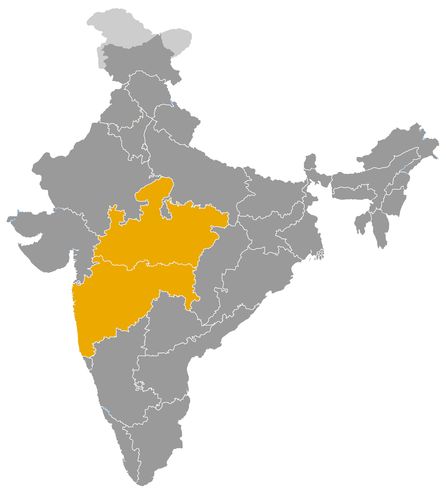
This map illustrates the maximum territory that the Holkar Dynasty had reached at its height, covering the current regions of Madhya Pradesh and Maharashtra in India. Its main purpose is to provide a visual aid to understand the geographical extent of this dynasty. However, it's important to note that the contemporary borders of these regions may not necessarily coincide with the historical territories.
The Holkar Dynasty and Its Role in the History of Central India
A Maratha house formed through military service
The Holkar dynasty occupies an important place in the history of early modern and modern India, especially in the development of Maratha power in central India. The Holkars did not begin as an ancient territorial royal house. They emerged in the eighteenth century as Maratha military commanders serving the peshwas, at a time when Mughal authority was weakening and Maratha influence was expanding across western, central and northern India.
The founder of Holkar power was Malhar Rao Holkar, who rose through military service and received rights and territories in Malwa. From this base, the Holkars gradually transformed themselves from commanders and revenue holders into regional rulers. Their political centre became associated with Indore, while Maheshwar acquired special importance under Ahilyabai Holkar. The dynasty’s history illustrates how Maratha military families converted mobility, fiscal rights and military success into durable territorial authority.
The Holkars within the Maratha Confederacy
The Holkars were one of the major houses of the Maratha Confederacy, alongside the Scindias of Gwalior, the Bhonsles of Nagpur, the Gaekwads of Baroda and the peshwas of Pune. Their role was closely linked to Malwa, a strategically located region between the Deccan, Rajasthan, Gujarat and the Gangetic plain.
Control of Malwa gave the Holkars access to agricultural revenue, trade routes and military corridors. It also placed them at the centre of Maratha operations beyond the Deccan. In the eighteenth century, the Holkars participated in campaigns, revenue collection and political negotiations across central and northern India. Their power depended on cavalry strength, local alliances, administrative control and the ability to operate within the loose structure of the Maratha Confederacy.
Their relationship with the peshwas was both dependent and increasingly autonomous. In theory, the Holkars acted within the wider Maratha political order. In practice, like other leading Maratha houses, they became increasingly independent as the confederacy became more decentralised.
Ahilyabai Holkar and the model of stable regional rule
Ahilyabai Holkar is the most celebrated ruler of the dynasty and one of the most respected figures in Indian political memory. After the death of her husband Khanderao Holkar and the brief reign of her son Male Rao, she governed the Holkar state from 1767 to 1795. Her capital was Maheshwar, on the Narmada River.
Her rule is often remembered for administrative discipline, justice, public works and religious patronage. She maintained political stability in a period of wider conflict and fragmentation. Unlike many rulers of the eighteenth century, her reputation rests less on expansionist warfare than on governance, reconstruction and the protection of trade and pilgrimage routes.
Ahilyabai also patronised religious and civic works far beyond her own territory. Temples, ghats, wells, rest houses and shrines connected with her name are found in several major sacred centres of India, including Varanasi, Somnath, Gaya, Ujjain, Nashik and Dwarka. This patronage gave the Holkars a cultural presence that extended well beyond Indore and Malwa.
Cultural influence through Maheshwar, Indore and sacred architecture
The cultural impact of the Holkars is particularly visible in Maheshwar and Indore. Maheshwar, under Ahilyabai, became a courtly, religious and administrative centre. Its riverfront ghats, temples and palatial structures reflect a form of Maratha patronage adapted to the landscape of the Narmada.
The Holkars were also associated with the development of textile traditions, especially the Maheshwari sari. While these crafts had broader regional roots, court patronage helped strengthen their visibility and economic importance. The dynasty thus supported both monumental culture and artisanal production.
Indore developed more fully as the political and administrative capital of the Holkar state. Under princely rule, it became a major urban centre of central India. Its growth reflected the transformation of the Holkars from mobile Maratha chiefs into territorial rulers with a defined capital, administrative institutions and courtly traditions.
Economic power based on Malwa and regional routes
The economic foundation of Holkar power lay in Malwa. This region was agriculturally productive and well placed along routes connecting northern India, western India and the Deccan. Agricultural revenue, market duties, transit rights and military contributions supported the army and court.
The Holkars benefited from the wider Maratha system of revenue collection, but their economic base became increasingly territorial as their control over Indore and surrounding districts strengthened. Trade routes passing through Malwa helped connect the state to Gujarat, Rajasthan, Bundelkhand and the Deccan. This position gave the Holkars both opportunity and vulnerability, since the same routes also brought military competition and political pressure.
Frequent wars, succession disputes and rivalry with other Maratha houses periodically weakened the economy. Nevertheless, the Holkar state retained sufficient resources to remain one of the principal powers of central India.
Rivalry with the British and transformation into a princely state
In the early nineteenth century, Yashwant Rao Holkar I played a major role in resisting British expansion. He confronted both rival Maratha powers and the East India Company during a period when the Maratha Confederacy was losing coherence. His military activity showed that the Holkars remained a significant force after the age of Ahilyabai.
The Anglo-Maratha wars changed the political position of the dynasty. After the defeat and weakening of Maratha power, Indore became a princely state under British paramountcy. The Holkars retained internal authority but lost independent control over foreign policy and major military decisions.
During the nineteenth and early twentieth centuries, the rulers of Indore operated within the framework of the British Raj. Some introduced administrative, educational and urban reforms, but always under the limits imposed by colonial supervision.
A lasting legacy in central Indian history
The Holkar dynasty links several major phases of Indian history: the expansion of Maratha power, the fragmentation of Mughal authority, the rise of regional states, the British colonial order and the integration of princely India after independence.
Its role was political, through the control of Malwa and participation in Maratha affairs; cultural, through patronage at Maheshwar, Indore and sacred sites across India; and economic, through the management of agricultural revenue, trade routes and urban centres. Although the Holkars never ruled a pan-Indian empire, they shaped the history of central India and left a durable legacy in its cities, religious landscapes and regional identity.
The Geographical Expansion of the Holkar Dynasty in Central India
A Maratha power established in Malwa
The Holkar dynasty developed as one of the major Maratha houses of central India. Its geographical expansion was closely connected with Malwa, a strategically placed region between the Deccan, Rajasthan, Gujarat and the northern plains. Unlike older dynasties that emerged from long established territorial kingdoms, the Holkars first rose through military service within the Maratha political order. Their territorial power grew from assignments, revenue rights and military authority granted during the expansion of Maratha influence beyond the Deccan.
The founder of Holkar power was Malhar Rao Holkar, a commander in the service of the peshwas. Through his military achievements, he obtained rights and territories in Malwa. These lands became the foundation of a durable Holkar state. Indore later became the main political and administrative centre, while Maheshwar gained special importance during the rule of Ahilyabai Holkar. The dynasty’s expansion was therefore both military and administrative: it involved campaigns, revenue collection, local alliances and the gradual transformation of fiscal rights into territorial sovereignty.
Malwa as the territorial core of Holkar authority
The strongest and most durable base of Holkar power lay in western and central Malwa, corresponding broadly to parts of present-day Madhya Pradesh. This region offered several advantages. It contained productive agricultural lands, commercial towns, transit routes and access to important corridors linking northern and southern India.
Indore became increasingly important because of its position on regional trade and military routes. It served as a practical centre for administration, revenue collection and political control. Maheshwar, located on the Narmada River, played a different but complementary role. Under Ahilyabai Holkar, it became a centre of government, religious patronage and courtly culture.
The Holkar domains were not always a compact or uniform territory. Like many eighteenth-century Maratha states, their power included districts, forts, rights to collect revenue and areas of influence that could be geographically scattered. Effective control varied according to military strength, political alliances, rival claims and changing relations within the Maratha Confederacy.
Relations with the peshwas and other Maratha houses
The geographical expansion of the Holkars cannot be separated from their place within the Maratha Confederacy. In their early phase, they owed much of their authority to the peshwas of Pune. Their rights in Malwa were part of the wider Maratha expansion into former Mughal territories. The Holkars collected revenue, maintained forces and helped project Maratha influence north of the Deccan.
However, the decentralised nature of the Maratha Confederacy allowed leading families to become increasingly autonomous. The Holkars, Scindias, Bhonsles and Gaekwads all developed their own territorial bases. In central India, the Scindias of Gwalior became the most important neighbours and rivals of the Holkars. Both houses had Maratha origins, operated in overlapping zones and competed for influence in Malwa and adjacent regions.
Relations with the peshwas also became more complex over time. The Holkars formally belonged to the Maratha political order, but their control over Indore and Malwa gave them an independent power base. As Maratha unity weakened, they increasingly acted as regional rulers rather than subordinate commanders.
Contact zones with Rajasthan, Gujarat and northern India
The location of Malwa placed the Holkars in contact with several neighbouring regions. To the north-west lay the Rajput states of Rajasthan. Relations with these states included diplomacy, military pressure, revenue demands and negotiated settlements. The Holkars did not permanently rule Rajasthan, but their position in Malwa allowed them to influence Rajput politics and participate in wider Maratha activity in western India.
To the west, routes toward Gujarat connected the Holkars with commercial networks and with other Maratha interests, especially those of the Gaekwads of Baroda. The Holkar state did not become a Gujarati power, but its influence formed part of a broader Maratha presence that linked Malwa, Gujarat and the Deccan.
Toward the north and north-east, the Holkars were connected with Bundelkhand and the approaches to the Gangetic plain. Their campaigns and alliances sometimes extended beyond their core territory, especially during periods of Maratha military mobility. Nevertheless, their lasting geographical base remained central India rather than the northern plains.
Yashwant Rao Holkar and the limits of military expansion
At the beginning of the nineteenth century, Yashwant Rao Holkar I gave the dynasty a wider military profile. He emerged from a succession crisis and became one of the most active Maratha leaders resisting British expansion. His campaigns showed that the Holkars were still capable of projecting power beyond their Malwa base.
Yet this expansion remained unstable. The East India Company was increasingly determined to limit the autonomy of Maratha houses. Rivalries among the Holkars, Scindias, peshwas and other powers weakened the possibility of coordinated resistance. After the Anglo-Maratha wars, the Holkar state was forced into a new political framework under British supremacy.
Indore as a princely state under British paramountcy
Under British paramountcy, the Holkar territories were stabilised as the princely state of Indore. The rulers retained internal authority, but they lost independent control over diplomacy, large-scale warfare and external expansion. The boundaries of the state became more clearly defined within the colonial system of central India.
This transformation changed relations with neighbouring dynasties. Open conflict with the Scindias, Gaekwads or Rajput states was restricted by British oversight. The Holkars became princely rulers governing a recognised territory rather than mobile Maratha chiefs expanding through campaigns and fiscal rights.
A regional geography shaped by Indore and Malwa
The geographical expansion of the Holkar dynasty remained centred on Malwa. Its influence reached Rajasthan, Gujarat, Bundelkhand and northern India at different moments, but Indore, Maheshwar and the surrounding Malwa territories formed its durable core.
This geography shaped all major Holkar relationships. The Scindias were their main Maratha rivals, the peshwas their original source of authority, the Rajput states their neighbours in diplomacy and conflict, and the British the power that finally fixed their territorial limits. Through their control of Malwa, the Holkars became one of the principal dynasties of central India, linking Maratha expansion, regional state formation and the later princely order of colonial India.
The Holkars were first Maratha military chiefs and subahdars linked to the peshwas, before becoming virtually independent rulers of Indore and later maharajas of a princely state under British paramountcy. The period 1797–1806 was marked by a disputed succession; after 1948, Indore’s integration into the Indian Union ended effective sovereign power, although dynastic titles continued to be used.
- Malhar Rao Holkar I (1731–20 May 1766) • Maratha chief and founder of Holkar power, he received territories in Malwa and made Indore the centre of his house.
- Male Rao Holkar (20 May 1766–5 April 1767) • Maharaja of Indore, he ruled briefly under the administrative influence of his mother Ahilyabai Holkar.
- Ahilyabai Holkar (April 1767–13 August 1795) • Maharani of Indore, she ruled from Maheshwar and is remembered for her administration, religious patronage and public works.
- Tukoji Rao Holkar I (13 August 1795–29 January 1797) • Maharaja of Indore, he had long served as military commander under Ahilyabai before succeeding her.
- Kashi Rao Holkar (1797–1799) • Maharaja of Indore with a disputed reign, he was weakened by rivalries among the sons of Tukoji Rao I.
- Yashwant Rao Holkar I (1799–27 October 1811) • Maharaja of Indore, he emerged after a succession crisis and became one of the leading Maratha chiefs opposed to the British.
- Malhar Rao Holkar II (27 October 1811–27 October 1833) • Maharaja of Indore, he first ruled under regency and saw the state become a British protectorate after the Third Anglo-Maratha War.
- Martand Rao Holkar (27 October 1833–2 February 1834) • Maharaja of Indore, he ruled very briefly after a contested adoption.
- Hari Rao Holkar (2 February 1834–24 October 1843) • Maharaja of Indore, he came to power after Martand Rao’s deposition and stabilised the succession.
- Khande Rao Holkar II (24 October 1843–17 February 1844) • Maharaja of Indore, he ruled for a few months before the adoption of Tukoji Rao II.
- Tukoji Rao Holkar II (23 June 1844–17 June 1886) • Maharaja of Indore, he governed during a long period of administrative reorganisation under British supervision.
- Shivaji Rao Holkar (17 June 1886–31 January 1903) • Maharaja of Indore, his reign ended with an imposed abdication in the context of colonial administration.
- Tukoji Rao Holkar III (31 January 1903–26 February 1926) • Maharaja of Indore, he ruled under the British Raj and abdicated in favour of his son.
- Yashwant Rao Holkar II (26 February 1926–22 April 1948 as effective ruler) • Maharaja of Indore, he was the last effective ruler before the state’s integration into Madhya Bharat and independent India.