

 Français (France)
  Nederlands (nl-NL)
 Rajwada Palace is a historic royal residence located in Indore, in the state of Madhya Pradesh, India. It served as the seat of the Holkar dynasty, which ruled the region for several generations under Maratha authority and later within the framework of British paramountcy. The structure has played a central role in the political and ceremonial life of the city. Damaged and restored at various moments in its history, it reflects successive phases of regional governance and urban transformation. Today, the palace functions as a cultural landmark and visitor site, illustrating Indore’s historical development and dynastic heritage.
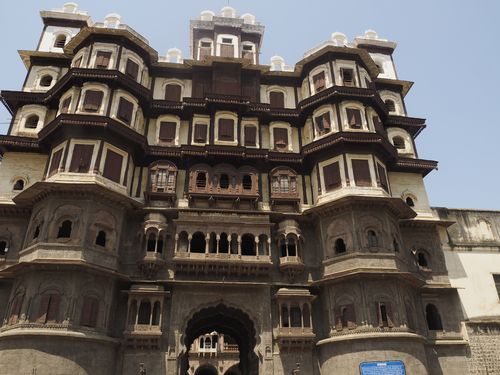
Indore • Rasjwadah Palace
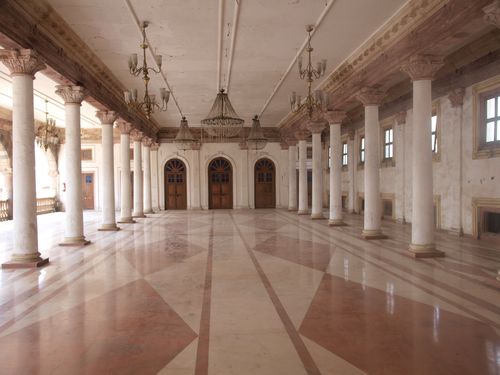
Indore • Rasjwadah Palace
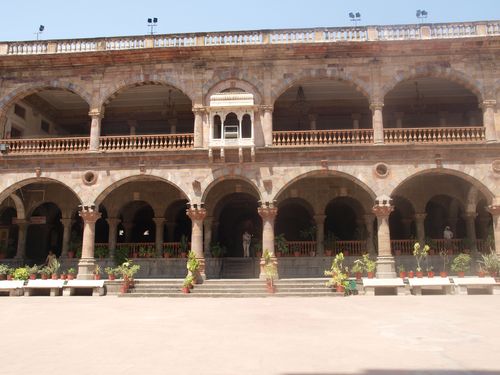
Indore • Rasjwadah Palace
Monument profile
Rasjwadah Palace
Monument category: Palace
Monument family: Palace and Annexes
Monument genre: Residential
Cultural heritage: Hindu
Geographic location: Indore • Madhya Pradesh • India
Construction period: 19th century AD
• Links to •
• Dynasties that contributed to the construction of the monument •


• List of videos about Indore on this site •
Indore, economic capital • Madhya Pradesh, India
Historical Development of Rajwada Palace, Indore
Rajwada Palace, located in Indore in the present-day state of Madhya Pradesh, stands as the principal historical seat of the Holkar dynasty, one of the leading Maratha ruling houses in central India. Constructed in the eighteenth century and repeatedly altered thereafter, the palace reflects the political consolidation of Maratha power in Malwa, its accommodation within the British imperial framework, and its subsequent transformation after Indian independence. Its history is inseparable from the emergence of Indore as an administrative and commercial center.
Political and Social Context of Construction
The palace was established during the mid-eighteenth century under the authority of Malhar Rao Holkar, a prominent Maratha military commander who secured control over the Malwa region in the aftermath of Mughal decline. As Maratha influence expanded northward, territorial consolidation required the creation of stable administrative headquarters. Indore, strategically situated along trade routes, became the dynastic capital.
The construction of Rajwada served multiple purposes. Politically, it embodied the legitimacy of a newly entrenched ruling house in a region historically administered under Mughal authority. Architecturally imposing residences were instruments of statecraft, signaling continuity, authority, and territorial permanence. Socially, the palace acted as the focal point of courtly life, ceremonial display, and bureaucratic governance. Its presence structured the urban core around a sovereign residence, thereby reinforcing centralized authority.
The ambitions of the Holkar rulers extended beyond symbolic representation. The palace functioned as a decision-making center for taxation, military organization, and diplomatic negotiation. Alliances with other Maratha houses and periodic tensions with rival factions influenced the consolidation of the state. While the Holkars maintained relative autonomy, their authority existed within a broader Maratha confederacy, requiring both cooperation and strategic positioning.
Major Historical Events and Dynastic Transitions
Throughout the late eighteenth and early nineteenth centuries, the Holkar state was drawn into conflicts that reshaped central India. The Anglo-Maratha Wars marked a decisive turning point. Following the defeat of Maratha forces in the early nineteenth century, the Holkars entered into subsidiary alliances with the British East India Company. Although political sovereignty was curtailed, the dynasty retained internal governance. Rajwada Palace continued to serve as the ceremonial and administrative center of the princely state.
The palace did not experience large-scale sieges comparable to earlier medieval conflicts, yet it was affected by episodes of unrest and accidental destruction. Several fires, notably in the nineteenth and early twentieth centuries, damaged substantial portions of the upper wooden structures. Reconstruction efforts were undertaken, sometimes incorporating modified layouts and structural reinforcements. These restorations illustrate the adaptability of the palace to evolving requirements while maintaining its symbolic centrality.
Dynastic succession within the Holkar family influenced internal modifications to the palace complex. Expansions, refurbishments, and alterations corresponded to shifts in courtly life and administrative needs. However, the essential role of the palace as a sovereign residence remained intact until the mid-twentieth century.
Global Context of Construction and Development
The initial construction of Rajwada occurred during a global era of dynastic reassertion and territorial realignment. In Europe, monarchies were consolidating power through monumental residences that embodied centralized authority. Similarly, in South Asia, regional polities emerging from the fragmentation of Mughal control erected palatial complexes to legitimize governance.
During the nineteenth century, as British imperial administration extended across India, princely states preserved their courts as symbols of negotiated autonomy. Rajwada must therefore be understood within the broader framework of imperial indirect rule, wherein architectural continuity signified the persistence of local authority under colonial oversight.
The palace’s survival and adaptation through this period parallel comparable developments in other princely capitals, where rulers maintained ceremonial spaces while modern administrative systems were introduced. In this sense, Rajwada formed part of a wider pattern of monumental continuity amid political transformation.
Transformations and Urban Evolution
Over time, Rajwada Palace underwent physical and functional changes. The most significant alterations followed episodes of fire that necessitated reconstruction of upper levels. Some structural components were reinforced, and spatial arrangements adjusted to accommodate changing administrative practices.
Following Indian independence in 1947 and the accession of princely states to the Union of India, the Holkar dynasty relinquished political authority. The palace lost its function as a sovereign seat and transitioned into a heritage structure. Portions of the complex were repurposed for public use, and the site increasingly became associated with historical commemoration rather than governance.
The rapid urban expansion of Indore during the twentieth century altered the palace’s immediate surroundings. What had once been the political nucleus of a courtly capital became enveloped by dense commercial activity. Roads, markets, and modern constructions reshaped the urban landscape, positioning the palace as a historic landmark within a dynamic metropolitan environment.
Contemporary Role and Cultural Significance
Today, Rajwada Palace functions primarily as a heritage monument open to visitors. It remains a symbol of Indore’s historical formation and of the Holkar dynasty’s role in regional governance. Cultural events, commemorative ceremonies, and occasional public gatherings are held in its vicinity, reinforcing its continued civic relevance.
For residents of Indore, the palace embodies a tangible connection to the city’s founding era. Its presence contributes to local identity and collective memory. At the national level, Rajwada illustrates the historical importance of princely states in shaping modern India’s political geography.
The monument’s visibility in tourism narratives enhances awareness of Maratha history in central India. Its association with a prominent ruling house provides historical depth to contemporary urban identity.
Current Conservation Status and Challenges
Rajwada Palace is not inscribed on the UNESCO World Heritage List. Its preservation is overseen by regional heritage authorities in cooperation with local administration. Conservation challenges arise from environmental exposure, pollution, and urban density.
The mixed material composition—stone foundations combined with wooden superstructures—requires specialized maintenance. Wood is vulnerable to fire, humidity, and biological deterioration, while stone surfaces are susceptible to atmospheric pollution. Vibrations from heavy traffic in surrounding commercial areas may also affect structural stability.
Restoration policies have focused on stabilizing weakened elements and maintaining historical authenticity. Efforts aim to balance public accessibility with structural preservation. Preventive conservation strategies include periodic inspections, controlled visitor access in sensitive areas, and reinforcement of compromised sections.
Conclusion
Rajwada Palace represents a continuous architectural and political narrative spanning the rise of Maratha authority, adaptation under British suzerainty, and transformation within independent India. Constructed as an assertion of dynastic legitimacy, it evolved through periods of conflict, reconstruction, and administrative change. While its political function has ceased, its symbolic and cultural significance endures. Embedded within the expanding city of Indore, the palace stands as a historical anchor linking eighteenth-century state formation with contemporary urban life. Its preservation underscores the enduring relevance of princely heritage in the broader historical landscape of India.
Architectural Analysis of Rajwada Palace, Indore
Rajwada Palace in Indore represents a significant example of Maratha palatial architecture in central India, developed from the eighteenth century onward and modified through successive reconstructions. Its architectural identity is defined by a composite structural system combining a massive stone-and-brick base with multi-storeyed wooden superstructures. The palace integrates defensive symbolism, administrative functionality, and residential requirements within a dense urban setting. Its architectural language reflects regional construction traditions while incorporating elements associated with Mughal and later colonial influences.
Technological and Architectural Innovations
The original conception of Rajwada relied on a hybrid structural strategy. The lower levels were built in load-bearing masonry using stone and brick bonded with lime mortar. This base provided compressive strength and resistance against environmental stress. Thick perimeter walls created a stable platform capable of supporting multiple storeys. Such masonry construction was typical of eighteenth-century political centers in Malwa, where durability and symbolic solidity were essential.
Above this foundation, the upper storeys incorporated extensive timber framing. Wooden beams, columns, and brackets allowed lighter construction and facilitated vertical expansion without excessive load on the masonry base. This dual system—stone below, timber above—was both practical and innovative in its balanced use of materials. It reduced overall structural weight while permitting complex façade articulation.
Timber galleries and projecting balconies were supported by carved brackets, distributing load laterally and preventing excessive stress on outer walls. This system required advanced joinery techniques, including mortise-and-tenon connections and interlocking beam assemblies. The adaptability of timber allowed rapid reconstruction after fires, a recurrent hazard in multi-storeyed wooden architecture.
Environmental design considerations were embedded in the layout. Courtyards acted as thermal regulators, promoting air circulation through stack effect and cross-ventilation. Deep overhangs and recessed openings reduced direct solar penetration, mitigating interior heat gain. The façade’s layered projections created shaded transitional zones between exterior and interior spaces.
Materials and Construction Methods
Stone, likely sourced from regional quarries, formed the structural plinth and ground-level walls. Its compressive strength and resistance to moisture made it suitable for foundational stability. Brick masonry supplemented stonework in upper sections of the lower levels, optimizing material efficiency.
Lime mortar functioned as the primary binding medium. Unlike modern cement, lime permitted slight structural movement, accommodating seasonal expansion and contraction. This flexibility was advantageous in a climate characterized by temperature extremes and monsoon humidity.
Timber, a defining element of the superstructure, was selected for availability and workability. Carved wooden façades, lattice screens, and balcony balustrades demonstrate skilled craftsmanship. The decorative woodwork served both aesthetic and structural purposes, reinforcing projecting elements.
Roofing systems consisted of timber frameworks supporting sloped coverings designed to channel monsoon rainfall. The integration of sloped surfaces within an otherwise rectilinear massing reflects adaptation to climatic conditions.
After episodes of fire, limited incorporation of iron reinforcements and improved joinery techniques enhanced resilience. These interventions illustrate incremental technological evolution without fundamentally altering the palace’s architectural character.
Architectural and Artistic Influences
Rajwada’s architectural vocabulary reflects Maratha courtly traditions adapted to the Malwa region. The monumental entrance gateway, articulated with arches and recessed openings, conveys defensive and ceremonial authority. Although not a fortified citadel, the structure evokes fortified typologies through its imposing ground-level massing.
The influence of Mughal architectural aesthetics is evident in the use of arches and symmetrical façade composition. However, unlike Mughal palaces characterized by expansive stone pavilions and domed halls, Rajwada emphasizes vertical layering and wooden ornamentation.
The projecting balconies and intricately carved wooden elements correspond to regional residential architecture, suggesting continuity between elite domestic forms and princely representation. Decorative motifs include floral carvings and geometric panels that align with broader subcontinental traditions while retaining localized stylistic traits.
Later interventions during the colonial period introduced subtle changes in spatial organization and finishes, but these did not substantially alter the structural composition. The palace therefore embodies a layered synthesis rather than a stylistic rupture.
Spatial Organization and Structural Configuration
The palace complex is organized around internal courtyards that structure circulation and hierarchy. The principal entrance leads to a forecourt and reception area historically used for official audiences. Administrative chambers occupied lower levels, while private apartments were situated in upper storeys.
Vertical circulation was achieved through internal staircases embedded within the structural mass. The clear separation between public and private zones reflects courtly protocol. Ground floors supported administrative and ceremonial functions, while upper levels provided residential accommodation.
Seven storeys have been attributed to the palace at its maximum development, though not all were uniformly masonry-built. The stone base typically comprised the lower three levels, with timber-framed storeys above. This stratification created a distinct visual transition from solidity to articulated lightness.
Balustrades, arcaded corridors, and colonnaded galleries defined transitional spaces. The façade’s rhythmic arrangement of openings established visual order while accommodating ventilation. The absence of large domes or monumental towers distinguishes Rajwada from northern palace complexes, emphasizing instead layered horizontality and vertical stacking.
Dimensions and Notable Features
Rajwada occupies a prominent urban plot within central Indore. Its façade rises to a height that dominates the immediate streetscape, particularly given the multi-storeyed composition. The entrance gateway constitutes a focal architectural element, functioning both symbolically and spatially as a threshold between city and court.
The juxtaposition of heavy masonry at ground level with delicately carved wooden superstructures creates a pronounced material contrast. This duality contributes to its architectural identity.
A notable characteristic is the palace’s resilience through reconstruction. Following destructive fires, upper levels were rebuilt while retaining foundational masonry. This continuity underscores the adaptability of its hybrid structural system.
International Recognition and Conservation
Rajwada Palace is not included on the UNESCO World Heritage List, yet it holds regional heritage status. Its architectural significance lies in exemplifying Maratha princely architecture adapted to central India’s climatic and material conditions.
Conservation challenges stem from its material composition. Timber elements remain vulnerable to humidity, insects, and fire. Stone surfaces are affected by urban pollution and vibration from surrounding traffic. The dense commercial environment intensifies environmental stress.
Restoration efforts focus on structural stabilization and preservation of carved woodwork. Maintenance requires periodic inspection of joinery, replacement of decayed timber sections, and reinforcement of masonry foundations. Conservation strategies aim to preserve original material wherever feasible, avoiding extensive replacement.
Rajwada’s architecture illustrates a balanced integration of structural pragmatism and symbolic representation. The combination of massive masonry and refined timber craftsmanship enabled vertical development within a compact urban parcel. Its hybrid construction, environmental responsiveness, and layered stylistic influences define its architectural character. As an enduring urban landmark, it remains a material record of Maratha statecraft expressed through built form.