

 Français (France)
  Nederlands (nl-NL)
 Of Hindu tradition, (with additional Buddhist and Jain influence), the Paramara dynasty ruled for approximately 500 years, ± between 800 and 1300 over all or part of Central India, North India and West India, during the Classical Period and the Medieval Period.
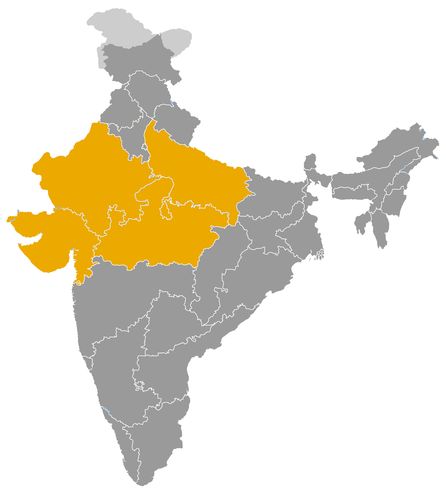
This map illustrates the maximum territory that the Paramara Dynasty had reached at its height, covering the current regions of Gujarat, Madhya Pradesh, Rajasthan and Uttar Pradesh in India. Its main purpose is to provide a visual aid to understand the geographical extent of this dynasty. However, it's important to note that the contemporary borders of these regions may not necessarily coincide with the historical territories.
The Paramara Dynasty and Its Political, Cultural and Economic Role in Medieval India
A regional power centred on Malwa
The Paramara dynasty was one of the important regional ruling houses of medieval India. Its main sphere of power was Malwa, a strategically placed region in central and western India. The dynasty’s principal capital was Dhara, present-day Dhar, while Ujjain remained a major religious, commercial and symbolic centre. From this base, the Paramaras participated in the political struggles of central India between the ninth and early fourteenth centuries.
The early Paramara rulers were probably connected to larger powers, especially the Rashtrakutas of the Deccan. Over time, however, the dynasty asserted its independence and became one of the leading forces in Malwa. Under rulers such as Siyaka II, Vakpati II Munja and Bhoja, the Paramaras developed from a regional lineage into a kingdom of considerable political and cultural influence.
Their importance in Indian history lies not in the creation of a vast and stable empire, but in their ability to make Malwa a major centre of power, learning, architecture and political competition. They illustrate the role of regional kingdoms in shaping medieval India after the decline of earlier imperial formations.
Malwa as a strategic crossroads of central India
The geographical position of Malwa gave the Paramaras a political significance greater than the size of their kingdom might suggest. The region connected Gujarat, Rajasthan, the Narmada valley, the Deccan and northern India. Control of Malwa meant access to routes used by armies, merchants, pilgrims and political envoys.
This position brought opportunities, but also constant danger. The Paramaras had to deal with several powerful neighbours: the Chaulukyas, or Solankis, of Gujarat, the Western Chalukyas of the Deccan, the Kalachuris of Tripuri, the Chandelas of Bundelkhand, the Chahamanas of Rajasthan and, later, the forces of the Delhi Sultanate. Their history was therefore marked by alternating phases of expansion, resistance, decline and recovery.
The dynasty’s political role was that of a balancing power in central India. It could project influence toward Gujarat, Rajasthan, the Narmada valley and the northern Deccan, but it was also repeatedly checked by stronger or equally ambitious neighbours. This made Paramara rule dynamic, competitive and vulnerable.
Bhoja and the ideal of the learned king
The most famous Paramara ruler was Bhoja, who reigned in the eleventh century. His name became strongly associated with the ideal of the scholar-king, a ruler who combined military power, cultural refinement and intellectual patronage. Although later tradition may have enlarged his reputation, Bhoja clearly became one of the most celebrated royal figures of medieval India.
Dhara acquired exceptional prestige under Bhoja. The ruler was linked to works on grammar, poetics, architecture, astronomy, medicine, philosophy and statecraft, although the precise authorship of all texts attributed to him remains debated. What matters historically is the image of a court deeply associated with learning and intellectual ambition.
Bhoja’s reputation gave the Paramara dynasty a cultural memory far beyond its political borders. Even after the decline of Paramara power, his name remained attached to royal wisdom, literary patronage and architectural ambition. In this sense, the cultural impact of the dynasty was more durable than many of its military achievements.
Patronage of architecture, religion and learning
The Paramaras contributed significantly to the architectural and artistic history of central India. Their patronage is associated with temples, religious foundations, reservoirs, inscriptions and centres of learning. The Bhojeshwar temple at Bhojpur, although unfinished, remains one of the most striking monuments linked with Paramara ambition. Its scale and conception reflect the desire to express royal power through monumental religious architecture.
Paramara architecture formed part of the wider Nagara tradition of northern and central India. Their buildings and inscriptions show connections with the artistic worlds of Malwa, Gujarat, Rajasthan and the Deccan. The dynasty’s patronage helped shape a regional style in which royal legitimacy, religious devotion and artistic prestige were closely connected.
The Paramaras mainly supported Hindu traditions, especially Shaivism, but their realm belonged to a broader religious environment in which Jainism and other currents were also present. As in many medieval Indian kingdoms, religious patronage served several purposes. It expressed piety, strengthened royal legitimacy, integrated local elites and gave the state a visible sacred presence in the landscape.
Agrarian revenue, trade routes and urban centres
The economic foundations of the Paramara kingdom lay in agriculture, land revenue and control of regional routes. Malwa was a fertile plateau with productive villages and access to important lines of communication. Agrarian income supported the royal court, armies, temple patronage and administrative structures.
Land grants played an important role in the political economy of the dynasty. Donations to temples, Brahmins and religious or learned institutions helped redistribute resources and strengthen ties between the king and influential social groups. These grants also extended royal authority into rural areas by linking land, ritual status and administrative recognition.
The location of Malwa also favoured trade. Routes connecting Gujarat, Rajasthan, the Narmada valley, the Deccan and northern India passed through or near Paramara territory. Dhara and Ujjain benefited from this position as centres of administration, religion and exchange. The economy of the Paramara kingdom was therefore both agrarian and connected to wider commercial movement.
A regional dynasty with a lasting historical memory
The Paramara dynasty declined gradually after the age of Bhoja. Later rulers restored power at times, but the kingdom remained exposed to pressure from Gujarat, the Deccan, Rajasthan and central Indian rivals. By the early fourteenth century, the conquest of Malwa by the Delhi Sultanate ended the effective sovereignty of the main Paramara line.
Despite this political decline, the dynasty left a durable legacy. It made Malwa a major centre of medieval Indian culture, gave lasting prestige to Dhara, produced the celebrated memory of King Bhoja and contributed to the architectural and religious landscape of central India.
The Paramaras are therefore important not because they ruled the whole subcontinent, but because they show how a regional dynasty could shape political geography, cultural production and economic organisation in medieval India. Their history reflects the vitality of central India as a crossroads of power, learning, religion and artistic creation.
The Geographical Extension of the Paramara Dynasty in Medieval Central India
A kingdom anchored in the Malwa plateau
The Paramara dynasty developed its main power in Malwa, a strategic region of central India situated between Rajasthan, Gujarat, the Narmada valley and the routes leading toward the Deccan. Its principal political centre was Dhara, present-day Dhar, while Ujjain retained strong religious, commercial and symbolic importance. This geographical setting gave the Paramaras a role that exceeded the size of their kingdom, because Malwa stood at the junction of several political and economic zones.
The territory ruled by the Paramaras was not a state with fixed modern borders. Like many medieval Indian kingdoms, it consisted of a core area under stronger control and peripheral zones where authority varied according to military strength, local alliances and the pressure of neighbouring powers. The most stable centre of Paramara authority was the Malwa plateau, but their influence could extend toward Gujarat, Rajasthan, the Narmada region and parts of central India during periods of strength.
Dhara and Ujjain as centres of territorial authority
Dhara became the dynastic capital and the main administrative centre of the Paramara kingdom. From there, the rulers controlled the surrounding plateau, agricultural villages, routes and religious establishments. Under Bhoja, Dhara acquired exceptional cultural prestige, but its importance was also territorial. It allowed the dynasty to govern a central zone from which military and diplomatic action could be directed in several directions.
Ujjain added another dimension to Paramara geography. As an ancient city of religious and commercial significance, it strengthened the symbolic authority of the dynasty. Control over Ujjain helped the Paramaras connect their rule with older sacred and urban traditions of central India. Together, Dhara and Ujjain formed the principal poles of a kingdom whose power depended on the control of routes, fertile lands and prestigious urban centres.
Western ambitions toward Gujarat and Rajasthan
To the west, the Paramaras came into contact with the Chaulukyas, or Solankis, of Gujarat. This frontier was one of the most contested areas of their political geography. The Paramaras sometimes attempted to project power toward Gujarat, especially under energetic rulers such as Munja, Bhoja and Subhatavarman. However, the Chaulukyas were a strong and durable rival, and Paramara control in this direction was often temporary or limited.
The north-western frontier also brought the Paramaras into contact with Rajput lineages of Rajasthan, including the Chahamanas. Relations with these powers included warfare, diplomacy, marriage alliances and competition for influence over routes and frontier zones. The geography of western Malwa made such relations unavoidable. The same roads that supported trade and communication also exposed the kingdom to raids, invasions and shifting alliances.
Northern and eastern relations with the Chandelas and Kalachuris
To the north and east, the Paramaras faced other central Indian powers, particularly the Chandelas of Bundelkhand and the Kalachuris of Tripuri. These dynasties controlled territories that bordered or approached the eastern limits of Paramara influence. The resulting relationships were often competitive, because each dynasty sought control over strategic routes, frontier regions and centres of prestige.
The Narmada valley was especially important. It functioned as a corridor between central India and the Deccan, and it linked several military and commercial zones. Paramara rulers sought to secure influence over this region, but they had to contend with Kalachuri ambitions. The Chandelas, established farther to the north-east, could also limit Paramara expansion in that direction. These rivalries show that the eastern extension of Paramara power was always shaped by competing regional states.
Southern pressure from the Rashtrakutas and Western Chalukyas
The early history of the Paramaras was closely connected with the larger powers of the Deccan. The first Paramara rulers were probably linked to the Rashtrakutas, either as subordinates or regional chiefs operating within their wider sphere of influence. The assertion of independence under Siyaka II marked an important shift in the territorial history of the dynasty. It transformed Malwa from a dependent region into the base of an autonomous kingdom.
Later, the Western Chalukyas became major rivals. The reign of Vakpati II Munja illustrates both the ambition and the limits of Paramara expansion toward the south. Munja launched campaigns beyond Malwa, but his defeat by the Western Chalukyas demonstrated that the Deccan powers could effectively resist Paramara advances. The southern frontier therefore remained a zone of military ambition, but not of lasting Paramara domination.
The wider influence achieved under Bhoja
The reign of Bhoja represented the height of Paramara prestige. His influence extended beyond the Malwa core into surrounding regions, including parts of Gujarat, Rajasthan, Bundelkhand and the Narmada zone. This wider reach should be interpreted carefully. It did not mean uniform administration over a vast empire. In many areas, Paramara authority took the form of military campaigns, temporary control, political influence or recognition of royal prestige.
Nevertheless, Bhoja’s reign made Malwa a major centre of medieval India. The kingdom’s geographical position supported cultural exchange as well as political ambition. Dhara attracted scholars, religious specialists and craftsmen, while the routes crossing Malwa connected the Paramara court with several neighbouring regions. The dynasty’s territorial influence was therefore both political and cultural.
Contraction under regional pressure and the Delhi Sultanate
After Bhoja, the Paramara kingdom experienced repeated phases of contraction and restoration. Neighbouring powers challenged its frontiers, and the dynasty struggled to maintain control over its peripheral zones. The Chaulukyas of Gujarat, the Kalachuris, the Chahamanas and other regional powers weakened Paramara authority in different directions.
Some later rulers, such as Vindhyavarman and Subhatavarman, restored part of the dynasty’s independence and prestige. Yet these recoveries were fragile. By the thirteenth century, the kingdom was increasingly vulnerable to both regional rivals and the expanding power of the Delhi Sultanate. The conquest of Malwa in the early fourteenth century ended the effective sovereignty of the main Paramara line.
A central Indian territory shaped by connection and vulnerability
The geographical importance of the Paramara dynasty lay in its control of Malwa, a region that linked western India, Rajasthan, central India, the Narmada valley and the Deccan. This position gave the dynasty access to trade routes, agricultural resources, sacred cities and political opportunities. It also placed the Paramaras in constant contact with powerful neighbours.
Their territorial history was therefore marked by expansion, contestation and vulnerability. The Paramaras did not create a stable subcontinental empire, but they shaped the political geography of central India for several centuries. Their rule shows how control of a strategic plateau could produce cultural brilliance, regional influence and continuous rivalry in medieval India.
This chronology concerns the main Paramara line of Malwa, centred on Dhara, and not related regional branches. The earliest rulers were probably regional chiefs or vassals before independent kingship was asserted under Siyaka II; the early dates remain approximate and vary according to epigraphic reconstructions.
- Upendra, or Krishnaraja (c. 800–818) • The first ruler generally associated with the Paramara line of Malwa, he belongs to the dynasty’s formative phase.
- Vairisimha I (c. 818–843) • He maintained Paramara authority in a context still dependent on the great powers of the Deccan and western India.
- Siyaka I (c. 843–893) • His reign belongs to the gradual consolidation of the Paramara house in Malwa.
- Vakpati I (c. 893–918) • He strengthened dynastic continuity before the clearer assertion of Paramara power.
- Vairisimha II (c. 918–948) • He ruled during a phase in which the Paramaras were still exposed to external pressure.
- Siyaka II (c. 948–972) • He asserted Paramara independence and campaigned against the Rashtrakutas, marking the political rise of the dynasty.
- Vakpati II Munja (c. 972–990) • A conquering king and patron, he expanded Paramara prestige but was defeated in conflicts with the Western Chalukyas.
- Sindhuraja (c. 990–1010) • He restored the dynasty’s position after Munja’s setbacks and consolidated the kingdom of Malwa.
- Bhoja (c. 1010–1055) • A major ruler, he made Dhara an important centre of politics, literature, science and architecture.
- Jayasimha I (c. 1055–1060) • He ruled during a period of crisis after Bhoja’s death and under pressure from neighbouring powers.
- Udayaditya (c. 1060–1086) • He partly restored Paramara stability and patronised important religious constructions.
- Lakshmadeva (c. 1086–1094) • His reign is associated with military campaigns, although his exact importance remains debated.
- Naravarman (c. 1094–1133) • He ruled during a phase of relative decline, facing the Chalukyas, Chandelas and other regional powers.
- Yashovarman (c. 1133–1142) • His reign was marked by the weakening of Paramara control over Malwa.
- Jayavarman I (c. 1142–1160) • He attempted to maintain dynastic authority during a period of strong regional instability.
- Vindhyavarman (c. 1175–1194) • He restored Paramara independence after a phase of Chalukya domination or influence.
- Subhatavarman (c. 1194–1210) • He continued the policy of Paramara assertion and campaigned toward Gujarat.
- Arjunavarman I (c. 1210–1218) • He briefly strengthened the kingdom’s prestige through victories and active cultural patronage.
- Devapala (c. 1218–1239) • He maintained the kingdom amid rivalries with the Chahamanas, Chalukyas and neighbouring powers.
- Jaitugideva (c. 1239–1255) • His reign is less well documented and belongs to the late phase of the dynasty.
- Jayavarman II (c. 1255–1274) • He ruled a weakened kingdom under increasing pressure from regional powers.
- Arjunavarman II (c. 1274–1283) • His reign belongs to the final contraction of Paramara authority.
- Bhoja II (c. 1283) • His reign was brief or poorly attested, in a context of difficult succession.
- Mahalakadeva (c. 1283–1305) • The last generally recognised Paramara ruler of Malwa, he was defeated during the Delhi Sultanate’s conquest of Malwa.