Français (France)
  Nederlands (nl-NL)
 Of Hindu tradition, (with additional Buddhist and Christian influence), the Kulasekhara Chera dynasty ruled for approximately 278 years, ± between 844 and 1122 over all or part of South India, during the Classical Period.
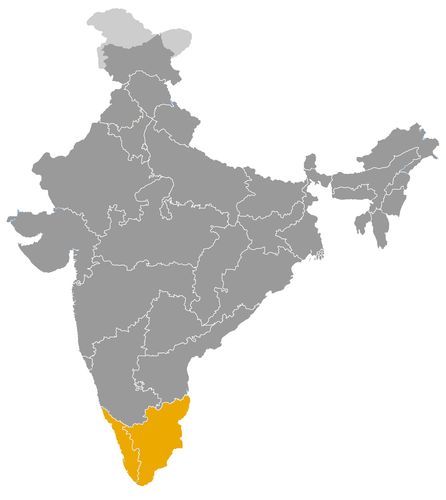
This map illustrates the maximum territory that the Kulasekhara Chera Dynasty had reached at its height, covering the current regions of Kerala and Tamil Nadu in India. Its main purpose is to provide a visual aid to understand the geographical extent of this dynasty. However, it's important to note that the contemporary borders of these regions may not necessarily coincide with the historical territories.
The Kulasekhara Chera Dynasty and Its Role in the Formation of Medieval Kerala
A regional dynasty rooted in the Chera tradition
The Kulasekhara Chera dynasty, often identified with the Chera Perumals of Mahodayapuram, occupied an important place in the history of South India between the ninth and early twelfth centuries. Their authority was centred in Kerala, especially around Mahodayapuram, also known as Makotai, near present-day Kodungallur. Although they claimed continuity with the older Chera tradition of the early historic period, the Kulasekhara Chera belonged to a different political and cultural context: the medieval world of temple institutions, maritime trade, regional aristocracies and competing South Indian dynasties.
Their role in Indian history was not that of a vast imperial power comparable to the Cholas or the Rashtrakutas. Their importance lay instead in their ability to give political coherence to the Malabar Coast and to shape the distinctive historical development of Kerala. The dynasty governed a region whose geography was marked by the Arabian Sea to the west and the Western Ghats to the east. This setting encouraged maritime exchange, regional autonomy and a political structure different from the large agrarian empires of the eastern Tamil plains.
Royal authority centred on Mahodayapuram
Mahodayapuram was the principal seat of Kulasekhara Chera power. From this centre, the rulers exercised authority over much of Kerala, though their control was not always direct or uniform. The political structure of the kingdom depended on a network of local chiefs, landed elites, temple corporations and merchant groups. The Chera Perumal ruler stood at the summit of this system, but his power was mediated through regional institutions.
This form of kingship helped maintain stability for several centuries, but it also contained the seeds of later fragmentation. Local powers retained considerable influence, and over time some of them became increasingly autonomous. The later emergence of regional polities such as Venad, Kolathunad and Perumpadappu can be partly understood as a consequence of this decentralised structure. The decline of Kulasekhara Chera power was therefore not simply a collapse, but a transformation of the political landscape of Kerala.
Relations with the Cholas, Pandyas and other South Indian powers
The Kulasekhara Chera dynasty existed in a political environment shaped by powerful neighbours. To the east, the Cholas of the Kaveri basin became the dominant imperial force in South India from the tenth century onward. Their expansion toward the western coast brought them into direct contact and occasional conflict with the Chera Perumals. Control of trade routes, ports and access across the Western Ghats made Kerala strategically important.
The relationship between the Chera and Chola powers was complex. It included military pressure, rivalry, diplomacy and dynastic interaction. Chola campaigns weakened Chera authority in some periods, particularly in areas connected to maritime commerce. Yet the Kulasekhara Chera were not merely passive victims of Chola expansion. They remained active participants in the political networks of peninsular India and preserved a regional identity that survived beyond the decline of the central monarchy.
The Pandyas of southern Tamil Nadu also formed part of this wider political environment. Their proximity to the southern Kerala region made them important neighbours, especially in relation to routes connecting the Tamil plains with the Malabar Coast. The Chera position between the sea and the inland powers made them both commercially valuable and politically exposed.
Temple institutions and cultural consolidation
One of the most significant cultural developments under the Kulasekhara Chera was the growth of temple-centred society. Hindu temples, especially those dedicated to Shiva and Vishnu, became central institutions in the social, economic and religious life of medieval Kerala. They received land grants, organised ritual life, employed specialists and functioned as centres of redistribution.
The period also contributed to the formation of Kerala’s regional culture. Sanskrit retained prestige in religious and learned circles, while early Malayalam gradually emerged more clearly from the older Tamil-Malayalam linguistic continuum. This process was not sudden, but the Kulasekhara Chera period represents an important stage in the cultural differentiation of Kerala from neighbouring Tamil regions.
Religious traditions associated with bhakti also became prominent. Some rulers and figures connected with the Chera Perumal period were later absorbed into sacred memory and devotional traditions. Even when specific identifications remain debated, they show the strong cultural resonance of the dynasty in Kerala’s historical imagination.
Maritime trade and economic prosperity
The economy of the Kulasekhara Chera kingdom was deeply connected to the Indian Ocean. The Malabar Coast was famous for pepper, spices, timber, ivory, textiles and other commodities sought by merchants from Arabia, Persia, China and different parts of India. Ports such as Kodungallur played a major role in these networks.
The dynasty benefited from this maritime prosperity by supporting merchant communities and granting privileges to trading groups. Jewish, Christian, Muslim and Hindu merchants all participated in the commercial life of Kerala. This gave the region a cosmopolitan character unusual in many inland kingdoms. Copper plate grants associated with the period illustrate the relationship between royal authority, trade and religious communities. They show that the Chera rulers understood the economic value of integrating diverse merchant groups into the structure of the kingdom.
A lasting legacy in Kerala’s political and cultural history
The Kulasekhara Chera dynasty played a formative role in the history of Kerala and, by extension, in the regional history of India. They did not create a large empire, but they strengthened a distinctive coastal polity linked to temples, ports, merchants and local aristocracies. Their period saw the consolidation of institutions that continued to shape Kerala after the decline of central Chera authority.
Their legacy lies in the political organisation of medieval Kerala, the growth of temple-based society, the expansion of maritime trade and the gradual formation of a regional cultural identity. The dynasty’s historical importance therefore rests less on conquest than on integration. The Kulasekhara Chera connected the Malabar Coast to South Indian politics and to the wider Indian Ocean world, making Kerala a significant regional actor in medieval India.
The Geographic Reach of the Kulasekhara Chera Dynasty on the Malabar Coast
A coastal kingdom shaped by Kerala’s geography
The Kulasekhara Chera dynasty, commonly associated with the Chera Perumals of Mahodayapuram, ruled between the ninth and early twelfth centuries over much of present-day Kerala. Their territorial base was located on the western side of the Indian peninsula, between the Arabian Sea and the Western Ghats. This geography strongly shaped the nature of their power. Unlike the Cholas of the Kaveri basin or the Rashtrakutas of the Deccan, the Kulasekhara Chera did not rule a broad inland empire. Their authority was concentrated in a narrow but economically important coastal region.
The kingdom’s political centre was Mahodayapuram, also known as Makotai, near present-day Kodungallur. This location gave the dynasty access to maritime trade, riverine routes and inland passes across the Western Ghats. The territorial identity of the Kulasekhara Chera kingdom was therefore both coastal and regional. It was not defined only by direct land control, but also by influence over ports, temple networks, merchant communities and local chiefs.
The core region around Mahodayapuram
The strongest zone of Kulasekhara Chera authority lay in central Kerala, especially around Mahodayapuram, Kodungallur, Thrissur and the nearby coastal lowlands. This area formed the political and ritual heart of the kingdom. It contained important temples, productive agricultural lands and access to maritime exchange. The royal centre was well placed to interact with both inland elites and overseas merchants.
The rulers did not govern every part of the kingdom through a uniform central administration. Their authority was mediated through local aristocracies, assemblies, temple corporations and regional chiefs. This means that the geographic extension of the dynasty should not be imagined as a modern territorial state with fixed borders. In some areas, the Chera Perumal ruler exercised direct influence; in others, his authority was expressed through ritual supremacy, alliances or recognition by local powers.
Northern and southern zones of influence along the Malabar Coast
The Kulasekhara Chera sphere extended beyond central Kerala toward both the north and the south of the Malabar Coast. In the north, their influence reached parts of northern Malabar, though local lineages and chiefs retained significant autonomy. These northern regions were important because they connected the kingdom with trade routes, forest products and coastal settlements facing the Arabian Sea.
Toward the south, Chera influence extended into regions associated with later Venad, in southern Kerala. Venad eventually emerged as one of the important successor polities after the weakening of central Chera authority. The southern zone was strategically important because it connected the Chera world with the Pandya country and the routes leading toward the Tamil plains. Control or influence over these areas allowed the Kulasekhara Chera to participate in the wider political and commercial networks of South India.
The Western Ghats as a frontier and corridor
The Western Ghats formed the eastern boundary of the Kulasekhara Chera sphere. They acted as a natural barrier between the Kerala coast and the interior regions of Tamil Nadu and Karnataka. Yet they were not an absolute frontier. Mountain passes allowed movement of people, armies, goods and religious influences between the Malabar Coast and the eastern plains.
These routes were vital for trade and diplomacy. Through them, pepper, spices, timber and other products could move from the Kerala region toward inland markets, while political influence from the Chola, Pandya and other powers could reach the coast. The Ghats therefore served both as protection and as a zone of contact. They helped preserve Kerala’s regional distinctiveness, but they also made the Chera kingdom vulnerable to eastern military pressure.
Relations with the Chola dynasty
The geographic position of the Kulasekhara Chera brought them into close contact with the Cholas, who became the dominant power in South India from the tenth century onward. The Cholas controlled the fertile Kaveri basin and expanded aggressively across the peninsula. Their interest in the western coast was driven by both political ambition and economic strategy. Access to the Malabar ports meant access to the lucrative trade of the Arabian Sea.
Chola expansion placed increasing pressure on the Chera kingdom. Campaigns across the Western Ghats affected the stability of Chera authority and challenged their control over strategic routes and coastal centres. However, the relationship was not purely one of war. There were also periods of diplomacy, dynastic interaction and political negotiation. The Kulasekhara Chera occupied a valuable position between the inland powers of South India and the maritime world of the Indian Ocean, making them both rivals and necessary partners in regional politics.
Relations with the Pandyas and other neighbouring powers
The Pandya dynasty, based in southern Tamil Nadu, was another important neighbour. The southern parts of the Chera sphere, especially areas connected with Venad, were close to the Pandya country. This proximity created opportunities for alliance, competition and shifting political influence. The Chera and Pandya worlds were linked by trade routes, religious networks and military corridors.
To the north and northeast, the Chera kingdom also interacted with powers connected to the Karnataka region and the Deccan. These relations were less central than the rivalry with the Cholas, but they contributed to the broader diplomatic environment in which the Kulasekhara Chera operated. Their territory was not isolated; it formed part of a wider South Indian system in which coastal and inland powers competed for trade, prestige and strategic access.
Fragmentation after the decline of central authority
By the early twelfth century, the central authority of the Kulasekhara Chera weakened. The kingdom did not simply disappear; rather, its territory fragmented into regional polities. Local powers such as Venad, Kolathunad and Perumpadappu became increasingly autonomous. This process reflected the earlier structure of the kingdom, where local chiefs and temple institutions had already played major roles in governance.
The geographic legacy of the Kulasekhara Chera remained important after their decline. They had helped organise Kerala as a distinct regional zone, tied together by ports, temples, trade routes and coastal settlements. Their kingdom was territorially limited compared with larger empires, but it controlled one of the most commercially valuable coastal regions of medieval India. Through this position, the Kulasekhara Chera shaped relations between Kerala, the Tamil plains and the wider Indian Ocean world.
The name “Kulasekhara Chera” refers to the Chera Perumals of Mahodayapuram or Makotai. The dates are indicative, as the chronology is mainly based on inscriptions and several scholarly reconstructions; not all rulers bore the name or title Kulasekhara.
- Sthanu Ravi Kulasekhara (c. 844-870) • The first clearly attested Chera Perumal ruler, he is associated with the Kollam plates and with active diplomatic and religious relations.
- Rama Rajasekhara (c. 870-883) • His reign is known from inscriptions and he is sometimes linked with the tradition of Cheraman Perumal Nayanar.
- Vijayaraga (c. 883-895) • He belongs to the phase of consolidation of the Chera kingdom around Mahodayapuram and maintained dynastic links with the Cholas.
- Goda Goda (c. 895-905) • A poorly documented ruler, he is sometimes associated with the title Kerala Kesari in chronological reconstructions.
- Goda Ravi (c. 905-943) • He ruled during a period of close relations with the Cholas and institutional continuity in medieval Kerala.
- Indu Goda (c. 943-962) • His reign remains little known, but it forms the transition between the tenth-century rulers and the long rule of Bhaskara Ravi.
- Bhaskara Ravi Manukuladitya (c. 962-1021) • An important ruler, he is associated with the Jewish copper plates of Cochin and the expansion of merchant networks on the Malabar Coast.
- Ravi Goda (c. 1021-1089) • His long reign corresponds to a period of increasing Chola pressure on Kerala and regional political reorganisation.
- Rama Kulasekhara (c. 1089-1122) • The last major Chera Perumal ruler, he reigned during the final phase of the kingdom before its fragmentation into regional powers.
 Links to the main sections of the site