

 Français (France)
  Nederlands (nl-NL)
 Christianity is a monotheistic religion that emerged in the 1st century CE in Roman Palestine. Based on the teachings of Jesus of Nazareth—regarded as the Messiah by his followers—it developed from Jewish traditions while establishing its own doctrine centered on faith in one God, redemption, love for others, and the hope of eternal life. Christianity soon organized itself around scriptures and communities, spreading first through the Roman Empire and then across Europe, the Near East, Africa, and Asia. On the Indian subcontinent, it has been present since antiquity, notably in Kerala through Syrian merchants and later through colonial missions. Christianity has contributed to various aspects of cultural history, especially sacred art, liturgical music, and architecture, through churches, missions, and educational institutions.
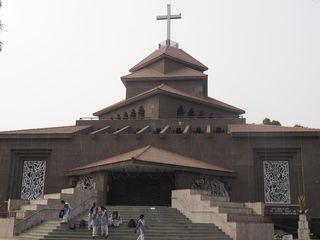
a church in Varanasi

St. Francis Church, Kochi
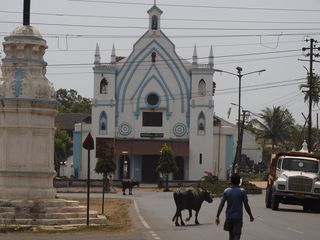
Our Lady of Belem, Goa
Christianity: History, Branches, and Core Beliefs
Historical Origins and Context of Emergence
Christianity is a monotheistic religion that emerged in the 1st century CE in the Roman province of Judea, a region marked by Jewish traditions and Roman political domination. It was founded on the teachings of Jesus of Nazareth, a wandering preacher whose followers regarded him as the Messiah foretold in Hebrew scriptures. His message, initially transmitted orally and later compiled into the New Testament, emphasized love, forgiveness, and redemption through faith.
Originally considered a reformist movement within Judaism, Christianity gradually became distinct, particularly through the outreach to non-Jewish populations (Gentiles) led by apostles such as Paul of Tarsus. Christians were often persecuted by Roman authorities until Emperor Constantine legalized the religion with the Edict of Milan in 313 CE. Later, under Emperor Theodosius in the 4th century, Christianity became the official religion of the Roman Empire.
Geographical Expansion and Presence in India
From its origins in the Eastern Mediterranean, Christianity spread westward and eastward through missionary work and political expansion. It reached Europe, North Africa, the Near East, and eventually Asia. On the Indian subcontinent, tradition holds that the apostle Thomas brought Christianity to the Malabar Coast (modern-day Kerala) as early as the 1st century CE. These early communities, known as Saint Thomas Christians, developed ties with the Syriac Churches of the East.
Over the centuries, the Christian presence in India was reinforced by the arrival of Portuguese missionaries in the 16th century and later by Protestant missions from Britain and Germany during the colonial period. Today, Christianity is most prominent in Kerala, Tamil Nadu, Goa, and several northeastern states such as Nagaland, Meghalaya, and Manipur. Christians make up around 2.3% of India’s population.
Major Branches and Denominations
Over time, Christianity developed into several distinct branches based on theological, cultural, and political differences. The main branches include:
- The Roman Catholic Church, led by the Pope in Rome, historically introduced to southern India by Portuguese missionaries and still dominant in Goa and parts of Kerala.
- Eastern and Oriental Orthodox Churches, such as the Syriac Orthodox Church and its Indian counterparts, which maintain apostolic traditions and use liturgies rooted in Eastern Christianity.
- Protestant Churches, originating from the 16th-century Reformation in Europe, are diverse and include Lutherans, Anglicans, Baptists, and others. Many were introduced to India through 19th-century missionary efforts.
- Pentecostal and Evangelical movements, which have expanded particularly in tribal and urban communities, emphasize personal conversion and spiritual experience.
These traditions differ in liturgical style, ecclesiastical structure, and language use, contributing to the diversity of Christian practices across India.
Core Beliefs and Religious Practices
Christianity is based on belief in one God, revealed through Jesus Christ, whose death and resurrection are central to the concept of salvation. The Bible, composed of the Old and New Testaments, is the foundational sacred text, though its canon may vary slightly among denominations.
Fundamental beliefs include:
- the doctrine of the Trinity (Father, Son, and Holy Spirit),
- the divine nature of Christ,
- salvation through faith and divine grace,
- and the promise of eternal life after death.
Key practices include prayer, reading of scripture, weekly worship (often on Sunday), and participation in sacraments such as baptism and the Eucharist. Worship styles vary widely, from the highly structured liturgies of ancient churches to the informal gatherings of evangelical communities.
In India, Christian practices often incorporate local elements such as regional hymns, festivals, and processions. Community celebrations, like Christmas and Easter, may include both liturgical services and social events.
Political Role and Identity Function
Christianity has historically maintained a complex relationship with political authority. While it began as a marginalized and persecuted faith, it eventually became the state religion of the Roman Empire and influenced the governance of many European and colonial states.
In India, Christianity has never been a state religion, but during colonial periods, it enjoyed protection and institutional support from European powers, particularly the Portuguese and British. Christian missions established many of India’s early modern schools, hospitals, and universities, contributing to education and healthcare.
In the present day, Christianity serves as a cultural and ethnic identity marker for many communities, especially in the northeastern states, where it is often intertwined with local traditions and community organization.
Views on Death, the Afterlife, and Commemorative Traditions
Christian doctrine affirms a belief in life after death, where each soul is judged according to its faith and actions. The righteous are promised resurrection and eternal life in communion with God, while those who reject divine grace face spiritual separation.
Funeral practices vary by denomination but generally include:
- prayers over the body,
- scriptural readings,
- rituals of blessing,
- and burial in consecrated ground. Cremation, though less common, has become more accepted in certain contexts.
Commemorative traditions include annual remembrances, visits to graves, and the maintenance of Christian cemeteries. In India, historical Christian cemeteries in cities like Goa, Chennai, and Kolkata reflect both colonial heritage and local adaptation of funerary customs. Crosses, chapels, and memorial stones serve as tangible links between faith, memory, and cultural identity.
Christian Architecture: Forms, Functions, and Symbolism
Religious Origins and Architectural Foundations
Christian architecture developed from the 1st century CE in response to the liturgical practices and theological principles of this monotheistic faith centered on Jesus Christ. From the outset, places of worship were designed as communal spaces where believers could gather for prayer, the reading of scripture, and the celebration of sacraments.
Early Christian architecture borrowed heavily from existing traditions, including Roman civic and Jewish religious structures. The longitudinal layout, the positioning of the altar at the focal point of the building, and the separation between clergy and congregation became defining characteristics of Christian places of worship. Over time, these structural principles were adapted to meet regional, cultural, and historical conditions, while maintaining the core purpose of facilitating communal and ceremonial practices.
Typologies and Functions of Buildings
Christian architecture encompasses a variety of structures with distinct purposes—liturgical, educational, and commemorative.
Places of Worship
Churches are the primary Christian religious buildings and may range from parish churches and monastic chapels to cathedrals serving as seats of ecclesiastical authority. Architectural plans vary across history and regions, including basilica-style layouts, centralized structures, or cruciform designs. These spaces are primarily intended for communal liturgy, such as prayer, scripture readings, and sacraments like baptism and the Eucharist.
In India, churches often reflect adaptations to local conditions, with vernacular design elements, locally sourced materials, and hybridized decorative motifs that merge Christian themes with regional aesthetics.
Ritual and Educational Spaces
Many Christian buildings incorporate areas for teaching, preaching, and community life, such as parish halls, cloisters, or seminar rooms. Monasteries and missionary compounds frequently include spaces dedicated to education, hospitality, and social service, reflecting the religion’s emphasis on moral instruction and community support.
Ancillary spaces also serve liturgical functions: baptisteries for initiation rites, sacristies for preparing services, and choir lofts for musical accompaniment.
Funerary Structures
Christianity places significant emphasis on the commemoration of the dead and the belief in resurrection. Cemeteries are often situated near churches or in dedicated enclosures and are typically arranged in a way that emphasizes order, dignity, and remembrance. Mausoleums, cenotaphs, and funerary chapels may be erected to honor prominent figures.
In India, Christian cemeteries often combine European forms with local influences. Crosses, stone memorials, and inscriptions in regional languages testify to the blending of Christian funeral traditions with indigenous practices.
Symbolism in Christian Architecture
Symbolism plays a central role in Christian architectural design, translating theological concepts into spatial and decorative elements.
- Orientation toward the east (sunrise) symbolizes resurrection and hope.
- The cruciform layout recalls the Passion of Christ and the centrality of the cross in Christian belief.
- Vertical emphasis, as seen in tall naves and steeples, suggests spiritual ascent toward God.
- The basilica plan, with its axial alignment, draws attention toward the altar as the focal point of the liturgical experience.
Decorative elements, including stained glass, relief sculptures, and painted panels, often depict biblical narratives or Christian symbols such as the fish, lamb, or dove. In India, these motifs may be reinterpreted through local artistic styles, colors, and iconographic traditions, blending Christian themes with regional aesthetics.
Materials and Construction Techniques
Christian buildings have historically employed a wide range of materials, determined by both geographical availability and technological advances.
- Traditional materials include stone, brick, timber, and plaster.
- Medieval churches often feature vaulted stone ceilings, while modern structures may use reinforced concrete or steel frameworks.
- Decorative finishes range from mosaics and frescoes to painted wood and carved stone.
In India, church construction often relies on local resources: wooden frameworks and tiled roofs in Kerala, laterite or brick walls in coastal regions, and European-style facades adapted to the tropical climate. This combination of imported design principles and indigenous techniques gives Indian Christian architecture its distinct character.
Geographic Spread and Local Adaptations
Christian architecture has spread widely across the globe, adapting to the cultural, climatic, and technical conditions of each region. On the Indian subcontinent, this has led to diverse stylistic expressions:
- Incorporation of regional motifs—floral and geometric designs familiar in local art are often integrated into church facades and interiors.
- Use of indigenous materials and layouts, such as courtyards or shaded verandas, to accommodate the local climate.
- Hybrid iconography, combining Christian themes with regional visual language.
Thus, Indian Christian architecture is less a direct replica of European forms than a dynamic synthesis of global religious traditions and local cultural patterns.
Intercultural Interactions and Cross-Influences
Christian architecture has historically interacted with other religious and cultural traditions, resulting in mutual influences and hybrid forms. In regions with religious diversity, the exchange of architectural ideas has shaped both Christian and non-Christian edifices.
- In India, churches often incorporate features inspired by Indo-Islamic architecture, such as domes, arches, and decorative screens, alongside Western-style bell towers.
- Decorative elements can draw from Hindu or Buddhist traditions, particularly in motifs and carvings, while retaining a Christian symbolic framework.
- Conversely, Christian architecture introduced new concepts of spatial organization, such as axial alignment and processional routes, into the broader architectural landscape during colonial periods.
This ongoing dialogue between imported religious forms and local building traditions has enriched the architectural heritage of India, resulting in churches, chapels, and cemeteries that reflect both global Christianity and regional identity.
The Role of Christianity in the History of Indian Dynasties
Christianity has been present in India since late antiquity, traditionally attributed to the apostle Thomas in the 1st century, and expanded significantly with the arrival of European colonial powers from the 16th century onward. While it was never the dominant religion of a major indigenous empire, it became central in territories controlled by the Portuguese, French, and later the British, where it reinforced political authority alongside missionary activity.
Colonial rulers used Christianity as a tool of legitimacy, linking it to European culture and institutions. However, in many regions, other religions—Hinduism, Islam, or Sikhism—continued to be practised and sometimes supported to preserve social stability.
Relations between Christianity and other faiths varied: peaceful coexistence in some areas, tensions or forced conversions in others. While Christianity was seldom the direct cause of local military conflicts, it played an indirect role in colonial wars, symbolising European influence.
Although a minority faith across the subcontinent, Christianity had a significant cultural and educational impact, notably through the establishment of schools, hospitals, and churches, leaving a lasting legacy in regions such as Kerala, Goa, and India’s Northeast.