

 Français (France)
  Nederlands (nl-NL)
 00:00 • intro | 00:59 • Jain nuns on pilgrimage | 01:26 • In the caves | 07:27 • The temple of Kailâsanâtha
Personal creation from visual material collected during my trip India - Kumbh Mela • Madhya Pradesh • Maharashtra • Goa (2018)
Map of places or practices in Ellora on this site
• Use the markers to explore the content •
Ellora, Rock-Cut Masterpiece of Faiths and Monumental Sculpture
A Major Sacred Landscape of the Deccan
Ellora Caves rank among the most remarkable archaeological sites in India. Carved into a long basalt escarpment in Maharashtra, the complex brings together Buddhist, Hindu, and Jain monuments created over several centuries. Few places illustrate so clearly the successive presence—and at times coexistence—of major religious traditions through rock-cut architecture.
This video presents Ellora not simply as a collection of caves, but as a monumental sacred landscape. Here, stone became monasteries, prayer halls, temples, stairways, courtyards, shrines, and sculpted façades. Visitors encounter an entire ceremonial world excavated from the hillside. Inscribed on the UNESCO World Heritage List in 1983, Ellora is one of the great achievements of medieval Indian art.
Main Themes Seen in the Video
The scenes showing Jain nuns on pilgrimage immediately remind viewers that Ellora is more than an archaeological remnant. The northern Jain caves still retain spiritual significance, and the presence of pilgrims connects ancient monuments with living religious practice. The site therefore remains linked to devotion as well as heritage.
The journey through the caves reveals an extraordinary diversity of interior spaces. Some excavations functioned as monasteries with cells and communal halls. Others took the form of temples with columns, sanctuaries, sculpted walls, and ceremonial axes. Light entering from the façades interacts with shadowed interiors, giving each monument a distinct atmosphere.
The Kailāsanātha Temple forms the climax of the visit. Unlike a conventional cave, it is a monolithic temple released from the rock mass by vertical excavation. Craftsmen removed stone around the monument to reveal a complete architectural ensemble including courtyard, pavilions, bridges, sculptural walls, and the central shrine. The result remains astonishing both in scale and technical ambition.
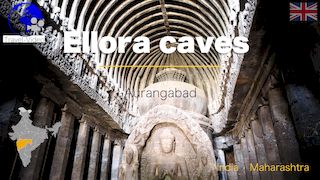
The detailed monuments associated with the video illustrate different aspects of Ellora. Cave 10, Vishwakarma, is a celebrated Buddhist chaitya hall with a ribbed vaulted ceiling. Cave 16 is the great Kailasa Temple. Caves 30 and 32, Chota Kailasa and Indra Sabha, represent the refined later Jain phase of the site.
Historical, Religious, and Architectural Context
Work at Ellora extended approximately from the sixth to the tenth century. Major early excavations are associated with Buddhism, followed by an important Hindu phase, then by Jain developments. This sequence does not necessarily imply strict replacement, since multiple communities may have been active in the region during overlapping periods.
The great Kailāsanātha Temple is generally attributed to the eighth century under the Rashtrakuta dynasty. It reflects a political authority capable of financing an immense enterprise and of expressing royal prestige through association with Shiva. A monolithic temple of this scale was not only a religious monument but also a declaration of power and technical mastery.
Ellora also demonstrates the transfer of forms from built architecture into rock. Elements familiar from masonry temples—pillared halls, towers, shrines, gateways, roof profiles, and sculpted decorative programs—were reinterpreted through excavation rather than construction. The site shows how artisans adapted architectural language to a single material mass without joints or assembled blocks.
Over time, some caves retained ritual functions while others became objects of study and tourism. Modern conservation efforts seek to control erosion, water infiltration, structural stress, and the impact of heavy visitor traffic.
What the Videos on This Site Make Especially Clear
The videos on travel-video.info are often created from carefully selected photographs animated through smooth transitions and progressive framing. This method is especially effective for a complex site such as Ellora. It allows viewers to move from wide views of the cliff face to detailed interiors without losing the sense of overall organization.
The spectator can more easily understand the logic of successive excavations, the relationship between façades and interior halls, and the difference between horizontally cut caves and the freestanding monolithic form of Kailasa. Such spatial comprehension can be difficult during a rapid on-site visit.
Slow transitions also highlight the richness of sculptural decoration: carved columns, narrative friezes, deities, symbolic animals, and monumental relief panels. Light and shadow—essential components of rock-cut architecture—become more legible when the image lingers on surfaces and volumes.
The inclusion of pilgrims and contemporary visitors further reminds the audience that these monuments are not isolated from present life. They remain places of memory, scholarship, and in some cases devotion.
A Mountain Turned into Sacred Architecture
Discovering Ellora through this video means approaching one of the most impressive architectural ensembles in the world, where an entire cliff was transformed into sanctuaries, temples, and ceremonial spaces. To continue the exploration, the detailed pages devoted to the principal caves offer deeper insight into the history, iconography, and engineering achievements of this extraordinary treasure of Maharashtra.




Audio Commentary Transcript
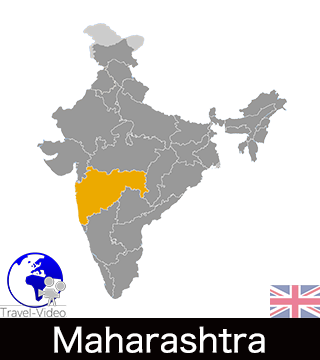
In India, in the state of Maharashtra, there are incredible archaeological wonders. A group of temples carved into a granite cliff during the first centuries of our era. These temples are Buddhist, Hindu and Jain, which once again proves India's great religious tolerance.
The Ellora Caves complex has more than a hundred cavities carved into the basalt.
Among the 34 caves open to the public, 12 of them are Buddhist, 17 Hindu and 5 Jain. Each includes statues of deities and mythologies that prevailed during the first millennium.
Many were monasteries for the respective religions. Cave number 16, Kailasha Temple is the largest excavated monument in the world.

Music:
- - Suresh Prajapati (Inde) - Indian Classical Instrumental - Flute Tabla Raga 1, Suresh Prajapati
- - K.S. Narayanaswami (Inde) - India IV - Karnatic Music (South India) - Pancharagam, Bärenteiter - Musicaphon (BM 30 L 2021)


