Français (France)
  Nederlands (nl-NL)
 00:00 • intro | 00:23 • Elephanta | 01:15 • the courtyard of the main cave | 01:58 • the main cave | 04:11 • Maheshmurti, 3 headed Shiva statue | 05:35 • Garbhagriha, sanctum sanctorum | 06:50 • annex of the main shrine hall
Personal creation from visual material collected during my trip India • Gujarat & Mumbai (2024)
Map of places or practices in Elephanta on this site
• Use the markers to explore the content •
Elephanta, Rock-Cut Shaiva Sanctuary in Mumbai Bay
A Sacred Island Facing the Modern Metropolis
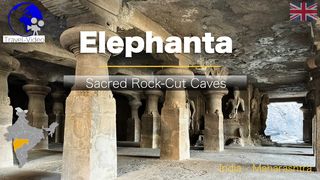
Elephanta Caves form one of the most significant rock-cut religious complexes in western India. Located on an island in Mumbai Bay, the site combines monumental sculpture, excavated architecture, and sacred symbolism within a dramatic maritime setting. Reaching Elephanta by boat already shapes the experience: as the skyline of modern Mumbai recedes, visitors approach a landscape of wooded slopes and volcanic stone associated with a much older spiritual world.
This video introduces a monument whose importance lies not only in its famous sculptures but also in the coherence of its spatial design. Elephanta is more than a decorated cave. It is a carefully planned temple complex carved into living rock, where columns, sanctuaries, ceremonial axes, and divine imagery work together as a complete sacred environment. The site was inscribed on the UNESCO World Heritage List in 1987.
Main Spaces and Themes Seen in the Video
The first views of Elephanta reveal the island environment itself. The combination of elevated terrain, vegetation, and relative separation from the mainland helps explain why such places could function as sacred retreats while still remaining accessible by sea. The path then leads toward the principal cave, the monumental core of the complex.
The open forecourt before the main cave plays an essential transitional role. It marks the passage from daylight into the shadowed interior, preparing visitors for the architectural rhythm of the excavated hall. This movement from exterior openness to interior density strengthens the ceremonial character of the approach.
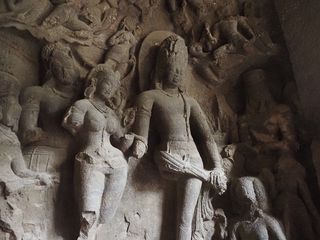
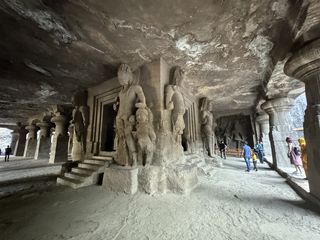
Inside the main cave, the scale of the excavation becomes immediately apparent. Rows of columns organize circulation, frame internal vistas, and divide the hall into structured zones. The walls contain large sculptural panels dedicated to different manifestations of Shiva, transforming the interior into both temple and theological narrative space.
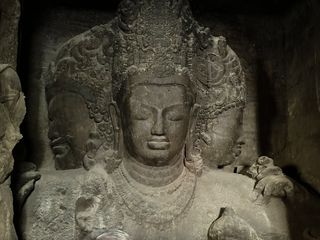
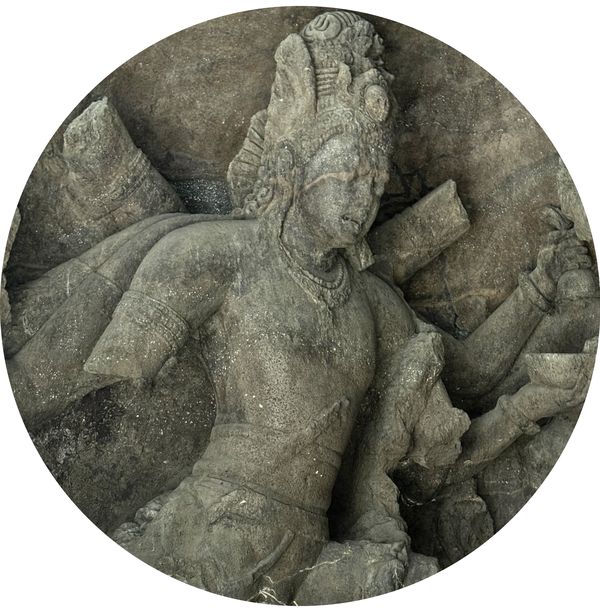
Among these masterpieces, the Maheshmurti is the most celebrated image. This colossal three-headed representation of Shiva is generally interpreted as expressing multiple dimensions of the deity: serenity, generative power, and transformative force. It stands among the great icons of Indian art and remains the visual emblem of Elephanta.
The garbhagriha, or innermost sanctuary, reminds viewers that the cave was conceived as a functioning temple rather than a symbolic monument alone. This sacred chamber once housed a linga, the central cult symbol of Shiva. Smaller subsidiary spaces and annexes complete the organization of the complex.
Historical, Religious, and Artistic Context
The Elephanta caves are generally dated between the sixth and eighth centuries, with the principal phase often placed in the sixth century. Exact attribution remains debated, since several regional powers controlled parts of the western coast during that period. Whatever the patronage history, the site clearly required major political support, skilled artisans, and sustained resources.
Elephanta belongs to the wider Indian tradition of rock-cut architecture, in which sanctuaries, monasteries, and temples were excavated directly into cliffs or hillsides. At Elephanta, that tradition reached an especially ambitious expression in service of Shaivism. The monument transforms stone mass into ceremonial architecture without abandoning the sense of geological permanence.
Its sculptural program presents Shiva in multiple forms: ascetic lord, cosmic dancer, divine householder, supreme principle, and master of destructive and regenerative energies. The temple therefore functioned both as a ritual center and as a visual statement of sophisticated religious ideas. Monumentality was not decorative excess; it was part of spiritual communication.
Later centuries brought decline, neglect, and episodes of damage, especially during the Portuguese period, when several sculptures were harmed. Modern archaeological and conservation campaigns have stabilized the site and improved long-term protection.
What the Videos on This Site Make Especially Clear
The videos on travel-video.info are often built from carefully selected photographs animated through smooth transitions and progressive framing. This method is particularly effective for a complex interior monument such as Elephanta. It allows viewers to move gradually from overall spatial understanding to precise sculptural details without losing orientation.
The relationship between the central hall, side panels, columns, and shrine chamber becomes easier to grasp. During a rapid physical visit, the eye may register fragments rather than structure. Here, the slower visual rhythm helps reconstruct the logic of the excavated temple.
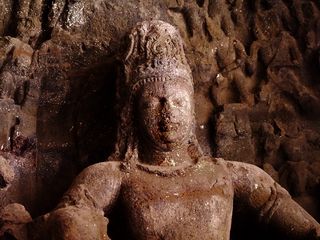
Close views also reveal aspects often missed at first glance: modeling of faces, tension in carved bodies, subtle damage to surfaces, and the dialogue between architecture and sculpture. The Maheshmurti especially benefits from successive approaches that clarify proportion and expression.
Transitions between exterior and interior scenes further illuminate the essential concept of the site: a hidden sanctuary carved into stone, yet designed with the grandeur of a built temple.
A Masterpiece of Rock-Cut India
Discovering Elephanta through this video means approaching one of the major achievements of Indian sacred art, where sculpture, Shaiva symbolism, and spatial mastery meet within an island landscape facing Mumbai. For those wishing to continue the exploration, the detailed page devoted to the Elephanta caves offers deeper insight into the history, iconography, and architecture of this exceptional monument.
Links to related pages





Audio Commentary Transcript
From the port of Mumbai, tourist boats depart daily for Elephanta Island, located about ten kilometres offshore. Now known for its rock-cut caves listed as a UNESCO World Heritage Site, the island was an important centre of Shaivite worship between the 6th and 8th centuries. The sanctuaries were carved into the basalt rock during a period marked by the development of religious art in western India.
Over the centuries, the island lost its spiritual role, and the temples were gradually abandoned. Its remoteness, the lack of continuous settlement, and political changes all contributed to their disappearance from collective memory. The caves were rediscovered in the 16th century with the arrival of the Portuguese. A large elephant-shaped statue, now housed in the Bhau Daji Lad Museum in Mumbai, gave the island its name in European sources.
The site remains modest, both in scale and in the number of truly accomplished caves.
Only the main cave, dedicated to Shiva and carved in the 6th century, offers genuine architectural and iconographic interest.
In front of its entrance lies an open courtyard. At its center, a circular base likely marks the spot where Nandi, Shiva’s sacred bull, once stood. The statue has since disappeared.
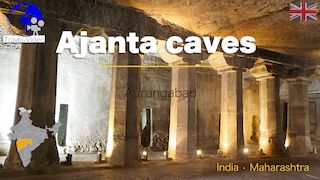
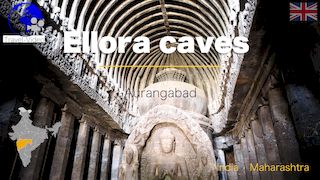
In contrast, the rock-cut complexes of Ajanta — active from the 2nd century BCE to the 6th century CE — and Ellora, developed between the 6th and 10th centuries, reflect far greater religious richness and diversity. Ajanta is entirely Buddhist, while Ellora brings together Buddhist, Hindu, and Jain sanctuaries.
The condition of the Elephanta caves is noticeably poorer than that of other rock-cut sites in Maharashtra. This is due to damage inflicted during the colonial period, when the Portuguese used the caves for target practice, as well as marine humidity, exposure to the elements, and many years of poorly regulated visitor access.
The famous three-headed sculpture in Elephanta’s main cave does not depict the classical Trimurti of Brahma, Vishnu, and Shiva.
Instead, it represents three aspects of Shiva united in a single form.
The central face embodies Shiva in his serene and eternal nature.
On his right, he appears as the fierce and destructive force, while on the left, he takes on a benevolent and creative expression.
This image reflects Shiva’s complexity — at once creator, protector, and destroyer, yet always one and indivisible.
Next to the main shrine hall of Elephanta is a more discreet annex, which also houses a garbhagriha, or inner sanctum. Inside, a second lingam, the symbol of Shiva, is enshrined in a simpler yet clearly sacred space. This dual sanctity reflects the deep-rooted Shaivite devotion on the island.
Music:
- - YouTube video library - Aalaap in Raag Jhinjhoti - Sandeep Das, Adhiraj Chaudhuri
- - YouTube video library - Kirwani - Teental - Aditya Verma, Subir Dev