Français (France)
  Nederlands (nl-NL)
 00:00 • intro | 00:28 • the birds are waiting | 01:01 • the birds fly over | 03:15 • the birds feast | 04:38 • the fish | 07:12 • the boats | 07:30 • salted fish market
Personal creation from visual material collected during my trip India • Gujarat & Mumbai (2024)
Map of places or practices in Diu on this site
• Use the markers to explore the content •
Diu: Fish Market Life on the Coast of Gujarat
A Working Harbour Between Sea and Local Tradition
Diu, on India’s western coast, is often associated with forts and colonial heritage. Yet the town also has another face, more everyday and equally revealing: its maritime life. Facing the Arabian Sea, fishing, fish trading and harbour activity have long played an important role in the local economy. The fish market remains one of the clearest expressions of that relationship.
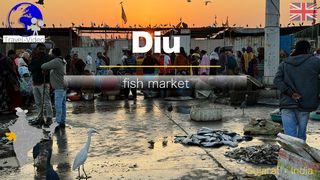
This video explores Diu through labour, movement and coastal routine. Boats arrive, seafood is handled and sold, birds gather above the market, and traditional preservation methods continue beside modern commerce. It presents a living heritage shaped not by monuments alone, but by practical knowledge, daily exchange and close dependence on the sea.
Birds, Fish and the Rhythm of the Market
One of the most striking features is the constant presence of birds waiting around the harbour and market areas. Gulls, crows and other opportunistic species are naturally attracted by discarded fish remains and the movement of fresh catches. Their waiting, circling and sudden descents become part of the visual atmosphere of the place.
These scenes show that coastal markets are not purely human environments. They are small ecosystems where animals, organic waste, tides and commercial activity interact continuously. The birds are therefore more than background detail: they are visible participants in the port landscape.
Fish itself is naturally at the centre of the activity. Sorted, displayed, carried or prepared for sale, it reflects the diversity of marine resources taken from the waters off Gujarat. Depending on species and condition, catches may be sold fresh, traded in bulk, processed or preserved.
Boats play an equally important role. Whether small wooden craft or more robust working vessels, they remind viewers that every market transaction begins offshore. Each boat represents labour at sea, navigation skills and the connection between fishing communities and urban demand.
The salted fish market adds another dimension. Salting and drying are ancient preservation techniques particularly suited to warm coastal climates and trade networks. They allow fish to be stored longer, transported farther and sold beyond the immediate port region.
A Long Maritime Tradition on the Gujarat Coast
The coast of Gujarat has participated in Indian Ocean exchange networks for centuries. Ports, anchorages and fishing communities maintained links with other parts of India, the Arabian Peninsula and East Africa. In this broader context, fishing was never only a local food source; it also formed part of larger systems of commerce.
Because of its island and harbour position, Diu naturally developed strong maritime activities. Even during periods when political history focused on fortifications or colonial rule, local livelihoods continued to depend heavily on the sea.
Fish markets still preserve many older practices today: rapid sorting of catches, direct bargaining, specialized sellers and schedules determined by tides or returning boats. Behind the apparent disorder lies an efficient and experienced system.
What the Videos on This Site Make Especially Clear
A video largely built from carefully selected and animated photographs is especially well suited to a market such as Diu’s. Slow movement across still images allows viewers to notice expressions, professional gestures, textures of fish and details of working boats.
Bird activity also becomes clearer when images take time to show positions, flight paths and proximity to the stalls. The viewer better understands the constant interaction between wildlife and commerce.
For the boats, this approach reveals hull shapes, colours, wear from saltwater use and the organisation of the quay. The salted fish section also becomes easier to interpret through attention to drying surfaces, stacked products and methods of display.
Together, the sequence creates a coherent narrative: the sea provides the resource, boats bring it ashore, the market distributes it and an entire living environment forms around that chain.
Everyday Heritage on India’s Western Coast
Diu’s fish market reveals another side of the town beyond its famous monuments. Here, work, trade and daily contact with the sea tell the story of the place. This video captures that energy and authenticity with clarity. For those wishing to explore further, the detailed page devoted to the fish market offers additional insight into one of Gujarat’s enduring coastal traditions.
Links to related pages
• Main dynasties that ruled the region • •


Audio Commentary Transcript
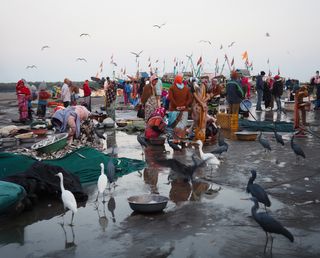
At dawn, on the docks of Diu in Gujarat, the women take their places. They wait — standing or crouching, with folded arms and empty baskets — all facing the sea. They are not alone. Dark silhouettes of birds are already circling above the port, joined by stray dogs and a few silent men. Everything is still quiet. No shouting, no bargaining. The boats are expected, the tubs are empty. It is not yet the market. It is that suspended moment, the one just before the commotion, when the town holds its breath before it begins to stir.
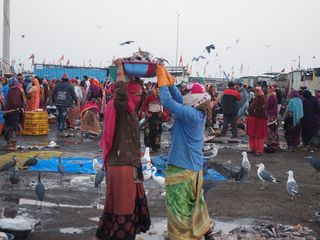
At the fish market in Diu, herons, seagulls, and crows move freely among the stalls and baskets. The vendors, absorbed in their sales, make no attempt to chase them away. Here, coexistence seems natural, almost companionable: everyone finds their place, the people sell, the birds take their share. This tolerance, shaped by a view of life in which every creature has its place, stands in marked contrast to other cultures, where such closeness would quickly be interrupted.
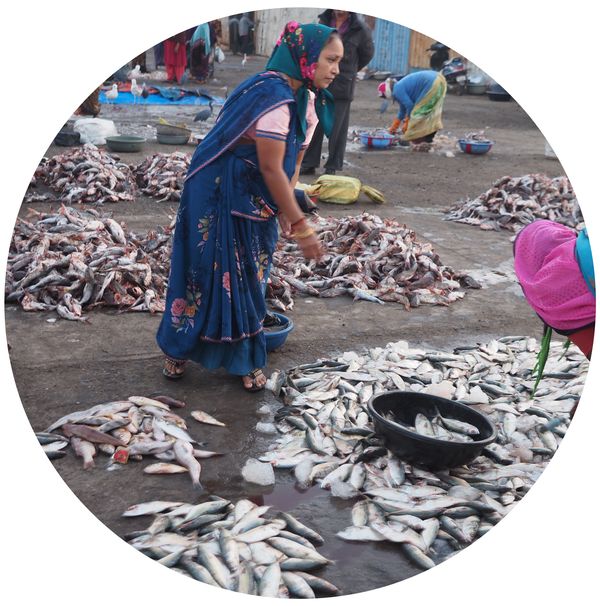
On the quay in Diu, the smell of fish mingles with the calls of the vendors. On the ground, compact piles of fish accumulate in apparent disorder, awaiting sorting or loading. Here, it is not just about selling retail: this is a place where everything is sorted, divided, and sent off again almost immediately. In the crowd, women walk with confident steps, basins balanced on their heads, disappearing sometimes behind a wall of crates, sometimes towards vehicles, sometimes improvised, ready to depart. Most of the catch is already destined for professional buyers, often well before it reaches the quay. Local residents, unable to absorb such quantities, take only a tiny share, while foreign visitors come mainly for the lively atmosphere and striking scene rather than to leave with a fish under their arm.
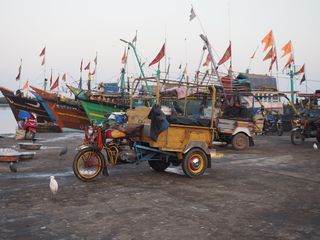
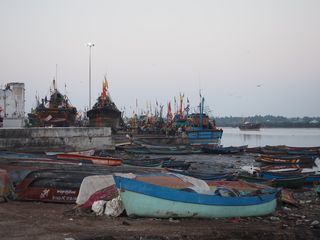
This bustling market would not exist without the boats that supply it. Moored nearby, their colourful hulls tell of long hours spent at sea and the holds emptied at dawn, bringing the quay to life each day.
A little further from the quay, where the smell of the tide is less insistent, a small market tries its luck. No boats here, no auction calls… just dried fish, quietly waiting for someone to take it home.
Far from the bustle of the quay, a small market goes about its quiet business. No freshly landed catch here, no hurried crowd… just dried fish, still under the sun, waiting for customers with the same patience it took to dry.
Music:
- - YouTube video library - Aalaap in Raag Jhinjhoti - Sandeep Das, Adhiraj Chaudhuri
- - YouTube video library - Adana - Teental - Aditya Verma, Subir Dev
- - YouTube video library - Constancy Part 1 - The Descent, (© Constancy Part 1 - The Descent by Kevin MacLeod is licensed under a Creative Commons Attribution 4.0 license. https://creativecommons.org/licenses/by/4.0/
- Source: http://incompetech.com/music/royalty-free/index.html?isrc=USUAN1100775
- Artist: http://incompetech.com/)
Disclaimer: Despite its appropriateness, copyright issues prevent the use of indian traditional music in "Diu • Lively fish market on India’s Arabian Sea coast", hence the use of royalty-free music. Despite our careful selection, some might regret this decision, which is necessary to avoid potential lawsuits. Although difficult, this decision is the only viable solution.