

 Français (France)
  Nederlands (nl-NL)
 Of Islamic tradition, (with additional Hindu and Jain influence), the Gujarat Sultanate ruled for approximately 166 years, ± between 1407 and 1573 over all or part of Central India, North India and West India, during the Medieval Period.
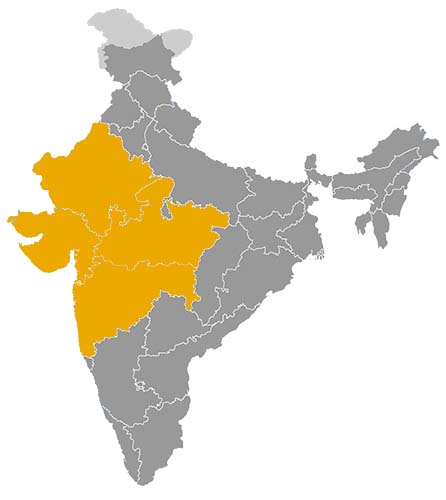
This map illustrates the maximum territory that the Gujarat Sultanate Dynasty had reached at its height, covering the current regions of Gujarat, Madhya Pradesh, Maharashtra and Rajasthan in India. Its main purpose is to provide a visual aid to understand the geographical extent of this dynasty. However, it's important to note that the contemporary borders of these regions may not necessarily coincide with the historical territories.
The Gujarat Sultanate and Its Role in the History of India
A regional power at the crossroads of western India
The Gujarat Sultanate was one of the most important regional states of medieval India. It emerged in the early fifteenth century, when Zafar Khan, a governor appointed under the weakening authority of the Delhi Sultanate, established an independent rule and became known as Muzaffar Shah I. From this political origin, the Muzaffarid dynasty transformed Gujarat into a powerful sultanate that played a major role in the history of western India.
Its importance came from its location. Gujarat stood between Rajasthan, Malwa, the Deccan and the Arabian Sea. This position gave the sultanate access to inland trade routes, fertile agricultural zones and some of the most active ports of the Indian Ocean. As a result, the Gujarat Sultanate became not only a military and political power, but also a commercial and cultural centre with influence beyond its territorial borders.
The creation of an independent political authority
The rise of the Gujarat Sultanate reflected the fragmentation of the Delhi Sultanate and the emergence of strong regional states across India. By asserting independence, the Muzaffarid rulers created a durable political structure that was rooted in local conditions rather than in direct control from northern India.
Ahmad Shah I, who ruled from 1411 to 1442, was especially important in this process. He founded Ahmedabad in 1411 and made it the capital of the sultanate. This act had political, administrative and symbolic significance. Ahmedabad became the centre of royal authority, a major urban settlement and a visible expression of the dynasty’s legitimacy.
The sultans of Gujarat had to govern a complex society. Their subjects included Muslims, Hindus, Jains, merchants, artisans, landholders and local chiefs. Political stability depended not only on military force, but also on negotiation with regional elites and commercial communities. This ability to integrate different social groups helped the sultanate remain influential for more than a century and a half.
Military expansion and regional diplomacy
The Gujarat Sultanate was deeply involved in the political rivalries of western and central India. It competed with the Sultanate of Malwa, Rajput powers such as Mewar and several smaller regional authorities. These rivalries were shaped by the control of forts, routes, borderlands and wealthy cities.
The reign of Mahmud Shah I Begada, from 1458 to 1511, marked the height of Gujarat’s political and military power. His conquests of Junagadh and Champaner strengthened the sultanate’s authority over strategic territories. Champaner was later developed as an important urban and royal centre, showing how military success could be followed by administrative and architectural investment.
The sultanate also faced major challenges in the sixteenth century. The rise of the Portuguese in the Indian Ocean threatened Gujarat’s maritime interests, while the Mughal Empire expanded from the north. Bahadur Shah, one of the last powerful rulers of the dynasty, had to deal with both pressures. The Mughal conquest under Akbar in 1573 ended the effective independence of the Gujarat Sultanate, but the region remained highly important within the Mughal imperial system.
A major commercial centre of the Indian Ocean
The economic role of the Gujarat Sultanate was exceptional. Gujarat was one of the richest commercial regions of medieval India. Its ports, including Cambay, Bharuch, Surat and Diu, connected the subcontinent with Arabia, Persia, East Africa and Southeast Asia. Through these ports passed textiles, cotton goods, indigo, spices, precious materials and many other commodities.
The prosperity of Gujarat depended greatly on merchant communities. Muslim, Hindu and Jain merchants all participated in regional and long distance trade. The sultans benefited from customs duties, port revenues and urban taxation. These resources supported the army, courtly culture, religious institutions and monumental building projects.
This economic strength also gave Gujarat a diplomatic importance that exceeded its size. Foreign merchants, maritime powers and neighbouring rulers all had reasons to maintain relations with the sultanate. At the same time, the wealth of the coast made Gujarat vulnerable to outside pressure, especially after the arrival of the Portuguese, who sought to control sea routes and strategic ports.
A distinctive cultural and architectural legacy
The Gujarat Sultanate produced a rich and distinctive cultural environment. Its architecture is among its most visible achievements. The buildings of Ahmedabad, Champaner and other centres combined Islamic forms with local craftsmanship. Mosques, tombs, gateways and palaces often display refined stone carving, balanced proportions and delicate perforated screens.
This architectural style was not simply an imitation of Delhi or Persian models. It drew strongly on regional traditions, including the skills of artisans familiar with Hindu and Jain building techniques. The result was an Indo Islamic style with a clearly Gujarati character. Structures from this period show how political power, religious expression and local artistic traditions could be joined in a distinctive visual language.
The sultanate also encouraged the growth of urban culture. Cities became centres of administration, worship, trade and craftsmanship. The interaction between different religious and mercantile communities gave Gujarat a cosmopolitan character, especially in its ports and major towns.
A lasting influence on western India
Although the Gujarat Sultanate disappeared as an independent state after the Mughal conquest, its historical role remained significant. It had shaped the political geography of western India, strengthened Ahmedabad as a major city, developed ports that remained crucial under later regimes and left an architectural heritage of great importance.
In the broader history of India, the Gujarat Sultanate represents the power of regional states during the medieval period. It combined military ambition, commercial wealth, urban development and cultural synthesis. Its history shows how a regional dynasty could become a major force by controlling both inland territories and maritime connections. For this reason, the Gujarat Sultanate occupies an important place in the political, economic and cultural history of India.
The geographical expansion of the Gujarat Sultanate in western India
A territorial power rooted in the Gujarat plain
The Gujarat Sultanate emerged in the early fifteenth century from the former province of Gujarat under the weakening authority of the Delhi Sultanate. Its territorial base lay in the fertile and commercially active plains of present day Gujarat, an area bordered by Rajasthan to the north and northeast, Malwa to the east, the Deccan to the south and the Arabian Sea to the west. This position gave the sultanate both inland and maritime strength.
The early Muzaffarid rulers inherited a region already structured by older urban centres, agricultural zones and trade routes. Towns such as Patan, Cambay, Bharuch and later Ahmedabad formed the core of political and economic control. From this base, the sultans gradually extended their influence over surrounding regions, including coastal districts, fortified hill areas and parts of the Kathiawar peninsula.
Ahmedabad and the consolidation of central Gujarat
The foundation of Ahmedabad by Ahmad Shah I in 1411 was a decisive moment in the geographical organisation of the sultanate. The new capital was located in central Gujarat, in a position that allowed the rulers to control both the inland agrarian districts and the routes leading to the coast. It replaced older centres of authority and gave the dynasty a stronger administrative and symbolic focus.
Central Gujarat became the political heart of the kingdom. From Ahmedabad, the sultans could supervise revenue collection, military campaigns and relations with local chiefs. The region contained productive agricultural land, important craft centres and merchant communities whose cooperation was essential to the prosperity of the state. Control over this core area gave the sultanate the stability required for expansion toward more contested frontier zones.
Expansion into Kathiawar and the western coastal lands
One of the most important directions of expansion was toward Kathiawar, also known as Saurashtra. This peninsula was strategically valuable because it controlled access to coastal routes, ports and maritime networks in the Arabian Sea. It also contained strong local lineages, including Rajput chiefs, who did not always accept the authority of the sultans.
The conquest of Junagadh under Mahmud Shah I Begada was one of the major achievements of Gujarat’s territorial expansion. Junagadh, situated near the Girnar hills, had strong military and symbolic importance. Its capture strengthened the sultanate’s position in western Gujarat and helped extend royal authority over parts of the peninsula. The expansion into Kathiawar also improved access to maritime commerce, though local resistance and semi autonomous powers remained a recurring feature of the region.
Champaner and the eastern frontier toward Malwa
The conquest of Champaner was another major stage in the territorial history of the sultanate. Located in the eastern part of Gujarat, near routes leading toward Malwa and central India, Champaner gave the sultans a strong frontier position. After its conquest by Mahmud Begada, it was developed as an important royal and urban centre.
This eastern expansion had direct consequences for relations with the Sultanate of Malwa. Gujarat and Malwa competed for influence over border territories, forts and commercial routes connecting western India with the central Indian plateau. The frontier between the two states was not merely a line of separation. It was a zone of rivalry, diplomacy and occasional military confrontation. Control of Champaner gave Gujarat a strategic advantage, but it also increased the likelihood of conflict with powers to the east.
Relations with Rajput states along the northern margins
To the north and northeast, the Gujarat Sultanate came into regular contact with Rajput states, especially Mewar and other powers of Rajasthan. These relations were shaped by geography. The frontier between Gujarat and Rajasthan included routes, hill forts and semi autonomous chiefs who could shift their loyalties according to political circumstances.
The sultans of Gujarat sometimes fought Rajput rulers, sometimes negotiated with them and sometimes became involved in wider regional rivalries. Mewar, in particular, represented a powerful neighbour whose ambitions overlapped with those of Gujarat in frontier areas. The competition was not only military. It also concerned prestige, access to routes and influence over intermediate territories. The presence of strong Rajput powers prevented Gujarat from expanding indefinitely northward, but it also made the sultanate an essential participant in the political balance of western India.
Maritime territories and the importance of the Arabian Sea
The geographical power of the Gujarat Sultanate cannot be understood without its coast. Ports such as Cambay, Bharuch, Surat and Diu connected the kingdom to the wider Indian Ocean world. Through them, Gujarat traded with Arabia, Persia, East Africa and Southeast Asia. The coast was therefore not a peripheral zone, but one of the foundations of the sultanate’s wealth and political influence.
Control of maritime outlets allowed the sultans to collect customs duties, encourage trade and maintain relations with foreign merchants. It also gave Gujarat a diplomatic role beyond the subcontinent. However, the same maritime exposure brought new dangers. In the sixteenth century, Portuguese expansion in the Indian Ocean challenged Gujarat’s control over sea routes and strategic ports, especially Diu. This changed the balance of power along the coast and forced the sultans to combine regional politics with maritime diplomacy.
The Deccan, Malwa and the limits of expansion
Although Gujarat was powerful, its expansion was limited by strong neighbours. To the east, Malwa remained a rival. To the south, the Deccan sultanates and other regional powers shaped the political horizon. To the north, Rajput states resisted sustained domination. These surrounding powers meant that Gujarat’s territory was never a simple expanding empire, but a regional state whose influence depended on strategic control of key zones.
The sultanate’s strength lay in combining a secure core, fortified frontiers and commercial ports. Its rulers did not need to control all surrounding regions directly in order to be influential. By holding Gujarat’s plains, parts of Kathiawar, Champaner and major ports, they could affect the politics of western and central India.
Mughal conquest and the transformation of Gujarat’s territory
By the sixteenth century, internal factionalism, Portuguese pressure and Mughal expansion weakened the sultanate. Bahadur Shah attempted to preserve Gujarat’s power, but the kingdom became increasingly exposed. In 1573, Akbar incorporated Gujarat into the Mughal Empire, ending its effective independence.
The territorial importance of Gujarat did not disappear after the fall of the sultanate. Its cities, ports and trade routes remained central to the Mughal economy and administration. The former sultanate had created a regional framework that later empires continued to exploit. Its geographical expansion therefore shaped not only the history of the Muzaffarid dynasty, but also the later political and economic organisation of western India.
The rulers of the Gujarat Sultanate bore the title of sultan. The early decades included phases of provincial governorship, gradual independence and contested rule. The dates given are generally accepted regnal dates, but in some cases they remain indicative depending on the chronology used.
- Muzaffar Shah I (1407–1411) • Former governor of Gujarat under the name Zafar Khan, he asserted the autonomy of the sultanate and founded the Muzaffarid dynasty.
- Muhammad Shah I (1403–1404, contested rule) • Son of Muzaffar Shah I, he briefly seized power before the independent sultanate was firmly consolidated.
- Ahmad Shah I (1411–1442) • He consolidated the state, founded Ahmedabad and made Gujarat one of the major regional sultanates of western India.
- Muhammad Shah II (1442–1451) • His reign maintained dynastic authority, but was marked by regional political and military tensions.
- Qutb ud-Din Ahmad Shah II (1451–1458) • He continued the policies of his predecessors amid rivalries with Malwa, Rajasthan and local powers.
- Daud Shah (1458) • He ruled very briefly before being removed by the nobles of the sultanate.
- Mahmud Shah I Begada (1458–1511) • He brought the sultanate to its political and territorial height, notably through the capture of Junagadh and Champaner.
- Muzaffar Shah II (1511–1526) • His reign prolonged Gujarat’s power, while facing rivalries with Malwa, Mewar and the powers of the Deccan.
- Sikandar Shah (1526) • He ruled for only a few weeks before being assassinated during a succession crisis.
- Mahmud Shah II (1526) • He was briefly proclaimed in the troubled context that followed the death of Sikandar Shah.
- Bahadur Shah (1526–1535, 1536–1537) • He was one of the last great sultans of Gujarat, fought the Portuguese and temporarily lost his kingdom to the Mughal emperor Humayun.
- Miran Muhammad Shah I (1537, disputed designation) • Sultan of Khandesh and designated heir of Bahadur Shah, he died before he could firmly establish his authority in Gujarat.
- Mahmud Shah III (1537–1554) • His reign was dominated by the influence of nobles as the central authority of the sultanate weakened.
- Ahmad Shah III (1554–1561) • He ruled during a period of growing political instability and rivalry between aristocratic factions.
- Muzaffar Shah III (1561–1573, then claimant until 1592) • The last effective sultan of Gujarat, he lost the kingdom during the Mughal conquest of 1573 and later remained an intermittent claimant.