Français (France)
  Nederlands (nl-NL)
 00:00 • intro | 00:20 • the Panikotha fortress | 01:02 • the fort of Diu | 03:38 • old town of Diu | 06:11 • St. Paul’s Church
Personal creation from visual material collected during my trip India • Gujarat & Mumbai (2024)
Map of places or practices in Diu on this site
• Use the markers to explore the content •
Diu: Colonial Heritage and Living History on India’s Western Coast
A Former Portuguese Enclave at the Crossroads of Maritime Worlds
Diu occupies a distinctive position on the western coast of India, just off the Kathiawar Peninsula and today administratively linked to the Union Territory of Dadra and Nagar Haveli and Daman and Diu. Small in size but rich in history, the town was once a strategic port in the Indian Ocean world. Its coastal location made it highly desirable for regional powers before it became one of the most important Portuguese possessions in India for several centuries.
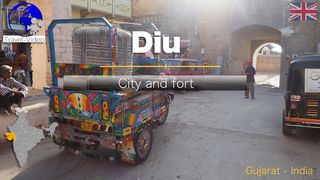
This video introduces a heritage landscape where military architecture, colonial urban form, Christian religious monuments and everyday local life continue to coexist. Sea-facing fortifications, historic streets, monumental churches and island defensive works create an ensemble rarely found elsewhere in India. Diu appears here as a place where European imperial history and Gujarati cultural continuity became deeply intertwined.
Maritime Fortresses, Historic Streets and a Remarkable Church
Panikotha Fortress is one of Diu’s most recognizable landmarks. Built on a small island facing the town, it once formed part of a larger defensive network protecting the harbour approaches. Surrounded by water, the structure illustrates how maritime security was essential in a region shaped by naval rivalry and commercial competition.
The Fort of Diu is the principal military monument of the town. Constructed in the sixteenth century after Portuguese consolidation, it combines massive walls, bastions, sea views and artillery-oriented design. Its commanding position allowed control over coastal routes and access to the port. Even today, the scale of its fortifications dominates the surrounding landscape and recalls the strategic ambitions of overseas empires.
The historic centre of Diu preserves an urban fabric strongly marked by the colonial era. Narrow streets, mixed architectural influences, modest yet elegant façades, small squares and civic buildings reflect long interaction between European planning traditions and local building practices. The townscape is not a frozen museum setting; it remains part of daily life.
St Paul’s Church is among the most remarkable religious monuments of Diu. Its richly ornamented façade, often cited as one of the finest examples of baroque church architecture in India, stands in contrast with the relative sobriety of nearby buildings. Inside, the spatial arrangement and decorative programme continue that architectural dialogue between devotion and display.
Between Regional Powers, Portuguese Rule and Modern India
Before Portuguese domination, Diu belonged to regional political systems connected with Gujarat. The port already participated in Indian Ocean trade networks linking Arabia, East Africa and South Asia. Control of Diu therefore represented both economic opportunity and military advantage.
In the sixteenth century, the Portuguese established a lasting presence and transformed the town into a fortified maritime outpost. Diu then became part of a chain of coastal settlements through which European powers sought influence over Asian trade routes. Unlike ports devoted mainly to commerce, Diu retained a strong defensive character.
After the integration of Portuguese territories into the Indian Union in the twentieth century, Diu continued to evolve as an Indian coastal town while preserving a distinctive urban memory. Its present identity results from layered history rather than a single cultural inheritance.
Architecturally, the town combines stone fortifications, Christian monuments, coastal domestic forms and Gujarati vernacular elements. Sea light, wind and open horizons remain central to the experience of the site.
What the Videos on This Site Make Especially Clear
A video largely built from carefully selected and animated photographs is particularly well suited to Diu. Slow movement across still images helps viewers understand the relationship between bastions, walls and the surrounding sea, which is essential to reading any coastal fortress.
At the Fort of Diu, this approach highlights wall thickness, firing angles, gateways and long defensive perspectives. At Panikotha, it emphasizes the strategic isolation of the island stronghold within the harbour waters.
In the historic centre, animated images make façades, street proportions and the coexistence of styles easier to appreciate. At St Paul’s Church, they reveal sculptural detail and the balance of the façade more clearly than rapid footage often can.
The sequence of views also creates a coherent interpretation of the town: maritime defence, inhabited streets, religious monument and coastal setting become connected parts of one historical landscape.
A Rare Coastal Heritage Site in India
Diu brings together fortifications, colonial memory and living urban continuity within a compact setting. This video offers a clear introduction to its many dimensions. For those wishing to continue the exploration, the detailed pages devoted to the fort, Panikotha, the historic centre and St Paul’s Church provide valuable additional insight into one of the most original heritage ensembles on India’s western coast.
Links to related pages
• Main dynasties that ruled the region • •




Audio Commentary Transcript
Portuguese colonization
The history of Diu, a small port town in Gujarat, western India, remains marked by its past as a Portuguese colony, established in the 16th century and maintained for more than 400 years. The Panikotha fortress, built on a rocky islet facing the fort of Diu, served both as a maritime outpost and as a prison, where local rebels and prisoners of war were held. Isolated in the Arabian Sea, it reflected the Portuguese ambition to dominate regional trade by controlling maritime routes and taxing transport to their own profit.
Long before colonisation, Diu was already known as Div or Dib, mentioned in local traditions and by Arab chroniclers. At that time, it was under the rule of the Chudasama dynasty of Junagadh, who governed the Kathiawar Peninsula for several centuries, before giving way to the Sultanate of Gujarat in the 14th century. It was in this context, marked by competition for the ports of India’s western coast, that the Portuguese settled in the 16th century. They then built these massive forts, with the main fort overlooking the town and Panikotha facing it, to consolidate their position and affirm their domination over the region.
The fort of Diu
The main fort of Diu, a vast citadel built by the Portuguese, housed much more than defensive walls. Inside were barracks, warehouses, and chapels, forming a small fortified town. Its seafront bastions not only protected the garrison but also controlled the port and the city below. Today, these structures still bear witness to daily life within a colonial outpost.
The old town
The historic center of Diu still bears the marks of Portuguese colonial architecture: arcaded houses, carved balconies and façades of European influence recall centuries of foreign rule. Yet beyond this visible imprint, the town has developed in a distinctly Indian way. Buildings have been reinterpreted and transformed, enriched with vivid colors and decorative forms typical of the subcontinent. In the streets, everyday life conveys an unmistakably Indian atmosphere, marked by vitality, contrasts, and local appropriation. The result is an urban fabric where colonial heritage and Indian identity coexist and interact.
Saint Paul’s Church
The last Christian temple still active in Diu, Saint Paul’s Church illustrates the baroque architecture introduced by the Portuguese. Its richly decorated façade forms part of an imposing conventual complex once occupied by missionaries. Inside, the whiteness of the walls contrasts with the finely carved dark wooden altarpiece, while the stuccoed vault recalls the virtuosity of the baroque style. Remarkably well maintained, the sanctuary is still frequented today by a small Catholic community, descendants of the families converted during the colonial period.

Music:
- - YouTube video library - Dhun (Sarangi, Tabla) - Sandeep Das, Aneesh Mishr
- - YouTube video library - For Originz, (© For Originz by Kevin MacLeod is licensed under a Creative Commons Attribution 4.0 license. https://creativecommons.org/licenses/by/4.0/
- Source: http://incompetech.com/music/royalty-free/index.html?isrc=USUAN1100700
- Artist: http://incompetech.com/)
- - YouTube video library - Swans In Flight - Asher Fulero
Disclaimer: Despite its appropriateness, copyright issues prevent the use of indian traditional music in "Diu • Colonial Heritage and Living History of Gujarat", hence the use of royalty-free music. Despite our careful selection, some might regret this decision, which is necessary to avoid potential lawsuits. Although difficult, this decision is the only viable solution.