Français (France)
  Nederlands (nl-NL)
 00:00 • intro | 00:37 • Rock Edicts of Ashoka | 01:55 • Shanti Stupa (Peace Pagoda)
Personal creation from visual material collected during my trip India • Amazing East India: Assam, Odisha, West Bengal (2023)
Map of places or practices in Dhauli on this site
• Use the markers to explore the content •
Dhauli: From Ashoka’s Edicts to the Shanti Stupa in Odisha
A Place Where Imperial History Meets Spiritual Memory
Dhauli, located in Odisha near Bhubaneswar, occupies an important place in the history of the Indian subcontinent. This hill overlooking the plains of the Daya River is closely associated with one of the most significant episodes of Emperor Ashoka’s reign: the Kalinga War in the third century BCE. According to long-established historical tradition, the scale of suffering caused by that conflict deeply affected the Mauryan ruler and influenced his turn toward a policy shaped by dharma and the spread of Buddhism.
This video presents a compact yet highly meaningful journey through two monuments from very different periods. On one side are Ashoka’s rock edicts, among the earliest political and moral inscriptions in Indian history. On the other stands the modern Shanti Stupa, a monument dedicated to peace. Dhauli therefore appears as a site of symbolic continuity linking imperial power, moral transformation and universal ideals.
Ashoka’s Edicts and the Peace Pagoda
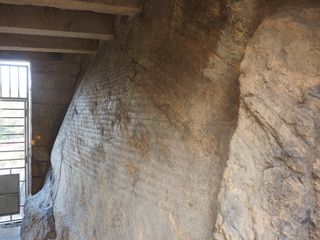
The first major feature of the site is the group of Ashokan edicts carved into the rock. These official inscriptions were placed across the Mauryan Empire to communicate the emperor’s principles of governance: moderation, justice, compassion, ethical conduct and concern for public welfare. Their presence at Dhauli gives the place exceptional historical value, directly connecting today’s landscape with one of the great moments of ancient Asia.
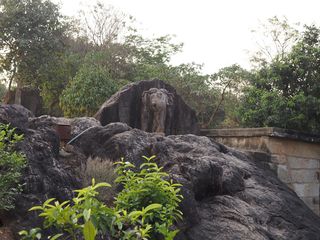
The rock is also famous for a sculpted elephant emerging from the stone. This striking image is often interpreted as a symbol of strength, awakening or Buddhist significance. It adds an artistic dimension to the site, where text and sculpture work together to express authority and meaning.
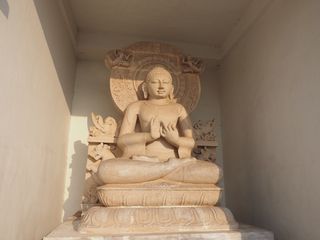
The second focal point is the Shanti Stupa, or Peace Pagoda. Built in the twentieth century with the support of Buddhist peace movements, it reinterprets the ancient stupa form in a modern context. Its white surfaces, circular terraces and sculptural panels depicting episodes from the life of the Buddha contrast with the austere simplicity of the ancient inscriptions below. From the hilltop, the monument overlooks the surrounding countryside.
From the Kalinga War to a Message of Peace
Dhauli is traditionally linked to the Kalinga War, fought by Ashoka during the expansion of the Mauryan Empire. Historical sources describe the conflict as extremely destructive. In later inscriptions, the emperor expressed remorse and a desire to govern through moral principles rather than conquest. Although historians continue to debate aspects of this transformation, Dhauli remains one of the places most strongly associated with that turning point.
The Mauryan Empire itself was one of the earliest large-scale political formations in Indian history. It governed vast territories and developed new forms of public communication, especially through inscriptions on rocks and pillars intended for broad audiences.
The Peace Pagoda adds a modern interpretation to the same landscape. Constructed in a century marked by world wars and ideological conflict, it transforms a place associated with ancient violence into a setting dedicated to reconciliation, reflection and peace.
What the Videos on This Site Make Especially Clear
A video largely created from carefully selected and animated photographs is particularly well suited to Dhauli. Slow movement across still images allows viewers to study Ashoka’s inscriptions, which can be difficult to appreciate quickly on site or in conventional footage.
For the Shanti Stupa, this method highlights geometric volumes, white surfaces, stairways, sculptural details and the relationship between monument and horizon. The viewer gains a clearer sense of why the stupa was placed on the hill.
The contrast between ancient epigraphy and modern architecture also becomes easier to understand. The video creates a visual dialogue between two eras separated by more than two thousand years.
A Major Historical Site of Odisha
Dhauli brings together imperial memory, epigraphic heritage and a modern message of peace within a striking landscape. Few places illustrate so clearly the passage from warfare to reconciliation. For those wishing to continue the exploration, the detailed pages devoted to Ashoka’s edicts and the Shanti Stupa offer valuable additional insight into one of Odisha’s most significant historical sites.
Links to related pages








Audio Commentary Transcript
In Dhauli, south of Bhubaneswar, two distinct monuments reflect very different historical periods.
The Shanti Stupa, built in the 20th century, continues a pacifist message that began long before.
It is part of a group of similar stupas erected by the Japanese organization Nipponzan Myohoji, including ones in Rajgir, in the Indian state of Bihar, and in Pokhara, Nepal.
A little further down, the rock edicts of Ashoka, dated to the 3rd century BCE, mark a political and moral turning point following the Mauryan conquest of Kalinga—an ancient kingdom once located in what is now Odisha.
Ashoka’s edicts are inscriptions carved into stone in the 3rd century BCE.
They reflect a major shift in policy following the bloody Battle of Kalinga, during which thousands of civilians were killed or deported.
Deeply affected by the scale of the massacre, Emperor Ashoka renounced violence and began promoting a form of governance based on morality, tolerance, and non-violence.
At Dhauli, these edicts are carved into a rock face topped by a sculpted elephant head, a traditional Buddhist symbol of awakening.
The Peace Pagoda of Dhauli, or Shanti Stupa, was built in 1972 by the Japanese Buddhist organization Nipponzan Myōhōji, founded by monk Nichidatsu Fujii. This movement began, after World War II, building peace stupas around the world — in India, Nepal, Sri Lanka, as well as in Europe and Japan.
The initiative arose from the trauma of the atomic bombings of Hiroshima and Nagasaki in 1945. For Nichidatsu Fujii, a follower of Nichiren Buddhism, it was urgent to remind the world of the Buddha’s teachings of peace in the face of nuclear threat. These modern stupas, modest yet universal, express a global call for nonviolence.
The parallel with Ashoka’s edicts, carved more than two millennia earlier on the rocks of Dhauli, is striking. Both emerged from a brutal awareness of war’s horrors. One after the battle of Kalinga in the 3rd century BCE, the other after the tragedies of the 20th century. Both deliver a message of peace, engraved in stone, as a lasting call to wisdom and compassion.

Music:
- - YouTube video library - Home for the Holidays - TrackTribe
Disclaimer: Despite its appropriateness, copyright issues prevent the use of indian traditional music in "Dhauli, Odisha • From Ashoka’s Edicts to the Shanti Stupa", hence the use of royalty-free music. Despite our careful selection, some might regret this decision, which is necessary to avoid potential lawsuits. Although difficult, this decision is the only viable solution.