

 Français (France)
  Nederlands (nl-NL)
 The historic centre of Diu, in the Indian state of Gujarat, presents an urban landscape shaped by a combination of cultural and colonial influences. Its layout reflects the legacy of Portuguese presence, visible in the street patterns, the architecture of buildings, and the presence of both civic and religious monuments. This area illustrates Diu’s former significance as a strategic point in regional maritime and trade networks. Today, it remains an active district, balancing local activity with heritage preservation, providing insight into the city’s urban development over several centuries.
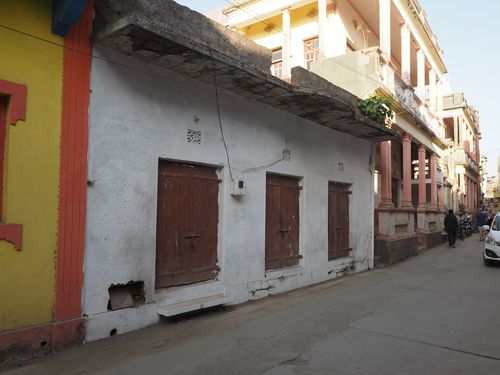
Diu • Historic centre

Diu • Historic centre

Diu • Historic centre
Monument profile
Historic centre
Monument category: Historic urban landscape
Monument family: Historic or traditional habitat
Monument genre: Residential
Geographic location: Diu • Gujarat • India
Construction period: 16th century AD
• Links to •
• List of videos about Diu on this site •
Diu • Colonial Heritage and Living History of Gujarat
Diu • Lively fish market on India’s Arabian Sea coast
History of the Historic Centre of Diu
The historic centre of Diu, located on the island of the same name in the present-day Indian state of Gujarat, represents a layered narrative of political ambition, maritime strategy, and cultural exchange. Its evolution over several centuries reflects both the local traditions of western India and the broader sweep of global maritime history during the age of European expansion.
Political and Social Context of Construction
The strategic importance of Diu was recognised long before European powers entered the Indian Ocean. In the early 16th century, the port was under the control of the Sultanate of Gujarat, a significant regional power that commanded extensive trade networks. Diu’s location along the Kathiawar coast made it an essential node in the maritime routes that connected the Arabian Peninsula, East Africa, and Southeast Asia.
Portuguese interest in Diu was driven by a combination of commercial and military imperatives. They sought to secure a fortified base that would give them dominance over the spice trade and protect their shipping lanes from competing powers, including the Sultanate of Gujarat, the Ottoman Empire, and emerging European rivals. The Treaty of Bassein, signed in 1534 between Sultan Bahadur Shah of Gujarat and the Portuguese, formalised the cession of Diu to Portugal in exchange for military assistance against the Mughals and other threats. This agreement marked the beginning of a long period of European control over the settlement.
The construction and consolidation of the historic centre under Portuguese authority were thus motivated by both defensive needs and the ambition to project imperial power across the Indian Ocean. Fortifications, administrative buildings, and religious institutions were established to secure their hold and to symbolise their cultural and political presence.
Major Historical Events
Diu became the focal point of several major military engagements in the 16th century. The sieges of 1538 and 1546, mounted by Ottoman fleets and their Gujarati allies, aimed to expel the Portuguese from the island. The defenders repelled these assaults, and the subsequent fortifications reinforced Diu’s reputation as one of the most secure Portuguese strongholds in Asia.
Over the following centuries, the relative importance of Diu diminished as other colonial powers, notably the Dutch and the British, expanded their influence in the Indian Ocean. Nevertheless, Diu remained under Portuguese control until the mid-20th century. During this period, the historic centre underwent gradual transformations, adapting to changing administrative needs and shifting trade patterns.
In 1961, the Indian government launched Operation Vijay to integrate Portuguese India into the Republic of India. Diu, along with Goa and Daman, came under Indian administration, ending more than 400 years of Portuguese presence. This political transition brought new uses for many of the buildings in the historic centre, as Indian authorities repurposed colonial structures for civic and commercial activities.
Global Context at the Time of Construction
The development of Diu’s historic centre coincided with a period of intense maritime competition worldwide. In the early modern era, European powers were establishing fortified outposts along major trade routes in Africa, Asia, and the Americas. The Portuguese applied similar principles in Diu as in other strategic locations such as Goa, Malacca, and Mombasa: fortified perimeters, integrated urban planning, and religious architecture intended to consolidate control and assert cultural influence.
These fortified towns were part of a larger network of maritime strongholds designed to protect shipping and monopolise commerce. The architecture and layout of the historic centre of Diu thus fit into a global trend of constructing multi-functional urban spaces that combined military defence, administrative governance, and mercantile activity.
Transformations Over the Centuries
Throughout its history, the historic centre has undergone numerous alterations. Defensive walls were expanded or reinforced after major sieges, and certain military installations were adapted for peacetime use. Religious buildings, particularly churches, were renovated or rebuilt to reflect evolving architectural styles and to accommodate changes in liturgical practice.
Periods of economic decline, especially in the 18th and 19th centuries, led to reduced maintenance and the repurposing of some structures for residential or storage purposes. In the post-colonial era, the Indian administration adapted several prominent buildings for government offices, museums, or cultural venues, while others were converted into hotels or shops catering to the growing tourist trade.
Urban development in the surrounding areas has also influenced the historic centre, with new roads and infrastructure altering access patterns and the spatial relationship between the old town and newer districts.
Role and Cultural Importance Today
Today, the historic centre of Diu functions both as a living neighbourhood and as a heritage attraction. Its blend of Indo-Portuguese architecture, narrow streets, and prominent landmarks draws visitors interested in history, culture, and architecture. For the local population, it remains a space of social interaction, commerce, and religious observance.
The centre also plays a role in shaping local identity, serving as a visible reminder of the island’s distinctive historical trajectory. Annual religious processions, community festivals, and cultural events often use the historic centre as their stage, reinforcing its significance as both a civic and a cultural hub.
State of Conservation and Modern Challenges
The preservation of the historic centre faces several challenges. Environmental factors, including high humidity, salt-laden winds, and seasonal monsoon rains, contribute to the gradual deterioration of stone, plaster, and wooden elements. Urban pressures from tourism and commercial development can lead to inappropriate alterations or neglect of less prominent structures.
Conservation policies have focused on stabilising major monuments and restoring key façades, but the diversity of ownership and the mix of private and public spaces complicate systematic preservation efforts. Proposals to seek UNESCO World Heritage status have been discussed, as such recognition could bring greater resources and stricter protection measures. However, achieving this goal would require comprehensive documentation, sustainable tourism planning, and community engagement to balance heritage preservation with economic needs.
Architecture of the Historic Centre of Diu
The historic centre of Diu, situated on the island of the same name in the present-day Indian state of Gujarat, represents a unique fusion of architectural traditions shaped by centuries of cultural exchange, maritime trade, and colonial governance. Its built environment reflects both the defensive needs of a strategic port and the aesthetic ambitions of Indo-Portuguese civic and religious architecture. The urban and architectural fabric reveals the adaptation of European forms to local materials, climate, and craftsmanship, resulting in a distinctive identity that still defines the area today.
Technological and Architectural Innovations of the Period
When the Portuguese consolidated their presence in Diu in the mid-16th century, they introduced construction techniques uncommon in the region at the time. The town’s layout integrated defensive and civic functions, with narrow winding streets designed to regulate movement, improve shade, and facilitate defence against invaders. The strategic placement of buildings maximised the natural ventilation provided by coastal winds, while elevated ground floors and solid stone foundations offered protection against seasonal flooding and tidal surges.
Military engineering influenced much of the design. Bastioned fortifications, curtain walls, and strategically placed watchtowers were incorporated into the urban grid. The adaptation of Renaissance fortification principles to an Indian coastal environment was a significant technological achievement, requiring modifications to withstand the high humidity and salinity of the Arabian Sea climate. The integration of open courtyards, loggias, and shaded arcades within civic and residential buildings demonstrated an understanding of local climatic needs, creating comfortable interior spaces in an otherwise hot and humid environment.
Materials and Construction Methods
The architecture of the historic centre is characterised by the extensive use of locally quarried stone, particularly sandstone and limestone, chosen for their availability, workability, and resilience to the corrosive effects of the marine environment. These stones, when combined with lime-based mortars, created durable structures capable of withstanding both monsoon rains and coastal winds.
Teak wood, abundant in the region and prized for its resistance to termites and moisture, was used extensively for structural beams, roof frameworks, and intricately carved doors and balconies. Roof coverings were typically made of terracotta tiles, chosen for their insulating properties and suitability for shedding heavy monsoon rains.
The Portuguese also introduced construction techniques such as barrel vaulting and the use of voussoir arches in load-bearing walls, providing greater stability and allowing for larger open interior spaces than was common in purely local building traditions. Stone was often finely dressed for monumental façades while rougher masonry was used for less visible structural elements, optimising material use without compromising strength.
Architectural and Artistic Influences
The historic centre’s architecture is an eloquent example of cultural synthesis. Portuguese influence is evident in the formal geometry of façades, the use of classical orders in columns and pilasters, and the inclusion of decorative pediments and cornices. Churches in the area exhibit elements of Mannerist and Baroque styles, with symmetrical façades, bell towers, and niches containing religious statuary.
Local Gujarati craftsmanship introduced elements such as finely carved wooden balconies (jharokhas), stone lattice screens (jali), and ornamental friezes featuring floral and geometric motifs. Islamic architectural influences, inherited from earlier Sultanate rule, are visible in certain arch profiles, domed structures, and the use of courtyards as spatial organisers.
Colour and texture also reflect the hybridisation of traditions: plastered walls painted in soft whites and ochres recall Mediterranean coastal towns, while carved stone surfaces bear the imprint of regional decorative vocabulary. These elements combined to create an architecture that was both functional and expressive of the town’s cosmopolitan identity.
Organisation and Structure
The spatial organisation of the historic centre demonstrates a clear hierarchy of uses. Near the waterfront, commercial warehouses and administrative offices occupied robust stone buildings with minimal ornamentation but strong load-bearing capacity. Residential quarters were typically arranged around narrow, shaded streets, with two-storey houses featuring arcaded ground floors and overhanging balconies for upper levels.
Public squares, often flanked by churches or civic buildings, acted as focal points for community life. The churches themselves were prominent both in scale and placement, often oriented to create commanding views along major streets or open spaces.
Architectural details of note include semicircular and segmental arches, heavy stone balustrades, colonnaded porticoes, and decorative corbels supporting wooden balconies. Frescoes and painted ceilings survive in some religious and residential interiors, though many have faded over time. The combination of functional defensive elements with civic and religious structures was distinctive, giving the historic centre both a fortified and a ceremonial character.
Notable Statistics and Anecdotes
While the historic centre is a composite urban area rather than a single building, several structures stand out for their scale and technical accomplishment. The walls of certain fortifications reach thicknesses exceeding two metres, designed to resist artillery fire. The largest church in the centre is over 30 metres long and features a vaulted nave that rises more than 15 metres, an impressive engineering feat for the time and place.
Local accounts mention that certain building materials, including paving stones and statuary, arrived as ballast on Portuguese ships and were repurposed for construction. Other traditions suggest that some of the town’s church bells were cast in Portugal and transported to Diu at great expense, underscoring the symbolic importance placed on these structures.
International Recognition and Conservation Challenges
The architecture of Diu’s historic centre contributes significantly to the study of Indo-Portuguese heritage, illustrating how European colonial powers adapted their building practices to distant and challenging environments. The site has been recognised at the national level for its cultural significance, and there have been periodic discussions about nominating it for UNESCO World Heritage status. Such recognition would underscore the centre’s role as a tangible record of cross-cultural exchange in the Indian Ocean.
Conservation efforts face persistent challenges. Salt-laden air and high humidity cause gradual erosion of stonework and corrosion of metal fittings. The wooden elements, though made from durable teak, require regular treatment to prevent deterioration. Urban pressures, particularly from tourism, risk introducing insensitive alterations or the replacement of traditional materials with inappropriate modern substitutes.
Recent restoration campaigns have focused on stabilising key monuments and repairing façades, often using traditional materials and techniques to maintain authenticity. However, the fragmented ownership of properties and the continued use of the area as a residential and commercial district mean that conservation must balance historical integrity with contemporary needs.
Conclusion
The historic centre of Diu stands as a testament to centuries of cultural fusion, technological adaptation, and strategic importance. Its architecture integrates defensive, civic, and religious functions into a coherent urban form that reflects both the ambitions of its Portuguese builders and the contributions of local artisans. The blending of materials, construction techniques, and decorative traditions has produced a built environment of enduring historical and cultural value. Protecting this legacy requires careful stewardship, ensuring that the lessons embedded in its stones continue to inform future generations.