

 Français (France)
  Nederlands (nl-NL)
 00:00 • intro | 00:07 • at dawn | 01:00 • the wild asses | 02:17 • the antelopes | 03:14 • the boars | 04:14 • the birds
Personal creation from visual material collected during my trip India • Gujarat & Mumbai (2024)
Map of places or practices in Little Rann of Kutch on this site
• Use the markers to explore the content •
The Little Rann of Kutch Between Salt Desert and Wildlife
A Semi-Arid Landscape of Gujarat
In western India, the Little Rann of Kutch forms one of the most distinctive natural environments of Gujarat. This vast semi-arid region is characterised by salt flats, seasonal wetlands and slightly elevated islands known locally as bets. Strongly influenced by monsoon cycles and extreme climatic variations, the landscape changes considerably throughout the year. Much of the area is protected within the Little Rann of Kutch Wild Ass Sanctuary, created to preserve one of the last surviving populations of the Indian wild ass.
This video explores the landscape at dawn, when low light reveals the textures of the salt plains, the reflections of shallow water and the silhouettes of animals moving across the open spaces. The scenes present an environment where wildlife remains particularly visible due to the sparse vegetation and the immense scale of the terrain.
Wild Asses and Mammals of the Rann
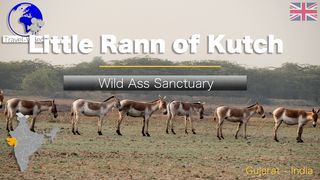
The Indian wild ass is the emblematic species of the Little Rann of Kutch. Stronger and better adapted to arid conditions than domestic donkeys, these animals have inhabited the saline plains and semi-desert regions of Gujarat for centuries. The video follows their movements across the open landscape and highlights their adaptation to an environment marked by heat, drought and seasonal flooding.
The antelopes visible in the reserve represent another important component of the local fauna. Semi-arid grasslands and open plains favour species capable of travelling long distances in search of water and vegetation. Their movements across the landscape reveal the particular ecological balance of the Rann, where mobility is essential for survival.
The presence of wild boars in wetter areas also demonstrates the environmental diversity of the sanctuary. Although the Little Rann often appears almost desert-like, it includes a combination of dry saline plains, marshes and seasonal wetlands that attract different species depending on climatic conditions.
Birds and Seasonal Wetlands
The Little Rann of Kutch also plays an important role for birdlife. After the monsoon season, temporary wetlands attract migratory birds as well as resident species that take advantage of shallow water zones and seasonal food resources. The video shows birds moving through these open landscapes where water surfaces and salt plains create favourable conditions for wildlife observation.
The contrast between dry terrain and temporary wetlands strongly shapes the visual identity of the Rann. Seasonal transformations alter the distribution of vegetation and wildlife across the sanctuary and contribute to the ecological richness of the region.
A Territory Shaped by Climate and Human Activity
Historically, the Little Rann of Kutch belonged to a region connected to trade routes linking Gujarat, Sindh and the ports of the Gulf of Kutch. Harsh environmental conditions limited permanent settlement in some parts of the salt desert, but several communities traditionally lived around its margins, practising salt production, pastoralism and forms of agriculture adapted to semi-arid conditions.
Climate remains the dominant force shaping the landscape. During the monsoon, parts of the Rann become temporarily flooded, while the dry season transforms the plains into vast expanses of cracked salt and dust. These environmental cycles explain the presence of animal species capable of adapting to rapidly changing conditions.
What the Videos on This Site Make Particularly Clear
The videos on travel-video.info make it easier to observe the variations of light across the salt flats, the movements of animals and the contrasts between wetlands and dry terrain. The animated photographic sequences highlight textures, reflections and silhouettes with unusual clarity, especially during the early morning scenes.
The gradual transitions between panoramic landscapes and closer views also help viewers better understand the relationship between wildlife and the surrounding environment. This visual approach reveals both the immense scale of the Little Rann of Kutch and the diversity of species inhabiting this semi-desert ecosystem.
A Wildlife Sanctuary of Western Gujarat
Through the wild asses, antelopes, birds and saline landscapes of the Little Rann of Kutch, this video presents a natural environment very different from the monumental and urban settings often associated with India. The detailed pages dedicated to the Little Rann of Kutch Wild Ass Sanctuary provide additional context for exploring one of the most distinctive ecosystems of western Gujarat.
Links to related pages


Audio Commentary Transcript
At the first light of day, the plain of the Little Rann of Kutch awakens to a discreet life.
Birds leave the bushes to reach the stretches of water, fragile silhouettes in a landscape still wrapped in mist.
The asses
Here, in the heart of Gujarat, lies a reserve created to protect an unexpected animal. Few people know that wild asses still exist in Asia. These equids, close cousins of the onager – a wild ass from Central Asia – have found refuge in this semi-desert territory, unique in the world.
Far from attracting attention like tigers or elephants, they are nevertheless the silent guardians of a fragile ecosystem. Their survival shows the importance of protected areas, even for species that may seem familiar, almost ordinary.
Behind their modest name, the Indian wild ass embodies a story of resilience and adaptation in one of India’s harshest environments.
The antelopes
The Little Rann of Kutch is best known for its wild asses, the symbol of the reserve and carefully protected.
But this semi-desert territory is also home to many other forms of life.
Among them, one presence often surprises visitors: the nilgai, or blue bull, the largest antelope in Asia.
Less emblematic than the wild asses, these elegant silhouettes sometimes appear at the edge of the bushes. Their almost unexpected presence reminds us that the richness of this sanctuary does not lie in a single species, but in the diversity of its wildlife.
Wild boars
Even more discreet, Indian wild boars sometimes cross the plains of the Little Rann of Kutch.
Their stocky silhouettes and vigorous movements contrast with the fragility of the birds or the elegance of the antelopes.
Omnivorous by nature, rooting the ground for roots, fruits or insects, they remind us that life clings here in varied, sometimes unexpected forms.
The birds
The Little Rann of Kutch is also the domain of birds.
Flamingos find their food in the saline waters, while cranes move slowly across the arid land, sometimes in family groups with their juveniles.
On the dry bushes, birds of prey watch for long periods, yet sudden quarrels remind us that life in the sanctuary is always in motion.

Music:
- - YouTube video library - Always remember
- - YouTube video library - Searching for the Missing Piece
- - YouTube video library - So Dramatic, (© So Dramatic by Audionautix is licensed under a Creative Commons Attribution 4.0 license. https://creativecommons.org/licenses/by/4.0/
- Artist: http://audionautix.com/)
Disclaimer: Despite its appropriateness, copyright issues prevent the use of indian traditional music in "Little Rann of Kutch • Gujarat, India • Wild asses and birds", hence the use of royalty-free music. Despite our careful selection, some might regret this decision, which is necessary to avoid potential lawsuits. Although difficult, this decision is the only viable solution.


