Français (France)
  Nederlands (nl-NL)
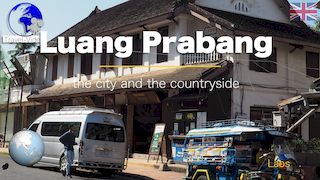
 00:00 • intro | 00:11 • the Mekong | 02:03 • stroll through the city streets | 03:10 • coconut milk cakes drying in the sun | 04:40 • Heuan Chan Heritage House | 05:40 • the Nam Khan river and the bamboo bridge | 06:15 • the surrounding countryside
Personal creation from visual material collected during my trip Laos and Bangkok (2022)
Map of places or practices in Luang Prabang on this site
• Use the markers to explore the content •
Luang Prabang: An Urban Landscape in Dialogue with the Countryside
A historic town shaped by rivers and rural surroundings
Located at the confluence of the Mekong and the Nam Khan, Luang Prabang presents a distinctive spatial organization where the boundaries between urban life and the surrounding countryside remain fluid. Once the royal capital of Laos, the town has preserved a human-scale urban fabric in which religious buildings, traditional houses, and colonial-era influences coexist without sharp contrasts.
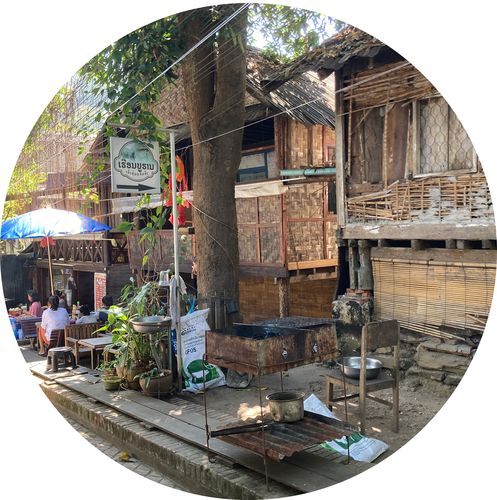
The video highlights this close relationship between built environment and natural setting. The presence of the Mekong structures daily activities and visual perspectives, while the town’s streets reveal a continuous transition between residential areas, small-scale commerce, and open spaces. Rather than a strictly defined urban core, Luang Prabang appears as a layered environment where cultural practices, local production, and everyday life unfold in direct contact with the landscape.
Streets, rivers and everyday practices
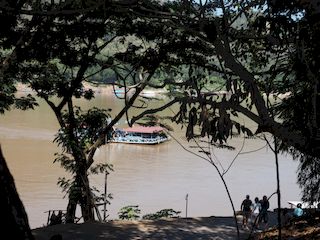
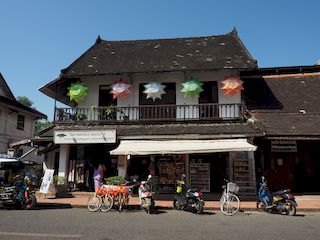
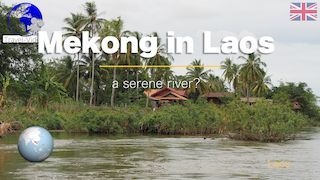
The sequences dedicated to the Mekong emphasize its role as both a physical and economic axis. It functions as a route for movement, a source of resources, and a defining feature of the town’s identity. Walking through the streets offers a complementary perspective, revealing an urban fabric where architectural coherence is less about monumentality than about continuity and adaptation.
Scenes of coconut-based cakes drying in the sun introduce a more intimate dimension of daily life. Such practices illustrate how food preparation remains closely linked to environmental conditions, relying on climate and available space. These activities, often conducted in semi-public areas, reflect a way of life in which domestic and communal spheres are closely intertwined.
The built heritage appears through key examples such as the Heuan Chan Heritage House. This preserved traditional residence provides insight into Lao architectural principles, including the use of local materials, elevated structures, and spatial organization adapted to climate and social customs. It offers a tangible reference for understanding how historical forms of habitation continue to inform present-day perceptions of identity.
Along the Nam Khan, a different atmosphere emerges. The river introduces a quieter, more localized environment, where the presence of a bamboo bridge illustrates a form of temporary architecture. Rebuilt regularly in response to seasonal water levels, this structure embodies a practical and adaptive approach to construction, rooted in local knowledge and environmental awareness.
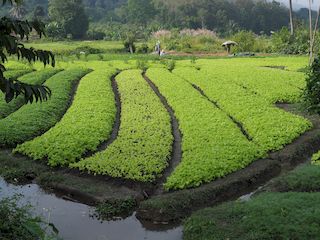
The surrounding countryside, visible at the margins of the town, reinforces this sense of continuity. Agricultural plots, vegetation, and nearby villages extend the urban space into a broader territorial framework, where transitions are gradual rather than abrupt.
Historical layers and spatial coherence
Luang Prabang’s development reflects a long historical trajectory shaped by its role as a political and religious center. The concentration of monasteries and religious institutions is a legacy of its former status as a royal capital, where Buddhism played a central role in structuring both urban space and social life.
Colonial influence, particularly from the French period, introduced new architectural elements and planning principles. However, these additions were integrated into the existing fabric without fundamentally altering its character. The result is a layered urban landscape in which different historical periods remain legible yet interconnected.
Environmental factors also play a decisive role. Seasonal flooding, tropical climate, and local topography have influenced construction techniques and settlement patterns. Elevated buildings, lightweight materials, and flexible structures reflect a long-standing adaptation to these conditions, contributing to the resilience of the urban form.
What the visual construction makes particularly clear
The video’s visual approach, largely based on carefully selected and animated photographs, allows for a precise reading of spatial relationships. The gradual transitions between images make it possible to follow the continuity from riverbanks to streets and from urban areas to rural surroundings.
This method enhances the visibility of details that might otherwise be overlooked in continuous motion footage. Architectural textures, proportions, and construction techniques become easier to observe, while everyday gestures and activities can be examined more closely. The viewer is given time to understand how different elements interact within the same environment.
By structuring the sequence in this way, the video offers not only a descriptive overview but also an analytical perspective, revealing how space is organized and experienced. The interplay between stillness and movement contributes to a clearer comprehension of the site’s complexity.
A balanced relationship between heritage and daily life
Luang Prabang illustrates a form of equilibrium between historical continuity, contemporary practices, and environmental context. The proximity between urban areas and the countryside, combined with the diversity of activities observed, creates a coherent and dynamic landscape.
Rather than focusing solely on individual monuments, the video presents the town as a living system, shaped by interactions between people, architecture, and natural surroundings. For those wishing to explore further, the related detailed pages provide additional insight into specific sites and practices, extending the understanding of this distinctive Lao environment.
Links to related pages






Audio Commentary Transcript
Luang Prabang is a peaceful city in Laos, nestled at the confluence of the Mekong and Nam Khan rivers. Known for its serene atmosphere and captivating landscapes, Luang Prabang stands out for its traditional architecture and quiet streets that invite exploration. The Mekong, a vital artery of the region, plays a crucial role in daily life, both for transportation and agriculture, while the proximity to the countryside offers a glimpse into the surrounding nature and tranquility. This city, where modernity and tradition harmoniously coexist, is a haven of peace for those looking to escape the hustle and bustle.
Recognized by UNESCO for its unique blend of religious and colonial architecture, Luang Prabang is a jewel of history and spirituality. Its emblematic Buddhist temples and colonial buildings bear witness to a bygone era, while reflecting the city's resilience in the face of trials, notably during the Vietnam War. This troubled period affected Luang Prabang, but did not extinguish its cultural legacy, preserved and valued today. Walking its streets, one feels the echo of a past that, despite conflicts, has managed to protect its unique essence for posterity.
In Luang Prabang, tradition basks in the sunshine. On hoods and walls alike, khao nom kok, Laotian coconut milk pastries, dry in the open air. Bridging heritage and modernity, these treats embody a culture adept at blending the ancestral with the urban in seamless harmony.
In Luang Prabang, several historic homes have been transformed into museums dedicated to the city's everyday life; among these, the Heuan Chan Heritage House stands out for its exceptional beauty.
In the heart of Luang Prabang, the Nam Khan River meanders gracefully, crossed by a seasonal bamboo bridge, a testament to local ingenuity. This bridge, rebuilt every year, is more than just a connection between two shores; it is a living link between tradition and the daily life of the inhabitants. Crossing this bridge is to immerse oneself in the history and culture of this region, where nature and heritage meet to offer a unique experience to visitors. The Nam Khan and its bamboo bridge embody the soul of Luang Prabang, inviting to discover the serenity and beauty of this Laotian city.
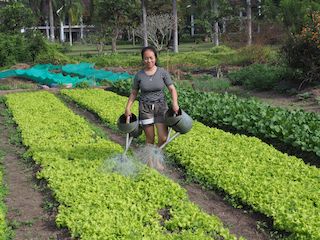
The countryside around Luang Prabang is dotted with vegetable gardens, meticulously tended by female farmers. They use traditional methods to enrich the fertile land, ensuring the sustainability of their community and the preservation of local farming practices. These activities are vital for the region's economy, providing plentiful food and strengthening ties to ancestral traditions.
Music:
- - YouTube video library - Simple Sonata - Sir Cubworth
Disclaimer: Despite its appropriateness, copyright issues prevent the use of laotian traditional music in "Luang Prabang, a City in the Countryside • Laos", hence the use of royalty-free music. Despite our careful selection, some might regret this decision, which is necessary to avoid potential lawsuits. Although difficult, this decision is the only viable solution.