

 Français (France)
  Nederlands (nl-NL)
 00:00 • intro | 00:29 • Process of making a sheet of paper | 04:16 • Some uses of traditional paper
Personal creation from visual material collected during my trip Laos and Bangkok (2022)
Map of places or practices in Luang Prabang on this site
• Use the markers to explore the content •
Traditional Paper Craft in Luang Prabang: Techniques, Materials and Uses
A living craft in a historic setting
Luang Prabang, in northern Laos, is widely recognized for its preserved urban fabric and its long-standing cultural traditions. Beyond its temples and colonial-era streets, the city also sustains forms of craftsmanship that reflect daily life as much as ritual practice. Among these, the production of handmade paper occupies a discreet yet meaningful place. The video explores a local workshop where this craft continues, offering insight into techniques that have changed little over time.
The setting is both modest and structured, typically located within residential compounds or small artisanal spaces. The environment reveals a close relationship between natural resources and manual production, as the materials used are locally sourced and processed on site. Through the observation of gestures, tools and intermediate stages, the workshop becomes a space where technical knowledge and cultural continuity intersect.
From plant fibres to finished sheets
The process of producing a sheet of traditional paper unfolds through a sequence of precise and methodical steps. It begins with the preparation of plant fibres, often derived from the bark of mulberry trees. These fibres are cleaned, boiled and softened before being manually beaten into a pulp. This transformation stage is essential, as it determines the texture and consistency of the final product.
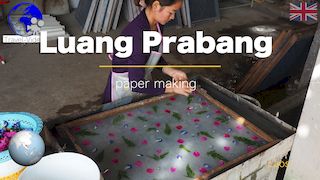
The pulp is then diluted in water and spread evenly across a rectangular frame fitted with a fine mesh. This step requires both control and experience, as the distribution of fibres must be uniform to ensure structural coherence. Once lifted from the water, the frame holds a thin layer of interwoven fibres that gradually form a sheet as excess moisture drains away.
Drying is typically carried out in natural conditions, with the frames placed in the sun. During this phase, decorative elements such as leaves, petals or fibres of contrasting colours may be added, embedding visual motifs directly into the material. The result is not only functional but also aesthetic, reflecting a balance between utility and ornamentation.
Uses and symbolic value
Traditional handmade paper in Laos serves multiple purposes, ranging from everyday objects to ritual items. It is commonly used for notebooks, lampshades, packaging and decorative panels. In a religious context, it may also be employed in offerings or ceremonial objects, reinforcing its connection to local belief systems.
The adaptability of this material is one of its defining characteristics. Its texture, translucency and natural tones make it suitable for both practical and artistic applications. In recent decades, the craft has also responded to tourism and external demand, leading to the development of new formats and designs while maintaining core techniques.
This dual role, both traditional and adaptive, allows the craft to remain economically viable while preserving its cultural significance. The workshop environment reflects this balance, where production is oriented toward both local use and external markets.
Cultural continuity and local knowledge
The persistence of handmade paper production in Luang Prabang is closely tied to the transmission of skills within families and communities. The techniques involved are not codified in written manuals but learned through observation and repetition. This mode of transmission reinforces the social dimension of the craft, embedding it within everyday life.
At the same time, the materials used highlight a sustainable approach based on renewable resources and low-energy processes. The reliance on plant fibres, water and sunlight situates the craft within a broader ecological context, where production remains closely linked to the natural environment.
Although modernization has introduced industrial alternatives, handmade paper retains a distinct value due to its material qualities and cultural associations. The workshop thus becomes a place where continuity is actively maintained, rather than passively inherited.
What the videos on this site make particularly clear
The visual approach used in these videos, often based on carefully selected and sequenced photographs, allows for a detailed reading of each stage of the process. Rather than capturing rapid movement, the structure emphasizes clarity and progression. Each step, from fibre preparation to drying, can be observed with precision, highlighting the transformation of raw material into a finished sheet.
This method also enhances the perception of textures, surfaces and subtle variations in colour. The viewer can follow the spatial organization of the workshop, understand the role of each tool and appreciate the rhythm of the gestures involved. The absence of visual distraction reinforces the educational dimension, making the technical aspects more accessible.
By structuring the sequence in a logical progression, the video facilitates a gradual understanding of the process, allowing the viewer to reconstruct the entire chain of production without ambiguity.
A discreet but enduring tradition
The handmade paper workshops of Luang Prabang illustrate how a simple material can carry both practical and symbolic meaning. Through a sequence of controlled gestures and natural transformations, plant fibres are turned into objects that circulate between everyday use and cultural expression.
This tradition, rooted in local knowledge and adapted to contemporary contexts, offers a complementary perspective on the city’s heritage. For those wishing to deepen their understanding, dedicated pages provide further detail on techniques, uses and the role of this craft within Laotian society.
Links to related pages








Audio Commentary Transcript
In the suburbs of Luang Prabang in Laos, far from the environmental controversies of the paper industry, an eco-friendly tradition endures: the artisanal production of paper from mulberry wood. This age-old technique, distinguished by its ecological approach, produces superior quality paper. Known for its unmatched texture and strength, this paper is chosen by artists for their creations and luxury brands for their packaging, thus symbolizing the ideal union between art, respect for tradition, and commitment to sustainability.
After meticulously transforming mulberry branches into a rich and uniform pulp, following careful cooking and thorough beating, the artisans move to the delicate stage of paper sheet creation. In this artisanal ballet, the pulp is gently poured into a sieve frame, thereby initiating the drainage process. It is during this artistic phase that flowers or leaves are often added, harmoniously incorporating into the paper's texture to imprint enduring natural patterns.

Music:
- - YouTube video library - No.2 Remembering Her - Esther Abrami
- - YouTube video library - No.7 Alone With My Thoughts - Esther Abrami
Disclaimer: Despite its appropriateness, copyright issues prevent the use of laotian traditional music in "Luang Prabang, paper making workshop • Laos", hence the use of royalty-free music. Despite our careful selection, some might regret this decision, which is necessary to avoid potential lawsuits. Although difficult, this decision is the only viable solution.


