Français (France)
  Nederlands (nl-NL)
 00:00 • intro | 00:29 • the Royal Palace | 01:49 • Haw Pha Bang temple
Personal creation from visual material collected during my trip Laos and Bangkok (2022)
Map of places or practices in Luang Prabang on this site
• Use the markers to explore the content •
Luang Prabang: Royal Palace and Sacred Heritage in Laos
A royal and spiritual center within a preserved historic landscape
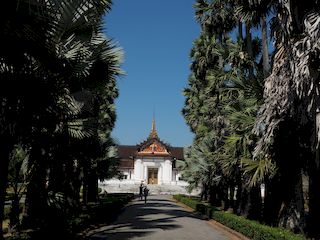
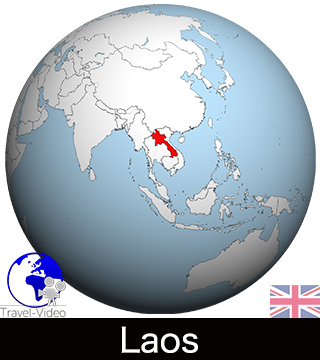
Luang Prabang, located at the confluence of the Mekong and Nam Khan rivers, stands as one of the most historically and culturally significant cities in Laos. Once the royal capital of the kingdom of Lan Xang and later the seat of the Lao monarchy until the twentieth century, it preserves a remarkably coherent urban and architectural ensemble. Within this setting, the Royal Palace and the Haw Pha Bang temple form a focal point where political authority and religious symbolism intersect.
The video offers a structured view of this core area, highlighting both the palace complex and its immediate religious counterpart. It allows for a clear reading of how these elements relate to one another, both spatially and symbolically, within the broader context of Luang Prabang’s heritage.
The Royal Palace and the sanctuary of the Pha Bang Buddha
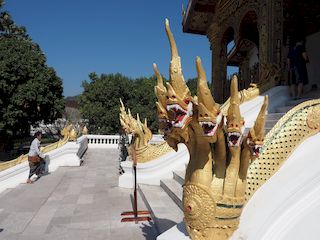
The Royal Palace of Luang Prabang, built in the early twentieth century, reflects a transitional period in Lao history, when the country was under French colonial influence while maintaining its monarchy. Architecturally, the building presents a synthesis of traditional Lao forms and European-inspired design. Its symmetry, layout, and interior organization echo Western influences, while the roof structures, decorative motifs, and ornamental details remain deeply rooted in local traditions.
Nearby, the Haw Pha Bang temple occupies a central position within the complex. This sanctuary houses the revered Pha Bang Buddha, a sacred image that holds both religious and historical significance, and from which the city derives its name. The temple’s architecture follows a carefully crafted traditional aesthetic, with layered roofs, gilded surfaces, and refined proportions. Together, the palace and the temple form a coherent ensemble, where royal authority and spiritual legitimacy are closely intertwined.
Historical context and architectural meaning
The Royal Palace embodies a period of adaptation and coexistence between Lao traditions and external influences. During the colonial era, Luang Prabang remained the royal capital under French protection, and the palace served both as a residence and as a ceremonial space. Its interior spaces reflect diplomatic exchanges and the evolving role of the monarchy in a changing political environment.
The Haw Pha Bang temple, on the other hand, represents continuity. The Pha Bang Buddha is associated with the protection of the kingdom and the legitimacy of its rulers. Its presence within the palace grounds emphasizes the traditional link between Buddhism and political authority in Lao society. Even after the abolition of the monarchy in 1975, the site retains a strong symbolic value and continues to play a role in cultural identity.
More broadly, the integration of the palace and temple into the urban fabric of Luang Prabang illustrates a characteristic feature of Southeast Asian cities, where religious, political, and social functions are closely connected. Monasteries, traditional houses, and public spaces coexist in a structured yet fluid arrangement, reinforcing the sense of continuity across centuries.
A visual reading enhanced by animated photographic sequences
The videos presented on this site, largely constructed from carefully selected and animated photographs, offer a particularly effective way of understanding such environments. Rather than relying solely on continuous motion, this approach allows the viewer to pause visually on key details, observe textures, and appreciate the craftsmanship of architectural elements.
The succession of images makes it easier to grasp spatial relationships, volumes, and alignments. It highlights how the Royal Palace and the Haw Pha Bang temple are positioned relative to one another, and how their architectural languages interact. This method also clarifies the transitions between different areas, revealing the underlying organization of the site.
In the case of Luang Prabang, this visual approach is especially valuable for perceiving the balance between tradition and adaptation. It draws attention to decorative details, roof structures, and the interplay of light on gilded surfaces, while maintaining a clear sense of the overall composition.
A key site for understanding Lao history
The Royal Palace and the Haw Pha Bang temple together form one of the most representative ensembles in Luang Prabang. They illustrate the historical evolution of the Lao monarchy, the enduring role of Buddhism, and the interaction between local traditions and external influences.
Exploring this site through a structured visual narrative provides a deeper understanding of its cultural and historical significance. For those wishing to go further, the detailed pages dedicated to each monument offer additional insights into their architecture, history, and symbolic meaning.
Links to related pages






Audio Commentary Transcript
Even though Luang Prabang ceased to be the capital of Laos since the early 16th century, it nonetheless remained the heart of the monarchy. In the early 20th century, during the period of French protectorate, King Sisavang Vong initiated the construction of this palace, aiming to enhance Laos's diplomatic exchanges with the wider world.
While the Royal Palace may not stand as the most magnificent highlight of Luang Prabang, the recent addition of the Haw Pha Bang temple at the threshold of the third millennium bestows upon it a renewed touristic dimension, signifying a harmonious blend of traditional Laotian spirituality with modern construction techniques.

Music:
- - YouTube video library - Darkest Child, (© Darkest Child by Kevin MacLeod is licensed under a Creative Commons Attribution 4.0 license. https://creativecommons.org/licenses/by/4.0/
- Source: http://incompetech.com/music/royalty-free/index.html?isrc=USUAN1100783
- Artist: http://incompetech.com/)
Disclaimer: Despite its appropriateness, copyright issues prevent the use of laotian traditional music in "Luang Prabang, Royal Palace • Laos", hence the use of royalty-free music. Despite our careful selection, some might regret this decision, which is necessary to avoid potential lawsuits. Although difficult, this decision is the only viable solution.