

 Français (France)
  Nederlands (nl-NL)
 Haw Pha Bang in Luang Prabang is a modern temple designed to enshrine the revered Phra Bang Buddha, regarded as a national spiritual emblem of Laos. Positioned beside the former Royal Palace, it stands as a symbol of cultural pride, Buddhist continuity, and state identity. Its form reflects traditional Lao religious architecture while expressing aspirations of renewal and prestige. The temple functions as a focal point for rituals and ceremonies, drawing both worshippers and visitors. It represents an important landmark within the urban landscape, reinforcing heritage values and the ongoing role of Buddhism in contemporary Lao cultural expression.
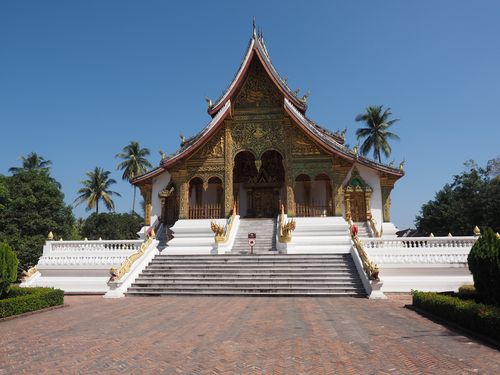
Luang Prabang • Haw Pha Bang temple
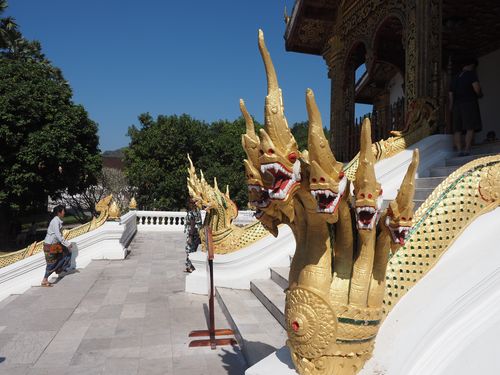
Luang Prabang • Haw Pha Bang temple
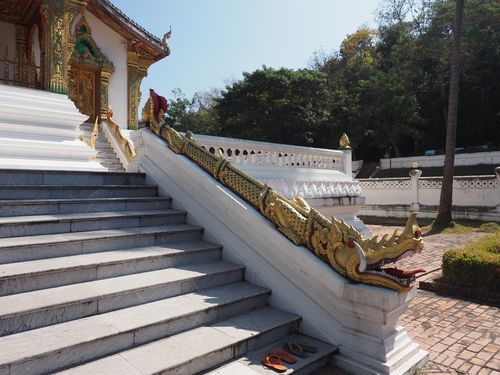
Luang Prabang • Haw Pha Bang temple
Monument profile
Haw Pha Bang temple
Monument category: Buddhist temple
Monument family: Temple
Monument genre: Religious
Cultural heritage: Buddhist
Geographic location: Luang Prabang • Laos
Construction period: 21th century AD
This monument in Luang Prabang is inscribed on the UNESCO World Heritage List since 1995 and is part of the serial property "Town of Luang Prabang".See the UNESCO monuments featured on this site
• Links to •
• List of videos about Luang Prabang on this site •
Luang Prabang, Royal Palace • Laos
Luang Prabang, the markets • Laos
Luang Prabang, Wat Sensoukharam temple • Laos
Luang Prabang, Sunset on Mount Phou Si • Laos
Luang Prabang, Wat Xieng Thong temple • Laos
Luang Prabang, paper making workshop • Laos
Laos • Fabric Arts
Luang Prabang, a City in the Countryside • Laos
Luang Prabang, some temples • Laos
• References •
UNESCO: Town of Luang Prabang
History of Haw Pha Bang Temple – Luang Prabang, Laos
Political and ideological background of its conception
Haw Pha Bang is a relatively recent yet highly symbolic religious structure erected in Luang Prabang to house the revered Buddha image known as the Phra Bang. Considered a national palladium since the Lao kingdoms, the image has historically been associated with sovereignty, legitimacy, and divine protection. The decision to construct a grand temple for it reveals much about shifting political visions in twentieth-century Laos. After French colonisation and during the late royal period, authorities sought to materialise a continuity between traditional Buddhist kingship and emerging state identity. The project was conceived as an architectural embodiment of cultural resilience at a time of ideological transition.
Its development continued into the post-revolutionary period after 1975, when the monarchy was abolished and the Lao People’s Democratic Republic was established. Interestingly, the new Marxist-inspired regime did not suppress Buddhist symbolism; instead, it reinterpreted it as a unifying cultural foundation. Haw Pha Bang thus became both a monument honouring the sacred Buddha and a political gesture demonstrating that national heritage could be integrated within a modern socialist narrative. Debates over style, funding, and ritual uses reflected tensions between tradition and institutional modernisation.
Historical events and evolution of the site
The site chosen for the temple lies adjacent to the former Royal Palace, now a museum. This location bears deep historical significance, since the palace compound was long perceived as the centre of royal legitimacy. The Phra Bang statue itself has a tumultuous history punctuated by displacements, thefts, and ritual returns. Throughout regional conflicts involving Siam, Burma, and later the French, control over the image was seen as synonymous with control over the kingdom.
Construction of Haw Pha Bang unfolded slowly, beginning during the late monarchy and interrupted repeatedly due to political instability, economic limitations, and shifting priorities. Its unfinished status for decades symbolised both the fragility of the Lao state and the persistent aspiration to secure spiritual protection. Only in the early twenty-first century did the temple reach completion and formal inauguration, marking the fulfilment of an ambition spanning generations.
Comparative perspective and global architectural context
The decision to build a monumental temple in a traditional style for a modern national purpose parallels developments across Buddhist Asia. In Cambodia, Thailand, Sri Lanka, and Myanmar, governments and monarchies invested in rebuilding stupas, ordination halls, and sanctuaries to reinforce political continuity and religious authority. Haw Pha Bang belongs to this broader trend whereby new monuments emulate ancient forms to legitimise present-day structures of power.
Its creation illustrates a widespread modern phenomenon: the state-directed revival of sacred architecture. Such projects often act as visual anchors of identity, projecting national heritage to domestic audiences, pilgrims, and tourists alike. Like its regional counterparts, Haw Pha Bang became part of a narrative in which architectural revival expresses the endurance of Buddhism and cultural autonomy.
Structural change, usage, and urban development
Since its completion, Haw Pha Bang’s functions have evolved. While conceived to house the Phra Bang permanently, practical and ritual considerations mean the image is displayed only on special occasions. The interior therefore serves as a ceremonial hall rather than a constant shrine. The exterior staircase, terrace, and façade offer space for processions and public rituals, particularly during the Pi Mai Lao New Year festival, when the image is traditionally paraded and briefly installed in the temple for public veneration.
Urban transformation has also shaped the monument’s presence. Luang Prabang’s inscription as a UNESCO World Heritage Site intensified heritage-led urban planning. The temple now stands within a protected cultural landscape, balancing religious function, museum context, and tourism. Increased accessibility and visitor flows have magnified its role as a visual symbol of the city.
Cultural role and identity projection
In contemporary Laos, Haw Pha Bang serves as an emblem of national revival and spiritual continuity. To residents of Luang Prabang, it reinforces the city’s prestige as a former royal capital. To visitors, it represents an iconic gateway into Lao Buddhist culture. It also plays an institutional role: the temple reinforces narratives of unity and tradition endorsed by the government, while allowing the Buddhist Sangha to reaffirm its ritual centrality.
Festivals reinforce this symbolism. Processions, community offerings, and official ceremonies use the temple as a background or destination, emphasising its dual identity as sacred space and civic emblem. The monument thus contributes to a sense of belonging among inhabitants and participates in shaping the cultural memory of the nation.
Conservation, representation, and challenges
The temple faces conservation issues linked to climate, urban pressure, and tourism. Its gilded ornamentation is vulnerable to humidity, sunlight, and dust, requiring periodic maintenance. Heavy visitor traffic affects flooring, staircases, and decorative surfaces. Conservation policies developed under the heritage status of Luang Prabang prioritise retention of its visual integrity while accommodating ritual use.
Its participation in a UNESCO-listed urban environment requires coordinated management: the building must remain accessible yet protected, serve local worshippers while meeting international conservation expectations.
In sum, Haw Pha Bang embodies the layered history of modern Laos. A contemporary creation built in ancestral form, it illustrates how states, religious institutions, and communities mobilise architecture to legitimise identity, preserve heritage, and visualise continuity. From contested origins and interrupted building phases to ritual centrality and global recognition, its history reveals the complex relationship between power, faith, and cultural memory.
Architecture of Haw Pha Bang – Luang Prabang, Laos
Overall conception and intended function
Haw Pha Bang is a contemporary temple conceived as a ceremonial reliquary for the revered Phra Bang Buddha image. Architecturally, it was designed from the outset to serve a dual purpose: a functional space for important religious rituals and an emblematic showcase of Lao Buddhist architecture within the former royal precinct. The building translates into built form the idea of a “national shrine”, integrating liturgical needs, royal symbolism and the requirements of a monument displayed to a growing flow of visitors.
The temple’s composition seeks to condense the main visual codes of northern Lao religious architecture: a dominant multi-tiered roof, a broad stairway guarded by nagas, richly decorated façades, and a single large interior hall focused on the principal image. Although the project is modern, its architectural language is deliberately historicising, so that the temple appears as a natural continuation of the traditional landscape of Luang Prabang.
Spatial organisation and structural layout
Haw Pha Bang stands on a high platform, accessed by a wide central stairway that emphasises the act of ascent. The stair is flanked by long, undulating nagas which guide the eye and the movement of worshippers towards the main entrance. This elevated base has several functions: it creates a visual separation from the surrounding square, protects the building from run-off water and occasional flooding, and reinforces the perception of sacred distance.
The ground plan is essentially rectangular, with the core consisting of a single main hall. This space is surrounded on three sides by an open gallery or veranda that provides shaded circulation and additional room during ceremonies. Inside, the hall is conceived as a large, uninterrupted volume, its axis leading directly to the raised platform where the Phra Bang image is displayed on special occasions. Structural supports are kept to the side, leaving a clear central area for ritual activities and the movement of participants.
The roof system dominates the exterior silhouette: several overlapping tiers descend almost to the level of the galleries, creating a strong horizontal emphasis that contrasts with the vertical lines of the gables and finials. This cascading roof both amplifies the monumentality of the building and protects the façades and galleries from sun and heavy rain.
Materials and construction techniques
The temple combines traditional materials with modern construction methods. The load-bearing structure uses masonry and reinforced concrete, especially in the core walls and pillars. These elements are then clad in carved timber, stucco and decorative finishes to reproduce the appearance of older wooden temples while providing greater structural reliability and longevity.
The roof framework is made of timber trusses, supporting rows of ceramic roof tiles in dark tones that contrast with the gold and red of the façades. Timber is used extensively in visible elements such as beams, brackets, doors and shutters, all of which are carved and painted. The façades and interior surfaces rely on a mixture of lime-based plaster, coloured pigments and gold leaf. Gold is applied more thickly and with higher quality near the main entrances, gable panels and interior liturgical focal points, while secondary surfaces use gold-coloured paint.
This palette of materials responds to several objectives. Masonry and concrete offer stronger resistance to fire, termites and heavy use than a fully timber structure, which was common in earlier periods. Timber cladding maintains the tactile, warm appearance associated with traditional temples. Plaster and paint allow periodic renewal of surfaces without the need to dismantle structural elements. Gold leaf and gilded paint create the luminous effect expected from a prestige sanctuary, yet can be replaced or repaired in discrete campaigns.
Technical and architectural innovations
Although Haw Pha Bang visually imitates older religious buildings, it incorporates technical advances typical of late twentieth-century construction in Southeast Asia. The hybrid structural system of concrete cores and timber exoskeleton makes it possible to span larger widths with fewer internal columns. This improves visibility of the altar and facilitates the circulation of large congregations.
Attention to ventilation and thermal comfort is another aspect of the design. The open galleries act as buffer zones, tempering the heat before one enters the main hall. The height of the roof structure provides a volume of hot air above the occupied zone, while the large doorways and windows help cross-ventilation. The deep eaves of the roof protect the walls from direct exposure and create shaded areas where worshippers and visitors can rest.
From an urban perspective, the siting and orientation of the temple were carefully considered. It closes the perspective of the former royal garden, forming a focal point at one end of the square, while remaining visually aligned with important axes of circulation. The building therefore functions as an architectural hinge between former royal power, the monastic world and the contemporary tourist city.
Artistic influences and decorative programme
The decorative language of Haw Pha Bang draws on a wide range of regional traditions. The general outline of the roof and the ornamented gables recalls northern Lao and Lanna (northern Thai) models. The nagas on the stairways and the density of gilded reliefs echo stylistic practices found across the Mekong region, while certain motifs show the influence of Siamese and Khmer iconography absorbed over centuries of contact.
However, the temple also expresses specifically Lao preferences. The concentration of ornament on the western façade, facing the main square, reflects local emphasis on the processional approach. The treatment of surfaces—almost entirely covered in gilded vegetal scrolls, mythological figures and geometric framing—creates a continuous decorative field that is characteristic of Luang Prabang craftsmanship. Inside, the emphasis is placed on the altar ensemble, columns and upper walls, leaving some floor and wall surfaces relatively plain to maintain a sense of order and focus.
The combination of carved timber, stucco relief and painted detail allows for a nuanced play of textures under changing light. At certain times of day, the façade appears almost flat and graphic; at others, the relief becomes pronounced, emphasising the three-dimensional character of the ornament.
Dimensions, perceptions and notable aspects
Exact measurements can vary according to sources, but Haw Pha Bang is medium in scale compared to the great royal temples of Bangkok or Phnom Penh. Its impact derives less from sheer size than from proportion: the width of the façade, the height of the stairway, and the depth of the roof overhangs are all calibrated to dominate the adjacent square without overwhelming it.
One striking aspect is the temporal paradox of the building. To an uninformed observer, the temple can easily be mistaken for an eighteenth- or nineteenth-century structure, even though it is a modern creation. This deliberate anachronism is part of its architectural identity: the monument was designed to appear timeless, fusing contemporary construction with historical style in a way that supports Luang Prabang’s image as a preserved royal town.
Architectural significance and conservation issues
Architecturally, Haw Pha Bang plays a key role in the urban ensemble of Luang Prabang. Its carefully crafted traditional silhouette contributes to the visual coherence that underpins the city’s recognition as a heritage site. The temple acts as a bridge between the former royal palace, the monastic landscape and the more recent tourist infrastructure, symbolising the continuity of Lao Buddhist architecture amid social and political change.
Conservation challenges arise primarily from the vulnerability of decorative layers and the intensity of use. Gilded and painted surfaces are exposed to sunlight, humidity, soot and dust, all of which accelerate fading and flaking. The constant flow of visitors places stress on stairways, floors and railings. Regular maintenance campaigns are necessary to clean, repair and occasionally regild parts of the building, while respecting the original decorative schemes.
Because the temple stands within a protected urban area, interventions must also consider the broader heritage context: any modification to lighting, access or landscaping around the building influences not only Haw Pha Bang itself but the perception of the palace complex and the historic townscape. The architecture of the temple therefore carries responsibilities beyond its own walls, contributing to both the spiritual life of Luang Prabang and its international image as a carefully curated Buddhist royal city.