Français (France)
  Nederlands (nl-NL)
 The fish market of Diu, located on the coast of Gujarat in India, plays a central role in the town’s commercial life. Every day, fishermen bring in their catches from the Arabian Sea to be sorted, negotiated, and sold—often by women. The market is known for its continuous activity, wide variety of seafood, and its importance to the local economy. It reflects a sustained form of direct trade between producers and consumers, where the rhythm of the tides continues to shape economic interactions.
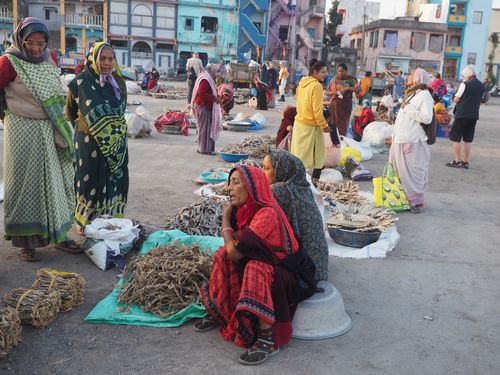
Diu • Fish market: dried fish sold on the side
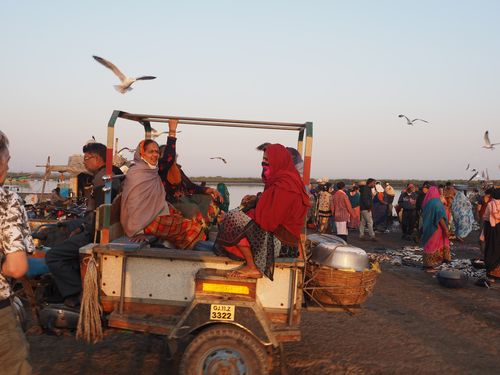
Diu • Fish market: end of the market

Diu • Fish market: a lively market
Tradition profile
Fish market
Tradition category: Local market
Tradition family: Traditional markets and fairs
Tradition genre: Trade and Local Creativity
Geographic location: Diu • Gujarat •
• Links to •
• List of videos about Diu on this site •
Diu • Colonial Heritage and Living History of Gujarat
Diu • Lively fish market on India’s Arabian Sea coast
From Fishing Port to Cultural Anchor: The Historical and Social Evolution of the Fish Market Tradition in Diu, India
The fish market of Diu, a small coastal enclave on India’s western edge in the state of Gujarat, represents a living tradition shaped by centuries of maritime commerce, colonial legacies, and enduring social structures. While it may appear as a simple venue for selling freshly caught seafood, its emergence and persistence reflect deeper political motivations, adaptive social innovations, and the complex interactions between local culture and global currents.
Origins and Early Motivations
The tradition likely emerged as early as the late medieval period, when Diu had become a regional hub of seaborne trade across the Arabian Sea. Located strategically along the maritime routes connecting the Arabian Peninsula, East Africa, and western India, Diu evolved as a port town where fishing was not merely a subsistence activity, but a vital economic resource. The fish market developed in response to political interests in sustaining coastal livelihoods, securing trade routes, and supplying both the local population and passing ships.
Politically, the administration—whether under local Rajput rulers, the Delhi Sultanate, or later Portuguese colonizers—had a vested interest in stabilizing the local economy through fishing and fish trade. Allowing the market to flourish ensured a steady supply of food and an opportunity to tax commerce, while also integrating coastal communities into broader administrative structures.
Socially, the market played an important role in fostering communal networks, particularly among fishing castes and women vendors. It became a space where informal economies thrived, women gained partial economic autonomy, and coastal knowledge systems were transmitted across generations.
Key Historical Events and Cultural Shifts
The most transformative event in the history of Diu was the arrival of the Portuguese in the 16th century. As part of the Estado da Índia, Diu became a heavily fortified Portuguese outpost and a commercial node in their Indian Ocean network. Although the Portuguese imposed certain regulations on fishing and trade, they generally allowed local markets to operate under customary laws.
This period introduced new cultural influences. Techniques such as salting and drying fish in specific patterns, previously uncommon in Diu, were reinforced or modified based on Portuguese maritime traditions. The linguistic landscape of the market also shifted subtly, as words of Portuguese origin entered the local lexicon, especially for types of fish, tools, or weights.
Economic liberalization in post-independence India, especially after the 1990s, introduced modern refrigeration, packaging, and commercial distribution networks, affecting how fish markets operated across the country. In Diu, these developments coexisted with older practices, but also brought new challenges: competition from industrial suppliers, shifting consumer expectations, and the threat of homogenization.
A Global Comparison
Comparable markets have long existed in other parts of the world: the Tsukiji fish market in Tokyo, the Mercado de Mariscos in Panama, or the Bergen fish market in Norway. These markets similarly arose in response to the economic centrality of seafood in coastal societies and often featured comparable gender dynamics, ritualistic sale practices, and integration with regional trade systems.
What makes Diu’s market distinctive is its relatively small scale combined with deep historical continuity. While other markets may have grown into logistical behemoths or tourist-oriented spectacles, Diu’s fish market retains a local, communal character, even as it adapts incrementally to modern pressures.
Transformations and Cultural Resilience
Over the centuries, Diu’s fish market has weathered shifts in political control—from indigenous dynasties to European colonizers and finally Indian governance. Each transition brought new regulations, trade relations, and infrastructure. Nonetheless, the market has shown remarkable continuity, thanks in part to its anchorage in everyday social practice.
Its layout and routines have adjusted to new technologies—plastic crates replacing bamboo baskets, digital scales appearing alongside traditional hand-held ones—but core cultural elements remain intact. The early morning rhythm of bargaining, the intergenerational training of vendors, and the social etiquette among sellers and buyers all continue to shape the identity of the market.
Cultural Significance and Present-Day Challenges
Today, the market is more than a trading venue—it is a marker of Diu’s coastal identity. It offers a space where local history is enacted daily, where knowledge about the sea, seasons, and fish species is shared. Its cultural value lies in the embodiment of a way of life that connects Diu’s past to its present.
However, several challenges threaten this continuity. Coastal erosion, overfishing, and climate change reduce the predictability of catches. Urban development projects, including plans for harbor modernization or tourism facilities, may displace or marginalize traditional vendors. Moreover, younger generations increasingly seek employment outside traditional sectors, risking a break in cultural transmission.
Preservation and the Path Forward
Efforts to preserve the market must be community-led and sensitive to its evolving character. Local documentation initiatives, the promotion of artisanal fishing, and government recognition through cultural heritage schemes could help safeguard this tradition. While it is not yet part of UNESCO’s list of intangible cultural heritage, the market meets many of the criteria: longevity, social value, and unique cultural expression.
Ultimately, the fish market of Diu stands as a living example of adaptive tradition—rooted in history, shaped by external forces, and carried forward by the people who gather each morning to exchange not only goods, but stories, knowledge, and a shared cultural memory.
Markets of Memory: Cultural Innovation and Social Identity in the Fish Market Tradition of Diu, India
The fish market of Diu, located on the western coast of India in Gujarat, is more than a commercial hub—it is a vibrant reflection of the region’s social innovation and cultural dynamism over centuries. Rooted in both necessity and tradition, this market illustrates how communities adapt to their environment while embedding layers of meaning and identity into everyday practices. It showcases a nuanced blend of local customs and foreign influences, demonstrating a living heritage that continues to evolve while maintaining its symbolic core.
Social Innovation in a Maritime Context
The emergence of the fish market in Diu likely dates back to the early centuries of the Common Era, when maritime trade flourished across the Arabian Sea. In this context, the market served not only as a commercial platform but also as a tool of social organization. Fisherfolk, predominantly from indigenous communities, structured their lives around the tides and the rhythms of marine harvesting.
One of the most notable innovations was the division of labor within the community: men typically engaged in fishing, while women managed the sale and distribution. This gendered role-sharing brought women into the economic foreground, giving them visible agency and a degree of financial independence uncommon in other sectors at the time. The fish market thus became a space of informal empowerment—an early example of gender-balanced economic participation in South Asian coastal society.
Rituals, Objects, and Symbolic Meaning
The market is punctuated by rituals that speak to both functional needs and cultural beliefs. Before dawn, vendors often sprinkle water at their stalls—a symbolic act of purification that also cools the environment and keeps the fish fresh. Seasonal festivals like Nariyal Purnima, which marks the beginning of the fishing season, see offerings made to the sea, blending ecological respect with religious devotion.
The tools used—woven baskets, locally crafted scales, wooden crates—carry both utilitarian and cultural significance. For instance, the use of palm-leaf fans to keep fish cool not only reflects an understanding of perishability but also recalls traditional coastal crafts. Some vendors decorate their stalls with conch shells or small statues of deities, invoking blessings for a fruitful day’s trade.
These objects and gestures together form a silent language, revealing values such as sustainability, reciprocity with nature, and communal identity.
A Fusion of Cultural Currents
Diu’s long history as a trading post under multiple regimes—Rajput, Sultanate, Portuguese—has left its imprint on the fish market. The Portuguese occupation from the 16th to the mid-20th century introduced new fishing techniques and preservation methods. Salt-drying, for example, became more widespread, along with new maritime terminologies that filtered into the local Gujarati and Konkani dialects.
This cross-cultural exchange is evident in the visual and auditory texture of the market. Languages spoken include Gujarati, Hindi, and a creolized form of Portuguese. Trade practices incorporate both traditional bartering and colonial-era measurements. Even culinary preferences—such as the preparation of vindaloo fish—reflect syncretism between Indian spices and Iberian cooking methods.
The result is a unique cultural mosaic that embodies the broader Indian Ocean world’s history of exchange and adaptation.
Anecdotes and Community Memory
According to local oral histories, a particularly abundant monsoon season in the 19th century led to a record fish catch so large that the entire market was extended onto nearby streets for a week. Such stories are part of community lore, passed down not through formal archives but through the memories of elderly fish vendors and long-time residents.
Anecdotal evidence also suggests that certain families have sold fish in the same corner of the market for generations, with space allocation functioning more through tradition than municipal regulation. These invisible systems of order and respect demonstrate how the market’s organization relies on social memory rather than imposed structure.
Global Recognition and Preservation Potential
While Diu’s fish market has yet to achieve international heritage status, its candidacy for recognition—such as through UNESCO’s Intangible Cultural Heritage list—could be justified by its longevity, socio-cultural depth, and embodiment of local values. Its rituals, tools, and gendered labor patterns meet several of UNESCO’s criteria for safeguarding living traditions.
Inclusion on such a list could have far-reaching effects. It would legitimize the practice in the eyes of policymakers, encourage investment in preservation, and provide a framework for intergenerational knowledge transfer. However, this recognition must be balanced with the need to maintain the market’s organic character and avoid over-commercialization or tourist commodification.
Conclusion: Living Heritage in a Changing World
Diu’s fish market stands as a resilient symbol of innovation grounded in tradition. It reflects how local communities can adapt to economic, political, and environmental pressures while maintaining rituals that reinforce identity and social cohesion. Its hybrid character—at once regional and global, sacred and commercial—offers valuable insights into the dynamics of cultural preservation in an interconnected world.
If recognized and protected appropriately, this modest but meaningful space could serve not only as a functional market but also as a beacon of cultural continuity, offering lessons in resilience, adaptation, and the quiet power of tradition.
 Links to the main sections of the site