Français (France)
  Nederlands (nl-NL)
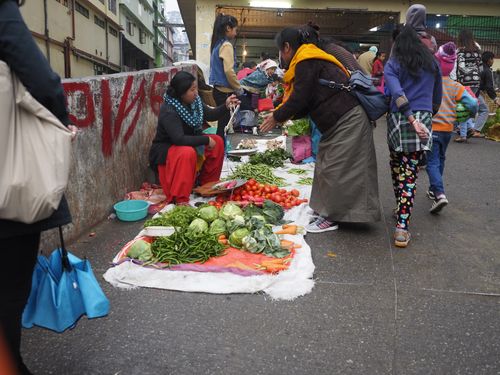
 MG Marg market, located in Gangtok, the capital of the Indian state of Sikkim, is the city’s main pedestrian commercial area. It brings together a wide range of shops, services, and food establishments serving both local residents and visitors. Designed exclusively for pedestrian use, the market plays a central role in Gangtok’s urban life by supporting retail activity, daily social interactions, and tourism-related services. It is frequented by inhabitants, government employees, and travelers, and functions as a key public space for commerce, leisure, and everyday circulation within an organized and regulated urban environment.

Gangtok • Market

Gangtok • Market
Gangtok • Market
Tradition profile
Market
Tradition category: Local market
Tradition family: Traditional markets and fairs
Tradition genre: Trade and Local Creativity
Geographic location: Gangtok • Sikkim •
• Links to •
• List of videos about Gangtok on this site •
Gangtok, the capital • Sikkim, India
The Market of MG Marg, Gangtok
Historical Formation and Urban Evolution
Early Commercial Functions in Gangtok
Before the mid-20th century, Gangtok functioned primarily as an administrative town under the Chogyal monarchy of Sikkim. Commercial activity was limited in scale and largely informal, concentrated along narrow roads that served both transport and daily trade. The route that later became MG Marg initially functioned as a practical thoroughfare linking administrative buildings, residential areas, and local supply points.
During the 1940s and 1950s, small permanent shops began to appear along this axis. These early establishments provided basic goods and services to a slowly growing urban population. At this stage, the street had no unified planning or architectural coherence and remained open to vehicular traffic.
Political Change and Renaming after 1975
A major shift occurred after 1975, when Sikkim formally became the 22nd state of India. As part of broader administrative and symbolic restructuring, the street was renamed Mahatma Gandhi Marg. This renaming reflected the integration of Gangtok into national political narratives and marked the beginning of more deliberate urban planning.
In the following decades, Gangtok experienced steady demographic growth. Census data show that the city’s population increased from under 30,000 in 1981 to over 100,000 by the early 2010s. At the same time, tourism to the eastern Himalayas expanded significantly, increasing commercial demand and intensifying pressure on central urban infrastructure.
Emergence as the Primary Commercial Axis
By the 1990s, MG Marg had become the city’s principal commercial corridor. Retail activity expanded to include restaurants, travel services, bookstores, and accommodation-related businesses. However, the street remained congested, with mixed pedestrian and vehicular use, limited public amenities, and inconsistent building standards.
Urban planners and state authorities increasingly viewed MG Marg as a strategic space requiring intervention. Studies conducted in the late 1990s identified traffic congestion, sanitation, and visual disorder as major constraints on further development.
Pedestrianisation and Redevelopment (2003–2006)
The most significant transformation took place between 2003 and 2006, when the Government of Sikkim implemented a comprehensive redevelopment project. MG Marg was fully pedestrianised, making it one of the first car-free commercial streets in a Himalayan capital. The project included new paving, improved drainage, street lighting, seating, and organised waste management systems.
Buildings along the street were renovated or reconstructed to meet uniform design guidelines. Informal vending was regulated, and commercial activities were formally registered. The pedestrian zone was officially inaugurated around 2006, marking a turning point in Gangtok’s urban history.
Consolidation and Contemporary Role
Since its redevelopment, MG Marg has remained under continuous municipal management. Periodic upgrades have focused on maintenance, lighting, and public safety. The market now extends for approximately 500 metres and accommodates several hundred registered commercial establishments.
Beyond its economic function, MG Marg has become a venue for public events, national celebrations, and civic gatherings. Historically, its evolution reflects Gangtok’s transition from a small administrative settlement to a planned urban capital integrated into national development frameworks.
The Market of MG Marg
Sociological Structure and Urban Practices
MG Marg as a Public Social Space
From a sociological perspective, MG Marg functions as the primary public space of Gangtok. The absence of vehicular traffic has reshaped patterns of movement and interaction, transforming the market into a space designed for walking, pausing, and social visibility. The street supports daily routines that extend beyond commercial exchange.
Residents frequently visit MG Marg without specific purchasing intentions. Walking, observing others, and spending time in public are central practices, reinforcing the market’s role as a shared urban environment rather than a purely economic zone.
Demographic Diversity and Daily Use
MG Marg attracts a broad cross-section of Gangtok’s population. Members of the Lepcha, Bhutia, and Nepali communities circulate alongside government employees, students, and business owners. Tourism further contributes to this diversity. Sikkim receives several hundred thousand visitors annually, many of whom pass through Gangtok and use MG Marg as their primary point of orientation.
This convergence of residents and visitors produces a continuous flow of social interaction. Encounters are typically brief and regulated, reflecting the norms of a small capital city where social familiarity and public behaviour are closely linked.
Commercial Behaviour and Consumption Patterns
The market’s commercial structure differs markedly from traditional open markets. Transactions are formalised, prices are fixed, and bargaining is rare. Shops operate according to standard retail practices, reinforcing predictability and efficiency in economic exchanges.
Consumption on MG Marg is generally moderate and oriented toward everyday needs, leisure, and tourism-related services. The street does not function as a wholesale market or a space for informal trade, but as an organised retail environment aligned with contemporary urban norms.
Social Regulation and Collective Norms
A defining feature of MG Marg is the high level of social regulation. Smoking and littering are prohibited, alcohol consumption in public is restricted, and cleanliness is actively maintained. Compliance is achieved through a combination of official enforcement and strong social consensus.
These norms contribute to a shared perception of safety and order. Visitors quickly adapt to expected behaviour, while residents play an active role in maintaining collective standards.
Symbolic Role in Urban Identity
MG Marg functions as a symbolic representation of Gangtok’s civic identity. Its controlled appearance, regulated behaviour, and orderly commercial environment convey an image of stability and modern governance. At the same time, everyday practices—language use, food habits, and social interaction—allow local identities to remain visible.
Sociologically, MG Marg represents a constructed urban tradition. It is not rooted in antiquity, but in planning decisions, regulatory frameworks, and sustained public acceptance. The market illustrates how a modern public space can become a stable social institution through shared norms and repeated daily use.
 Links to the main sections of the site