

 Français (France)
  Nederlands (nl-NL)
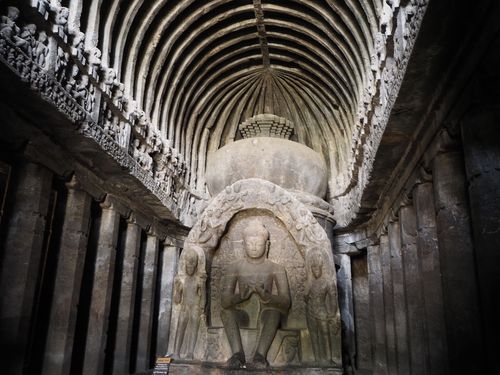
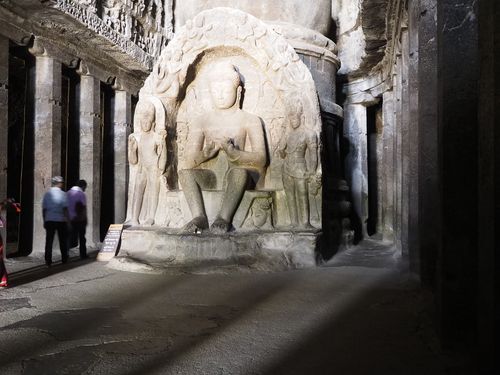
 Cave 10, also known as Vishwakarma, is one of the 34 caves at Ellora, located in the Indian state of Maharashtra. This impressive Buddhist temple, dedicated to Vishwakarma, is renowned for its large worship hall and an imposing statue of Buddha. Carved directly into the rock, the cave stands as a remarkable example of Indian rock-cut architecture. The intricate details and monumental design reflect the craftsmanship of ancient artisans and the religious significance of the site.
Monument profile
Cave 10, Vishwakarma
Monument categories: Monastery, Rock Sanctuary, Buddhist temple
Monument families: Temple • Monastery • Rock Sanctuary and Monumental Bas-reliefs
Monument genres: Religious
Cultural heritage: Buddhist
Geographic location: Ellora • Maharashtra • India
Construction period: 7th century AD
This monument in Ellora is inscribed on the UNESCO World Heritage List since 1983 and is part of the serial property "Ellora Caves".See the UNESCO monuments featured on this site
• Links to •
• Dynasties that contributed to the construction of the monument •

• List of videos about Ellora on this site •
Ellora Caves, troglodyte treasure • Maharashtra, India
• References •
Wikipedia EN: Ellora caves
UNESCO: Ellora Caves
The Political and Social Motivations Behind the Construction of Cave 10, Vishwakarma at Ellora: Historical Context, Transformations, and Modern Challenges
Political and Social Motivations for the Construction of Cave 10
Cave 10, also known as the Vishwakarma Cave, is part of the Ellora complex in Maharashtra, India, and dates back to the 7th century during the reign of the Rashtrakuta dynasty. The cave, dedicated to Vishwakarma, the divine architect, is a Buddhist chaitya hall (prayer hall) carved into rock. The construction of such monumental rock-cut caves had deep political and social motivations.
Politically, the Rashtrakutas sought to legitimize their rule by aligning themselves with the major religious movements of the time. Patronizing Buddhism, along with Hinduism and Jainism, allowed these rulers to present themselves as benevolent, tolerant, and powerful figures. By constructing large religious sites like Ellora, they could project their authority across the region and reinforce their image as protectors of the faith.
Socially, the construction of Cave 10 reflected the importance of the artisan class, who were highly regarded in Indian society. By dedicating this cave to Vishwakarma, the symbol of craftsmanship, the Rashtrakutas honored the skill and labor of these artisans. The cave also served as a communal space for spiritual gatherings, strengthening social cohesion through shared religious practices.
Historical Context and Global Comparisons
The construction of Cave 10 occurred during a period of great religious and cultural activity in India, characterized by a flourishing of rock-cut architecture. Buddhism, although declining in India by this time, remained influential, particularly in the western Deccan region. The creation of such a monumental chaitya hall symbolized the continuing importance of Buddhism, even as it faced competition from Hinduism and Jainism.
Globally, the 7th century was a time of significant transformation. In Europe, this era witnessed the decline of the Roman Empire and the rise of the Byzantine and Merovingian dynasties. In the Middle East, the spread of Islam had begun following the death of the Prophet Muhammad, drastically reshaping the political and cultural landscape. Comparatively, in Asia, Tang dynasty China was experiencing a golden age of art, culture, and religious tolerance, similar to the multi-religious patronage seen in India under the Rashtrakutas.
The construction of Buddhist rock-cut monuments during this period paralleled developments in other parts of Asia, particularly China and Southeast Asia, where similar caves and temples were being built to accommodate Buddhist monks and travelers along trade routes. Sites like the Longmen Grottoes in China, which were contemporaneous to Ellora, share similarities in their monumental scale and religious significance.
Major Transformations of Cave 10 Over the Centuries
Cave 10, along with the entire Ellora complex, underwent various transformations over the centuries as political powers shifted in the region. The decline of Buddhism in India, especially from the 8th century onward, reduced the religious prominence of sites like Ellora. As Hinduism and Jainism gained influence, newer caves were carved at the site, reflecting the changing religious landscape.
Under the Yadava dynasty (12th–14th century) and later during the Muslim rule of the Deccan Sultanates, Ellora was largely preserved but neglected as a major religious center. The caves did not suffer significant destruction during these periods, unlike other religious sites in India, but they did lose some of their earlier prominence as centers of worship.
Despite these changes in political and religious dominance, Cave 10 retained its architectural integrity and cultural importance. Its conversion into a site of pilgrimage and later its rediscovery by European scholars in the 19th century brought renewed attention to its historical significance.
Cultural Significance and Conservation Efforts
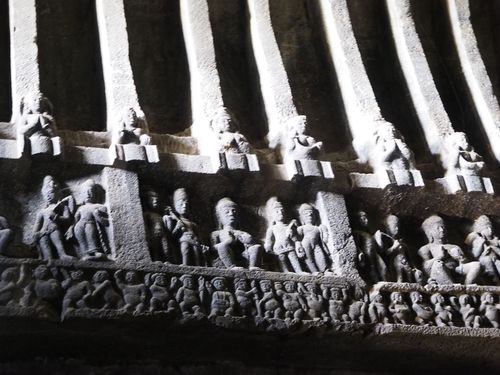
Cave 10’s cultural significance lies in its remarkable fusion of architectural and artistic traditions, reflecting both local craftsmanship and broader Buddhist influences. The large stupa inside the chaitya hall, along with the grand statue of Buddha, symbolizes the spiritual function of the cave, while the intricate carvings of animals and geometric patterns demonstrate artistic mastery.
In 1983, the Ellora complex was designated a UNESCO World Heritage site, which has significantly contributed to its international recognition and preservation. This status has increased global awareness of the cave’s historical and cultural value, helping to protect it from modern threats. Conservation efforts, spearheaded by both Indian authorities and international bodies, have focused on preventing further erosion of the rock and mitigating damage from tourist activity.
Challenges to Preservation in the Modern Era
Despite its recognition and protected status, Cave 10 faces several modern challenges. One of the most significant threats is the erosion of the basalt rock, accelerated by both natural factors and human impact. The cave’s intricate carvings are particularly vulnerable to weathering caused by monsoon rains and fluctuations in temperature.
Additionally, tourism poses a constant challenge to preservation. The growing number of visitors to Ellora can lead to the physical deterioration of the cave’s interiors, especially in areas where foot traffic is high. Measures such as limiting visitor access and enhancing protective barriers around the most fragile areas have been implemented to reduce damage.
Urban development around Ellora and the broader region also presents a challenge. The construction of roads and tourist facilities, while necessary to accommodate visitors, can disrupt the natural landscape and lead to environmental degradation, further threatening the stability of the caves.
Ongoing conservation efforts, supported by UNESCO and Indian heritage authorities, aim to address these issues through restoration projects, public awareness campaigns, and stricter visitor regulations. However, balancing the need for preservation with the desire for public access remains a delicate challenge.
Conclusion
Cave 10, Vishwakarma, at Ellora is an extraordinary example of India’s architectural and artistic achievements during the 7th century. Politically motivated to showcase the Rashtrakutas' power and socially significant for honoring artisans and Buddhist traditions, the cave represents a period of cultural and religious fluidity. Over the centuries, despite the decline of Buddhism in India, the cave has survived political shifts and religious changes, maintaining its cultural importance. Today, it stands as a testament to the ingenuity of ancient Indian craftsmen, though it faces modern challenges related to preservation and sustainable tourism.
The Architectural Mastery of Cave 10, Vishwakarma at Ellora: Technological Innovation, Artistic Fusion, and Global Recognition
Technological Advances and Innovation in the Vakataka Era
Cave 10, also known as Vishwakarma, is one of the most remarkable examples of rock-cut architecture in Ellora, Maharashtra, India, dating back to the 7th century. Although constructed during the reign of the Rashtrakuta dynasty, its roots lie in the architectural advancements of the earlier Vakataka period (3rd-6th centuries), whose innovations greatly influenced the construction techniques seen at Ellora.
The construction of Cave 10 demonstrates advanced technological prowess in rock-cut architecture. The artisans used the monolithic technique, which involved carving the entire cave out of a single mass of basaltic rock. This required precise planning and coordination, as mistakes could not easily be corrected. Unlike brick or timber constructions, where materials can be added or adjusted, rock-cut architecture demanded detailed blueprints and expert craftsmanship from the start. The cave was carved top-down, minimizing the risk of collapse and ensuring the overall structure's stability.
The key material used was basalt, a volcanic rock that was abundant in the Deccan region. Its hardness made it durable but also required sophisticated tools and techniques to carve out intricate details. Tools made of iron, such as chisels and hammers, were used to painstakingly shape the stone, allowing artisans to create both grand spaces and fine decorative elements.
Artistic Fusion: Regional and Foreign Influences
The architectural and decorative elements of Cave 10 reflect a rich blend of regional Indian traditions and foreign influences that were present in the subcontinent due to extensive trade and cultural exchanges.
The layout of the cave follows the traditional Buddhist chaitya hall design, featuring a large central stupa and colonnaded aisles for circumambulation. This structure reflects Indian architectural principles of space and function, emphasizing spiritual practice. However, the details of the cave’s carvings—particularly the geometric patterns and floral motifs—suggest influences from regions as far as Persia and the Greco-Roman world. These influences likely reached India through trade routes, particularly via the Silk Road, which connected India with Central Asia and beyond.
One of the most striking features of the Vishwakarma Cave is the massive Buddha statue in the main hall, symbolizing enlightenment and peace. The figure is framed by intricately carved motifs that combine local artistic elements with foreign aesthetic styles. These carvings, along with other sculptures of deities and animals, demonstrate a remarkable level of artistic finesse.
The ceiling of the cave is designed to resemble wooden beams, showcasing the artisans’ ability to simulate various textures in stone. This detail, while entirely in stone, mimics traditional Indian wooden architecture, further highlighting the artistic synthesis of different materials and styles.
Notable Structure and Plan
Cave 10’s architectural plan is centered around a chaitya hall, which served as a prayer hall for Buddhist monks and devotees. The hall features a large stupa in the center, allowing for ritualistic circumambulation, which is a critical element of Buddhist worship. The stupa itself, coupled with the towering figure of Buddha, reflects the symbolic nature of the architecture, meant to inspire awe and reverence.
The acoustics of the cave are another noteworthy feature. Designed to enhance the chanting and prayers of the monks, the cave’s vaulted ceiling creates a natural amplification system. This architectural innovation not only served a religious function but also underscores the technical understanding of sound dynamics in ancient Indian architecture.
Anecdotes and Statistics
Cave 10 is often referred to as the "Carpenter’s Cave" due to the detailed carving of the ceiling, which mimics wooden beams. This demonstrates the artisans’ ability to create the illusion of a different material, showing their versatility and skill in working with stone.
It is believed that hundreds of artisans worked over several decades to complete the cave. The complexity of the design and the precision required to carve the cave directly into the basalt cliffs without modern tools is a testament to the advanced knowledge of engineering and geometry possessed by the builders.
International Recognition and UNESCO World Heritage Status
Cave 10, along with the rest of the Ellora complex, was recognized as a UNESCO World Heritage site in 1983. This designation has significantly contributed to its preservation and raised awareness of its global cultural significance. The recognition of Ellora as a UNESCO site has facilitated international efforts to conserve the monument and ensure that it remains accessible to future generations.
The site’s inclusion on the World Heritage list has also increased global tourism to Ellora, bringing attention not just to the Buddhist caves but also to the Hindu and Jain temples in the complex. This influx of tourism has both positive and negative effects. On the one hand, it has provided funding for conservation efforts. On the other hand, increased foot traffic presents challenges in maintaining the integrity of the carvings, which are susceptible to wear over time.
Challenges to Conservation
Preserving the basalt rock of Cave 10 is one of the primary challenges. Over time, the rock faces erosion due to environmental factors, such as monsoon rains and fluctuating temperatures, which can weaken the structure. Additionally, the continuous flow of visitors has raised concerns about the physical degradation of the sculptures and the stupa inside the cave.
The Indian government, in collaboration with UNESCO, has initiated several conservation projects to address these issues. Measures such as restricting access to certain areas of the cave, installing barriers to protect the most fragile sculptures, and employing new technologies to monitor the structural integrity of the cave are currently in place.
Conclusion
Cave 10, Vishwakarma, at Ellora stands as a monumental example of architectural innovation during the Vakataka period, reflecting not only the technological advancements of the time but also the rich fusion of artistic traditions and cultural influences. Its intricate carvings, acoustical design, and symbolic stupa continue to captivate visitors and scholars alike. Recognized as a UNESCO World Heritage site, the cave remains a testament to the ingenuity of ancient Indian craftsmen while facing modern challenges of preservation. Its ongoing conservation efforts underscore its importance as a global cultural treasure, ensuring its survival for future generations to appreciate.