Français (France)
  Nederlands (nl-NL)
 Of Hindu tradition, (with additional Islamic influence), the Maratha dynasty ruled for approximately 87 years, ± between 1674 and 1761 over all or part of Central India, North India, South India and West India, during the Medieval Period.
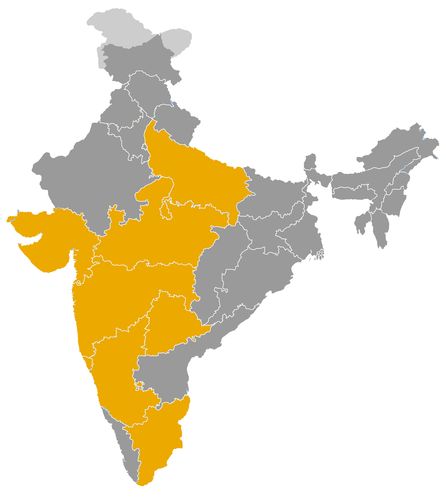
This map illustrates the maximum territory that the Maratha Dynasty had reached at its height, covering the current regions of Karnataka, Madhya Pradesh, Maharashtra, Tamil Nadu, Telangana and Uttar Pradesh in India. Its main purpose is to provide a visual aid to understand the geographical extent of this dynasty. However, it's important to note that the contemporary borders of these regions may not necessarily coincide with the historical territories.
The Maratha Dynasty and the Political Transformation of India
A Deccan power that challenged Mughal supremacy
The Maratha dynasty and the wider Maratha political system occupy a major place in the history of India between the seventeenth and nineteenth centuries. Emerging from the western Deccan, especially the region of present-day Maharashtra, the Marathas became one of the most important forces in the decline of Mughal power and in the reshaping of the subcontinent before British dominance. Their rise began under Shivaji, who was crowned Chhatrapati in 1674 and established a sovereign Maratha kingdom based on forts, mobile warfare, regional support and administrative discipline.
The term Maratha dynasty needs to be understood carefully. It refers first to the royal Bhonsle house of Shivaji and his successors, but the Maratha political world later expanded into a much broader confederacy. In this system, the Chhatrapati retained dynastic legitimacy, while the Peshwas of Pune gradually became the effective political leaders. Powerful Maratha houses such as the Scindia, Holkar, Gaekwad and Bhonsle of Nagpur developed their own territorial bases, making the Maratha state both expansive and internally complex.
Shivaji and the creation of a new regional kingship
Shivaji’s role was foundational. He built a kingdom in a region contested by the Mughal Empire and the Deccan sultanates, especially Bijapur and Golconda. His authority rested on a network of hill forts, a capable military command, an efficient intelligence system and the support of local elites. His coronation gave ideological and ritual legitimacy to a power that had emerged through warfare, negotiation and regional mobilisation.
Politically, Shivaji created a model of kingship rooted in the Deccan but ambitious in scope. He presented himself as an independent Hindu ruler, yet his administration was pragmatic and included people of varied backgrounds. His state drew strength from local society, revenue management, fort control and rapid cavalry operations. After his death, Sambhaji, Rajaram and Tarabai continued resistance against the Mughals. The long war in the Deccan exhausted imperial resources and helped weaken Mughal authority across India.
The Peshwas and the growth of a Maratha confederacy
In the eighteenth century, effective authority increasingly passed from the Chhatrapatis of Satara to the Peshwas of Pune. Balaji Vishwanath strengthened the position of the Peshwa as chief administrator under Shahu I. Baji Rao I transformed the office into a centre of military leadership and territorial expansion. Under him and his successors, Maratha influence extended far beyond Maharashtra into Malwa, Gujarat, Bundelkhand, Rajasthan, central India and the region around Delhi.
The Maratha system did not become a tightly centralised empire. It functioned more as a confederacy, with major military families exercising power in different regions while maintaining varying degrees of allegiance to the Peshwa. This structure allowed rapid expansion and flexibility, but it also created tensions. Regional chiefs often pursued their own interests, and the central authority at Pune could not always impose unity.
A decisive force in the decline of the Mughal order
The political impact of the Marathas was immense. They became one of the main beneficiaries of Mughal decline and one of the principal powers competing to control the post-Mughal order. Their armies entered northern India, intervened in imperial politics and at times acted as protectors or arbiters of the Mughal emperor in Delhi.
Their defeat at the Third Battle of Panipat in 1761 was a severe setback, but it did not destroy Maratha power. Under Madhav Rao I, the confederacy recovered much of its strength. By the late eighteenth century, the Marathas remained one of the strongest Indian political formations, alongside Mysore, Hyderabad, the Sikh power and the expanding British East India Company. Their history therefore belongs to the transition between Mughal imperial dominance and British colonial rule.
Cultural influence through language, patronage and regional identity
The Marathas had a lasting cultural impact, especially in western India. Their rise strengthened the political prestige of the Marathi language, which became important in administration, correspondence and regional identity. Sanskrit retained ritual and scholarly importance, but Marathi gained wider political authority through state documents, court culture and local governance.
Maratha rulers and elites supported temples, religious institutions, Brahman scholars, devotional traditions and local festivals. The bhakti heritage of Maharashtra, associated with saints and vernacular religious expression, remained an important cultural background. Maratha patronage was not limited to one narrow religious model. Although the state often used Hindu royal symbolism, its political practice was pragmatic and adapted to the varied societies it governed.
Architecture and urban development also reflected Maratha power. Pune grew as a political centre under the Peshwas, while regional courts such as Gwalior, Indore, Baroda and Nagpur developed their own administrative and cultural environments. The Maratha legacy therefore spread through both royal symbolism and regional institutions.
Economic power based on taxation, tribute and military mobility
The Maratha economy rested on agriculture, fort networks, local revenue systems and expansion into tribute-paying territories. In their early phase, the Marathas drew resources from the lands of Maharashtra and the western Deccan. As they expanded, they developed fiscal claims over wider regions through chauth and sardeshmukhi, forms of revenue demand imposed on territories not always directly administered.
This system gave the Marathas access to large revenues and supported mobile armies capable of operating across the subcontinent. It also encouraged the rise of regional commanders who collected revenue and built their own power bases. The economic structure of the confederacy was therefore dynamic but unstable. It could finance expansion, but it also increased decentralisation.
The confrontation with British power and the survival of Maratha states
The Marathas eventually became the main obstacle to British expansion in western and central India. The Anglo-Maratha wars revealed both the military strength of the confederacy and the danger of its internal divisions. The Treaty of Bassein in 1802 weakened the independence of the Peshwa, and the defeat of Baji Rao II in 1818 ended the central political power of the Marathas.
Several Maratha states survived under British paramountcy, including Gwalior, Indore, Baroda and Kolhapur. Their continued existence preserved elements of Maratha political identity within the princely order.
A major legacy in the making of modern India
The Marathas were one of the decisive powers of early modern India. They challenged the Mughals, reshaped regional politics, expanded Marathi political culture and created a confederacy that dominated much of the subcontinent for part of the eighteenth century. Their history explains the transition from Mughal imperial authority to a fragmented political landscape in which the British gradually gained supremacy. Their legacy endured through regional identity, princely states and the lasting memory of Shivaji as a foundational figure in Maharashtra and Indian history.
The Geographic Expansion of the Maratha Dynasty in India
A western Deccan origin shaped by mountains and forts
The Maratha power emerged in the western Deccan, especially in the region corresponding to present day Maharashtra. Its first territorial base lay among the hill forts, valleys and plateaus of the Western Ghats, together with parts of the Konkan coast. This landscape strongly influenced the early development of Maratha authority. Rather than beginning as a vast territorial empire, the Maratha state grew from a compact but defensible region where local knowledge, fortified positions and rapid cavalry movements gave it a strategic advantage.
Under Shivaji, crowned Chhatrapati in 1674, the Marathas consolidated control over a network of forts such as Raigad, Pratapgad, Sinhagad and other strongholds. These forts were not only military posts. They served as administrative centres, symbols of sovereignty and bases for expansion. From this western Deccan core, Shivaji extended his authority into surrounding territories contested by the Deccan sultanates and the Mughal Empire.
Expansion across the Deccan during the Mughal wars
The first major phase of Maratha expansion took place in the Deccan. Shivaji built his kingdom in a political environment dominated by the sultanates of Bijapur and Golconda, while the Mughal Empire was advancing southward. By exploiting rivalries among these powers, the Marathas expanded through military campaigns, negotiated settlements and control of strategic routes.
After Shivaji’s death, the Mughal emperor Aurangzeb launched a long campaign to subdue the Marathas. This conflict placed severe pressure on the Maratha state, but it also transformed it. Maratha forces became increasingly mobile and decentralised, able to operate across wide areas rather than remaining confined to their original forts. During the reigns of Sambhaji, Rajaram and the regency of Tarabai, resistance continued across the Deccan, including regions of present day Maharashtra, Karnataka, Telangana and parts of central India.
The result was not simply survival. The Marathas emerged from the Mughal wars as a major military and fiscal power. Their influence began to extend beyond areas of direct administration through the collection of chauth and sardeshmukhi, revenue claims imposed on territories that acknowledged Maratha pressure or protection.
Northward movement into Malwa, Gujarat and central India
In the eighteenth century, especially under the Peshwas of Pune, Maratha expansion became subcontinental in scale. The weakening of Mughal authority opened opportunities in Malwa, Gujarat, Bundelkhand and central India. These regions were strategically important because they connected the Deccan with northern India and provided access to rich agricultural and commercial zones.
Malwa became one of the key areas of Maratha influence. Its position allowed Maratha armies to move toward Rajasthan, the Gangetic plain and Delhi. Gujarat offered access to prosperous trading centres and revenue networks linked to the Arabian Sea. Bundelkhand and central India became zones where Maratha military commanders established claims, alliances and eventually territorial bases.
This expansion did not produce a uniform empire ruled directly from Pune. Instead, Maratha authority took different forms: tribute, tax rights, military garrisons, local alliances, political protection and direct rule by regional Maratha houses. The Scindia of Gwalior, the Holkar of Indore, the Gaekwad of Baroda and the Bhonsle of Nagpur became major pillars of this wider Maratha political world.
A confederacy stretching from Maharashtra toward Delhi and Odisha
At its height, Maratha power extended or exerted influence across much of India. Its core remained in Maharashtra and the western Deccan, but its political reach covered Gujarat, Malwa, Bundelkhand, Berar, Nagpur, parts of Odisha, central India and the region around Delhi. Maratha armies also intervened in Rajasthan and northern India, where they became deeply involved in the politics of the declining Mughal Empire.
The Marathas were sometimes protectors of the Mughal emperor, sometimes rivals of other regional powers, and often collectors of tribute from states that retained their own rulers. This created a flexible but fragmented system. The Peshwa was the leading authority of the confederacy, yet the great Maratha houses increasingly acted with autonomy in their own spheres.
The geographic reach of the Marathas therefore combined expansion and decentralisation. Their influence was broad, but their internal structure was complex. The farther their armies and revenue networks moved from Maharashtra, the more dependent the system became on regional commanders and negotiated authority.
Relations with Rajputs, Sikhs, Hyderabad and Mysore
Maratha expansion reshaped relations with neighbouring dynasties and states. In Rajasthan, many Rajput kingdoms had to negotiate with Maratha armies and revenue demands while trying to preserve their own autonomy. Relations were often marked by tribute, alliance, military pressure and shifting diplomacy.
In the north, Maratha involvement around Delhi brought them into contact with the weakened Mughal court and with rising Sikh power in Punjab. Their defeat at the Third Battle of Panipat in 1761 against Ahmad Shah Durrani halted their northern advance for a time, but it did not eliminate their influence. They later recovered much of their strength in central and northern India.
In the Deccan, relations with Hyderabad were central. The Nizam’s state and the Marathas competed over revenue, territory and influence. To the south, Mysore under Haidar Ali and Tipu Sultan became another major regional power. Maratha relations with Mysore alternated between conflict, strategic calculation and temporary alignment, depending on the balance of power and the growing presence of the British.
Conflict with the British East India Company
The wide geographic expansion of the Marathas eventually brought them into direct conflict with the British East India Company. By the late eighteenth century, the British saw the Maratha Confederacy as one of the principal obstacles to their dominance in western and central India. The Anglo Maratha wars exposed both the strength and weakness of the confederacy.
The Marathas possessed large armies, strong regional bases and deep political influence. However, their divided structure made unified strategy difficult. The Treaty of Bassein in 1802 placed the Peshwa under British protection and alarmed other Maratha chiefs. The final defeat of Baji Rao II in 1818 ended the central power of the Peshwas, though several Maratha states survived as princely states under British supremacy.
A territorial expansion that transformed India’s political map
The geographic expansion of the Marathas was one of the decisive developments of early modern India. From a fortified core in the western Deccan, they extended their influence across Maharashtra, Gujarat, Malwa, central India, Bundelkhand, Odisha, the Deccan and the approaches to Delhi.
Their power did not create a single centralised empire, but a confederacy of regional authorities linked by military, fiscal and dynastic interests. This structure allowed rapid expansion, but it also made coordination difficult. The Marathas helped dismantle the old Mughal order, shaped relations with nearly every major Indian power of their time, and became the last great indigenous force to challenge British expansion before the establishment of colonial supremacy.
Maratha chronology distinguishes the Chhatrapatis, sovereign kings of the Bhonsle house, from the Peshwas, chief ministers who gradually became the effective rulers of the Maratha Confederacy. After the reign of Shahu I, the Chhatrapatis of Satara retained mainly nominal authority, while the Peshwas of Pune exercised the principal political power. The Kolhapur branch formed a parallel and rival line.
Chhatrapatis of the Maratha kingdom and Satara
- Shivaji I (1674–1680) • Founder of the Maratha kingdom, he assumed the title of Chhatrapati at his coronation in Raigad. He established independent authority against the Mughals and the Deccan sultanates.
- Sambhaji (1681–1689) • Son of Shivaji I, he continued resistance against the Mughal Empire. He was captured and executed on Aurangzeb’s orders.
- Rajaram I (1689–1700) • Brother of Sambhaji, he led Maratha resistance from the Deccan and then from Jinji. His reign preserved dynastic continuity during the war against the Mughals.
- Shivaji II (1700–1707, regency of Tarabai) • Son of Rajaram I, he was proclaimed Chhatrapati under the regency of his mother Tarabai. His authority was challenged after Shahu’s release.
- Shahu I (1708–1749) • Grandson of Shivaji I, he established himself as Chhatrapati at Satara after a succession war. Under his reign, the Peshwas became the main administrators of Maratha expansion.
- Rajaram II (1749–1777) • Also called Ramaraja, he ruled as Chhatrapati of Satara with very limited authority. Effective power passed to the Peshwas of Pune.
- Shahu II (1777–1808) • Chhatrapati of Satara, he retained a dynastic and ritual function. Real political power remained in the hands of the Peshwas.
- Pratap Singh (1808–1818, nominal Maratha sovereign; 1818–1839, princely Raja of Satara) • Last Chhatrapati associated with the end of independent Maratha power. After 1818, he ruled Satara under British supremacy.
Peshwas of Pune, effective rulers of the Maratha Confederacy
- Balaji Vishwanath (1713–1720) • First major hereditary Peshwa, he consolidated the authority of Shahu I. He obtained fiscal recognitions that strengthened the Maratha position in the Deccan.
- Baji Rao I (1720–1740) • An exceptional military Peshwa, he rapidly extended Maratha influence into northern and central India. His rule made Pune a major political centre.
- Balaji Baji Rao (1740–1761) • Also called Nana Saheb, he led the Maratha Empire at its greatest extent. His government was marked by the defeat at Panipat in 1761.
- Madhav Rao I (1761–1772) • He restored Maratha power after Panipat. His reign is often regarded as a phase of administrative and military recovery.
- Narayan Rao (1772–1773) • A young Peshwa, he was assassinated during a court crisis. His death caused serious political instability.
- Raghunath Rao (1773–1774, contested) • He claimed the office of Peshwa after Narayan Rao’s death. His conflict with Maratha factions helped trigger British intervention.
- Madhav Rao II (1774–1795) • Also called Sawai Madhav Rao, he ruled under the strong influence of ministers such as Nana Fadnavis. His reign maintained the fragile balance of the confederacy.
- Baji Rao II (1796–1818) • Last effective Peshwa, he increasingly depended on British support after the Treaty of Bassein. His defeat in 1818 ended the political power of the Peshwas.
Parallel branch of Kolhapur
- Shivaji II of Kolhapur (1710–1714, Kolhapur branch) • He was supported by Tarabai in the rivalry against Shahu I. His power was soon displaced by Sambhaji II.
- Sambhaji II of Kolhapur (1714–1760) • He consolidated the rival Kolhapur branch. His reign confirmed the lasting separation between Satara and Kolhapur.
- Shivaji III of Kolhapur (1762–1813) • He ruled Kolhapur in a context of rivalry among Maratha houses. His authority remained regional.
- Sambhaji III of Kolhapur (1813–1821) • He governed during the final phase of independent Maratha power. After 1818, Kolhapur entered the princely order under British influence.
 Links to the main sections of the site