

 Français (France)
  Nederlands (nl-NL)
 The Maratha Palace of Thanjavur is one of the principal historical complexes of the former royal capital in Tamil Nadu. Shaped by several political periods, the site is closely associated with the Maratha rulers who governed the region between the seventeenth and nineteenth centuries. The complex includes buildings connected with administration, court life, ceremonies, and cultural activities. Today, the palace remains an important heritage site through its museums, libraries, and public spaces. It also plays a significant role in understanding the political and cultural history of southern India during the Maratha period.
Monument profile
Maratha Palace
Monument category: Palace
Monument family: Palace and Annexes
Monument genre: Residential
Geographic location: Thanjavur • Tamil Nadu • India
Construction period: 16th century AD
• Links to •
• Dynasties that contributed to the construction of the monument •


• List of videos about Thanjavur on this site •
Thanjavur • Chola temples • Tamil Nadu, India
• References •
Wikipedia EN: Thanjavur Maratha Palace
The Maratha Palace of Thanjavur and Royal Authority in Southern India
Origins of the Palace Complex and Political Transition
The Maratha Palace of Thanjavur developed through a long political evolution connected with changes in royal authority in southern India. The complex originated from earlier structures associated with the Nayak rulers of Thanjavur, who governed the region after the decline of the Vijayanagara Empire. In the seventeenth century, the conquest of Thanjavur by the Marathas transformed the political organization of the kingdom and led to the adaptation of the palace for the needs of the new ruling dynasty.
The Maratha rulers used the complex as an administrative center, royal residence, and location for official ceremonies. Several buildings were expanded or modified to accommodate political, military, and cultural functions associated with the court. Over time, the palace became one of the principal symbols of Maratha authority in Tamil Nadu.
Although the Thanjavur Marathas maintained a degree of regional autonomy, their political position was increasingly influenced by neighboring kingdoms and by European trading powers operating along the southern Indian coast.
Cultural Development Under the Maratha Rulers
The palace played an important role in the intellectual and artistic life of Thanjavur during the Maratha period. Royal patronage supported literature, music, scholarship, and religious activities, transforming the city into a major cultural center of southern India.
King Serfoji II occupies a particularly significant place in the history of the palace complex. During his reign in the late eighteenth and early nineteenth centuries, several cultural institutions within the palace were expanded and reorganized. The Saraswathi Mahal Library became especially important through the preservation and collection of manuscripts written in Sanskrit, Tamil, Telugu, and Marathi. This activity established the palace as a major center for the conservation of regional knowledge and literary traditions.
Contacts with Europeans also influenced aspects of palace administration and cultural life. Serfoji II maintained relations with missionaries and Western scholars, contributing to the introduction of new educational and scientific practices within the royal environment.
Decline of Royal Power and Transformation of the Complex
During the nineteenth century, the political influence of the Maratha rulers gradually declined under British colonial expansion in southern India. After Thanjavur was integrated into the British administrative system, the palace lost much of its former political and military importance.
Some sections of the complex nevertheless continued to be occupied by members of the royal family and by institutions connected with education and cultural preservation. Other areas were adapted for museums, archives, and heritage collections. These changes allowed the palace to retain symbolic significance despite the disappearance of Maratha political authority.
Throughout the twentieth century, restoration campaigns were undertaken to preserve historic buildings and collections within the complex. The palace gradually became an important heritage site associated with the dynastic history of Thanjavur and the cultural memory of the Maratha period in southern India.
The Palace Within the Global Context of the Maratha Period
The development of the Maratha Palace of Thanjavur took place during a period marked by the expansion of European maritime powers in the Indian Ocean and by the transformation of Indian regional kingdoms after the weakening of the Mughal Empire. During the seventeenth and eighteenth centuries, commercial networks linking India with Southeast Asia, the Middle East, and Europe expanded considerably. The growing presence of British, French, and other European powers progressively altered political balances across southern India.
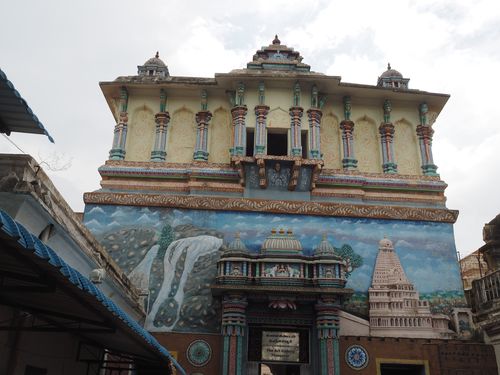
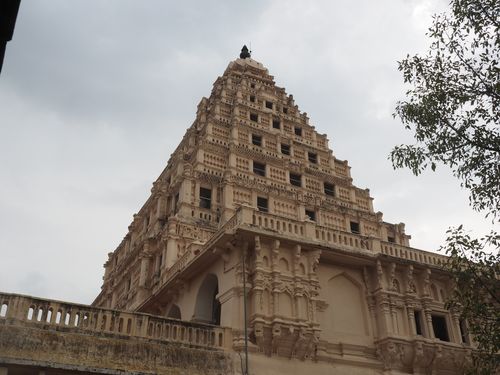
The Maratha Palace in Thanjavur, India, is a quintessential embodiment of the architectural innovation and technical mastery of its era. Built primarily during the Nayak rule in the 16th century and later expanded by the Marathas, the palace showcases a remarkable blend of Dravidian and Maratha architectural styles, reflecting the rich cultural synthesis that characterizes the history of Thanjavur.
Architectural Innovation and Technical Mastery
One of the most striking aspects of the Maratha Palace's architecture is its ingenious use of space and light. The palace complex was designed to accommodate the administrative functions of the Maratha rulers while providing spaces for public ceremonies and private contemplation. The use of extensive courtyards, high ceilings, and intricately carved pillars not only enhanced the aesthetic appeal but also served practical purposes, promoting air circulation and cooling in the tropical climate of Tamil Nadu.
The technical mastery of the era is evident in the construction techniques employed. The builders used locally sourced materials, such as granite and laterite, and employed traditional construction methods that have allowed the structure to withstand the test of time. The palace's durability is a testament to the advanced engineering knowledge and skills of its architects and builders.
Unique Architectural Features
The Maratha Palace is renowned for several unique architectural features that contribute to its global recognition:
Saraswathi Mahal Library: Part of the palace complex, it is one of the oldest libraries in Asia, housing an extensive collection of rare manuscripts and books. The library's architecture, with its vaulted ceilings and wooden shelving, is designed to preserve these valuable texts from the humid climate.
Art Gallery: The palace also hosts an art gallery that contains a vast collection of Tanjore paintings, sculptures, and artifacts, showcasing the rich artistic heritage of the region. The gallery's layout and lighting are thoughtfully designed to highlight the intricate details of each piece.
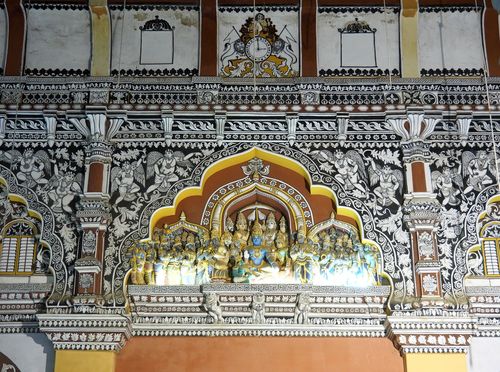
Durbar Hall: This grand audience hall, where the Maratha kings held court, is noted for its spacious design and ornamental decorations, including lavish frescoes and carved pillars. The Durbar Hall's architecture reflects the Marathas' power and their patronage of the arts.
Construction Statistics and Sources
While specific statistics regarding the construction duration, cost, and labor involved are scarce, historical records indicate that the palace complex was built and expanded over several centuries, reflecting the contributions of successive rulers. The Saraswathi Mahal Library, for instance, was established in the 16th century and has been meticulously maintained and expanded over the years.
Sources of information on the Maratha Palace and its architecture include historical documents and studies by the Archaeological Survey of India, as well as academic research published in journals dedicated to Indian history and architecture. These works provide insights into the palace's construction techniques, architectural styles, and cultural significance.
The Maratha Palace's architecture is a vivid illustration of the innovation and skill of its time, offering a window into the cultural and historical milieu of Thanjavur. Its unique features not only underscore its importance as a monumental heritage site but also highlight the rich legacy of architectural and artistic excellence in India.