

 Français (France)
 Nederlands (nl-NL)
Of Hindu tradition, (with additional Islamic and Christian influence), the Bhonsle of Thanjavur dynasty ruled for approximately 181 years, ± between 1674 and 1855 over all or part of South India, during the Colonial Period and the Modern Period.
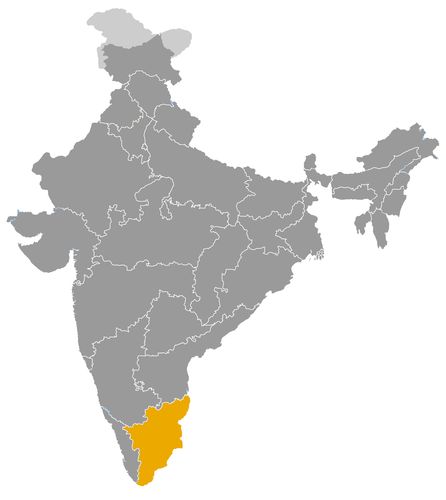
This map illustrates the maximum territory that the Bhonsle of Thanjavur Dynasty had reached at its height, covering the current regions of Tamil Nadu in India. Its main purpose is to provide a visual aid to understand the geographical extent of this dynasty. However, it's important to note that the contemporary borders of these regions may not necessarily coincide with the historical territories.
The Bhonsle Dynasty of Thanjavur: Regional Power and Cultural Patronage in Indian History
The Establishment of Maratha Rule in Southern India
The Bhonsle dynasty of Thanjavur ruled a kingdom in southern India from approximately 1674–1676 until 1855. Its founder, Ekoji I, also known as Venkoji, was a half brother of Shivaji, the founder of the Maratha kingdom in western India. Although connected to the wider expansion of Maratha power, the Thanjavur branch developed a distinct political identity shaped by its southern setting.
Ekoji established his authority following military intervention in the conflicts surrounding the declining Nayak kingdom of Thanjavur. Originally serving the sultanate of Bijapur, he assumed control of a territory centred on the fertile Kaveri delta, principally within present day Tamil Nadu. The kingdom also initially included Karaikal and neighbouring settlements, now belonging to the Union Territory of Puducherry.
The new rulers inherited established administrative institutions, agricultural infrastructure and artistic traditions. Their historical significance lay partly in adapting these foundations to a court that connected Maratha elites with the Tamil and Telugu cultural worlds.
Political Autonomy and the Expansion of British Influence
The Thanjavur Bhonsles were regional sovereigns rather than governors administering a southern province for the principal Maratha authorities. Their policies reflected local conditions and relations with neighbouring powers, including Madurai, the nawabs of Arcot and Mysore.
During the eighteenth century, succession disputes, warfare and financial demands weakened the monarchy. European trading companies increasingly influenced regional politics through military intervention and alliances. In 1773, forces of the nawab of Arcot, supported by the British East India Company, occupied Thanjavur and displaced Tuljaji. He recovered his throne in 1776, but the episode demonstrated the kingdom’s vulnerability.
A decisive agreement in 1799 transferred the administration and most territorial revenues to the East India Company. Serfoji II retained royal status, financial provisions and limited authority around his residence. The monarchy consequently survived as a restricted court under British supremacy. Following the death of Shivaji II in 1855, the British annexed its remaining possessions, ending the dynasty’s political rule.
Agriculture, Revenue and Regional Exchange
The economic foundations of Bhonsle Thanjavur rested on the productive agricultural landscape of the Kaveri delta. Rice cultivation depended on irrigation channels and water management systems developed over successive centuries. Maintaining this infrastructure was essential to food production, rural livelihoods and government income.
Land revenue supported the administration, armed forces and royal household. It also financed religious establishments, scholarly communities and charitable foundations. Grants to temples and other institutions connected political authority with the distribution of agricultural resources, reinforcing relationships between the monarchy and influential local groups.
Royal support extended to chattrams, institutions providing meals and accommodation for pilgrims and travellers. These establishments combined charity with practical support for movement across the region.
Commercial links with the Coromandel coast connected agricultural production and local markets to wider trading networks. Nevertheless, military expenditure, tribute and debt placed increasing pressure on royal finances. The progressive transfer of Karaikal and surrounding settlements to the French from 1739 reflected the intersection of financial constraints and European territorial expansion.
A Multilingual Court and the Development of Performing Arts
Cultural patronage was the dynasty’s most enduring contribution to Indian history. The court supported literary production in Marathi, Telugu, Tamil and Sanskrit, creating an environment in which different linguistic traditions interacted.
Several rulers participated directly in intellectual and artistic activity. Shahaji composed literary and dramatic works, while Tulaja I contributed to musical scholarship through his Sangita Saramrita. Their patronage continued traditions established under the Nayaks while introducing additional Maratha influences.
Thanjavur became an important centre of Carnatic music, supported by networks of court musicians, religious institutions and patrons. Royal sponsorship also sustained dance traditions associated with temples and court performance. During the early nineteenth century, the Thanjavur Quartet helped organise a repertoire that became fundamental to modern bharatanatyam.
Painting, craftsmanship and palace decoration likewise benefited from elite patronage. These developments emerged through interaction between inherited regional practices and the demands of the Maratha court.
Serfoji II and the Preservation of Knowledge
Serfoji II, restored to power in 1798, became particularly influential as a patron of learning. He expanded the Sarasvati Mahal Library, an institution inherited from the Nayak period, through manuscript acquisition, copying and scholarly activity. Its collections preserved literature and knowledge across several languages and disciplines.
He also encouraged education, printing and medical investigation. His medical establishment brought Indian therapeutic traditions into contact with European knowledge, illustrating the intellectual exchanges accompanying colonial expansion.
The dynasty remained Hindu throughout its rule, while patronage also extended to Muslim and Christian institutions. Its legacy therefore encompasses both religious foundations and broader intellectual networks. Although its territorial power diminished, Bhonsle Thanjavur remained a significant centre of artistic production, scholarship and cultural exchange in southern India.
The Bhonsle Kingdom of Thanjavur: Territorial Extent and Relations with Neighbouring Powers
The Establishment of a Southern Maratha Kingdom
The Bhonsle dynasty governed Thanjavur from approximately 1674 to 1676, depending on the chronology adopted for its establishment, until 1855. Its founder, Ekoji I, also known as Venkoji, established his authority following military intervention in the conflicts surrounding the declining Nayak kingdom. Initially a commander serving the sultanate of Bijapur, he transformed his position into an independent regional monarchy.
The kingdom’s principal territories lay in the Kaveri delta and adjoining areas of southern India. They corresponded mainly to parts of present day Tamil Nadu, together with settlements around Karaikal, now within the Union Territory of Puducherry. These possessions were distinct from those of other Maratha houses, including the Bhonsles of Nagpur.
The Kaveri Delta as the Territorial Core
Thanjavur served as the dynastic capital and administrative centre. Important towns within the kingdom included Kumbakonam, Mayiladuthurai, Tiruvaiyaru, Mannargudi and Pattukkottai. Their surrounding agricultural districts supplied revenue and supported the institutions through which the monarchy exercised authority.
The Kollidam, the northern branch of the Kaveri, provided a major geographical reference along the kingdom’s northern approaches. To the west lay territories associated with Tiruchirappalli and Madurai. Southern frontiers extended towards Aranthangi and the lands adjoining Pudukkottai and Ramnad.
The kingdom’s boundaries changed throughout its existence. Frontier districts, forts and revenue rights could pass between rulers through warfare, negotiation or financial settlements. Consequently, its greatest territorial extent cannot be represented by simply combining every place temporarily occupied during different reigns. Its most consistent geographical foundation remained the fertile delta.
Rivalry with Madurai and Relations with Shivaji
The Bhonsles inherited the strategic consequences of earlier rivalry between the Nayak kingdoms of Thanjavur and Madurai. The replacement of Thanjavur’s Nayak rulers did not eliminate disputes over western approaches, agricultural resources and neighbouring strongholds. Tiruchirappalli remained especially important because of its military position and association with the Madurai kingdom.
Relations with other Maratha rulers also involved competition. Ekoji was Shivaji’s half brother, but their family connection did not produce a unified territorial administration. Shivaji’s southern expedition in 1677 raised disputes over their father Shahji’s inheritance and challenged Ekoji’s position.
Thanjavur subsequently pursued policies shaped primarily by southern conditions. Its rulers negotiated with neighbouring dynasties according to immediate strategic needs, rather than acting consistently under instructions from the principal Maratha centres.
Contested Southern Frontiers with Ramnad and Pudukkottai
The southern borderlands brought Thanjavur into repeated contact with the Sethupathi rulers of Ramnad. Fortresses, taxable agricultural land and routes connecting inland settlements with the coast were recurring objects of competition.
Aranthangi was particularly significant within this frontier zone. Its changing possession illustrates the instability of boundaries between neighbouring kingdoms. Military intervention could secure a fort or district without establishing permanent authority over the wider surrounding region.
The rise of the Tondaiman rulers of Pudukkottai further complicated these relationships. Territories between Thanjavur, Pudukkottai and Ramnad became subject to competing claims. Local alliances and, increasingly, the involvement of larger powers influenced their allocation. The Bhonsles therefore combined attempts at expansion with efforts to defend exposed peripheral districts.
Coastal Possessions and European Territorial Enclaves
Access to the Coromandel coast connected the kingdom with maritime commerce, but the coastline was not uniformly under direct royal administration. European settlements operated under arrangements that sometimes originated before the Bhonsle conquest.
The Danish establishment at Tranquebar dated from 1620, during Nayak rule. Nagapattinam was controlled by the Dutch for much of the Maratha period. These settlements created a coastal landscape in which territorial sovereignty, commercial privileges and tribute obligations overlapped.
From 1739, Karaikal and neighbouring villages progressively passed into French possession. Further agreements expanded the French enclave during subsequent years. In 1749, Devikottai was ceded to the English East India Company. Such transfers reduced the kingdom’s coastal holdings while strengthening European access to strategically valuable locations.
Territorial Contraction under Arcot and British Supremacy
The agricultural wealth of the Kaveri delta made Thanjavur attractive to the nawab of Arcot and his British allies. In 1773, their forces occupied the kingdom and removed Tuljaji from power. His restoration in 1776 preserved the dynasty but did not eliminate external pressure.
The agreement of 1799 transferred the kingdom’s administration and most territorial revenues to the East India Company. Serfoji II retained royal status, financial support and restricted rights around his residence, while the former kingdom came under British administration.
Following Shivaji II’s death in 1855, the British annexed the remaining royal possessions. The dynasty’s geographical history thus moved from control of a productive regional kingdom to the survival of a restricted court within an expanding colonial state.
The rulers are described as rajas or maharajas depending on the source; Sujana Bai ruled as queen. Dates are indicative, particularly for the foundation and the successions of the 1730s. Occupation by the nawab of Arcot interrupted Tuljaji’s reign between 1773 and 1776. From 1787, Amar Singh exercised power as regent and subsequently as ruler, while Serfoji II initially held nominal kingship. In 1799, territorial administration passed to the British: Serfoji II and Shivaji II retained royal dignity and limited rights. The list ends with the annexation of 1855 and excludes subsequent purely titular successors.
- Ekoji I, also known as Venkoji (c. 1676–1684) • Founded the Thanjavur branch of the Bhonsle dynasty following the fall of the Nayaks.
- Shahaji, also known as Shahuji I (1684–1712) • Patronised multilingual literature, drama and music.
- Serfoji I (1712–1728) • Intervened in regional conflicts, particularly those involving Ramnad.
- Tukkoji, also known as Tulaja I (1728–1736) • A scholarly ruler associated with the musical treatise Sangita Saramrita.
- Ekoji II (1736–1737) • Succeeded his father Tukkoji for a brief reign.
- Sujana Bai (1737–1738) • Queen regnant and widow of Ekoji II, overthrown during a succession crisis.
- Shahuji II, also known as Katturaja (1738–1739) • Seized the throne through a disputed claim of descent from Serfoji I.
- Pratap Singh (1739–1763) • Consolidated his authority amid regional rivalries and European intervention.
- Tuljaji, also known as Tulaja II (1763–1773 and 1776–1787) • Deposed by the nawab of Arcot, regained his throne after three years of occupation.
- Serfoji II (1787–1793, nominal reign under a regency; 1798–1832, restored) • Patron of scholarship and the Sarasvati Mahal Library; transferred territorial administration to the British in 1799.
- Amar Singh (1787–1793, regent; 1793–1798, ruler) • Exercised power before being displaced in favour of Serfoji II with British support.
- Shivaji II (1832–1855, kingship under British supremacy) • The dynasty’s last king; his death was followed by annexation of the remaining possessions.
 Links to the main sections of the site