

 Français (France)
 Nederlands (nl-NL)
Of Hindu tradition, (with additional Islamic influence), the Bhonsle of Satara dynasty ruled for approximately 140 years, ± between 1708 and 1848 over all or part of South India and West India, during the Colonial Period and the Modern Period.
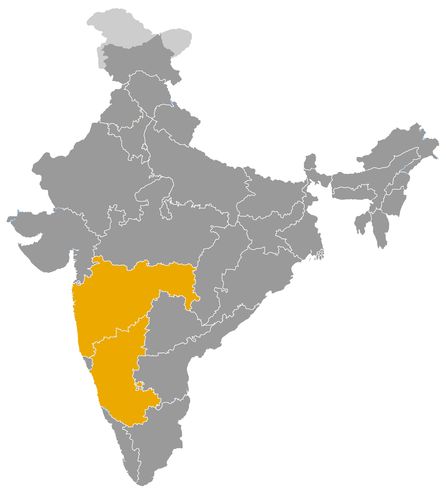
This map illustrates the maximum territory that the Bhonsle of Satara Dynasty had reached at its height, covering the current regions of Karnataka and Maharashtra in India. Its main purpose is to provide a visual aid to understand the geographical extent of this dynasty. However, it's important to note that the contemporary borders of these regions may not necessarily coincide with the historical territories.
The Bhonsle Dynasty of Satara: Royal Authority and Political Change in Maratha India
The Formation of a Distinct Royal Branch
The Bhonsle dynasty of Satara linked the kingdom founded by Shivaji to the expanding Maratha political order of the eighteenth century. Its history as a distinct ruling branch conventionally extends from Shahu’s enthronement at Satara in 1708 to the death of Shahaji in 1848. During this period, its rulers provided dynastic legitimacy while effective authority increasingly passed to ministers, military commanders, and eventually the British.
Shahu was Shivaji’s grandson and the son of Sambhaji, whom the Mughal emperor Aurangzeb had executed in 1689. Released from Mughal captivity in 1707, Shahu challenged Tarabai, the widow of Shivaji’s younger son Rajaram, who governed on behalf of her own son. Their struggle produced rival royal centres at Satara and Kolhapur. The Treaty of Warna in 1731 formalized the territorial division between these branches.
Shahu and the Expansion of Maratha Power
Shahu’s reign, lasting until 1749, established Satara as an important centre of royal recognition and political negotiation. The king confirmed appointments, distributed honours, and mediated between powerful families whose cooperation sustained Maratha expansion.
His principal ministers included Balaji Vishwanath and Baji Rao I, both holders of the office of peshwa. Under their leadership, military campaigns and diplomacy extended Maratha influence beyond Maharashtra into Gujarat, Malwa, and central India.
Imperial grants obtained in 1719 recognized Shahu’s claims to ancestral territories and revenue collections across the Deccan. These concessions strengthened his position within the declining Mughal political order. They also helped finance further expansion.
The resulting structure was not a uniformly administered kingdom governed from Satara. Military leaders established substantial regional interests, while families such as the Holkars, Scindias, Gaekwads, and Bhonsles of Nagpur developed increasingly autonomous domains.
The Transfer of Effective Government to the Peshwas
The growth of Maratha power gradually weakened the practical authority of the Satara monarchy. The peshwas coordinated campaigns, managed diplomatic relations, and controlled increasingly extensive financial resources. Their residence at Pune became the principal centre of government.
This development accelerated after Shahu’s death. His successor, Rajaram II, also known as Ramraja, faced disputes involving Tarabai and competing political interests. The Sangola arrangements of 1750 reinforced the peshwa’s administrative predominance.
Nevertheless, the Satara rulers retained significance as chhatrapatis, the royal title inherited from Shivaji. Their recognition helped legitimize offices and political arrangements throughout the Maratha order. Satara therefore remained a source of hereditary authority even when its monarchs exercised limited executive power.
Agricultural Revenue and the Financing of Government
The dynasty’s economic foundations rested primarily on agriculture, territorial revenue rights, and contributions associated with Maratha expansion. Two important claims were chauth, theoretically one quarter of assessed revenue, and sardeshmukhi, an additional tenth.
These revenues supported military establishments, royal expenditure, and administrative service. Their collection depended on local officials, hereditary intermediaries, and commanders assigned rights over particular districts. Such arrangements enabled expansion but also dispersed financial power.
The monarchy consequently faced a persistent tension between royal claims and the resources controlled by its servants. Revenue assignments could strengthen loyalty while allowing influential families to consolidate independent positions.
In the smaller nineteenth century kingdom, agriculture remained central. Roads, markets, and water infrastructure supported regional exchange. Pratapsinh encouraged improvements in Satara and its communications, although British supervision constrained the kingdom’s political freedom.
Religious Patronage and the Preservation of Royal Culture
The Bhonsles of Satara were Hindu rulers whose patronage supported temples, religious teachers, charitable grants, and ceremonial institutions. Royal observances preserved the connection between sovereignty, sacred authority, and the memory of Shivaji.
Their support also extended to Muslim institutions. Pratapsinh financed a mosque in Satara, illustrating how Hindu royal identity could coexist with patronage benefiting other religious communities.
Palaces, temples, waterworks, and court ceremonies gave the dynasty a lasting presence in the regional landscape. Satara’s cultural importance derived particularly from its role as a repository of royal traditions during the political ascendancy of Pune.
British Supremacy and the End of Ruling Authority
Following the defeat of the peshwa in 1818, the British established Pratapsinh as ruler of a restricted Satara kingdom under their paramountcy. Its territories included areas within present day Maharashtra and Karnataka.
The British deposed Pratapsinh in 1839 and replaced him with his brother Shahaji. After Shahaji died in 1848, they rejected the adopted succession and annexed the kingdom under the doctrine of lapse.
The dynasty’s ruling authority ended, but the family survived. Its historical importance lies in the continuity it provided between Shivaji’s monarchy, the expanding Maratha political order, and the princely institutions reshaped by British colonial rule.
The Bhonsle Dynasty of Satara: Territorial Reach and Relations with Neighbouring Powers
Satara and the Geography of Maratha Kingship
The Bhonsle dynasty of Satara emerged as a distinct ruling branch when Shahu established his throne there in 1708. Its political heartland lay in the western Deccan, principally within present day Maharashtra. Satara occupied a strategic position near the Western Ghats, connecting agricultural districts on the plateau with routes leading towards the Konkan coast.
Between 1708 and the end of its ruling authority in 1848, the dynasty’s territorial position changed considerably. Its directly governed possessions must be distinguished from lands administered by the peshwas and other Maratha chiefs, and from regions subject to revenue demands. The greatest geographical extent of Maratha power therefore cannot be treated as a single kingdom administered directly from Satara.
The Territorial Division between Satara and Kolhapur
The dynasty’s initial territorial structure developed through a succession struggle. Shahu, the son of Sambhaji and grandson of Shivaji, returned from Mughal captivity in 1707 and asserted his hereditary rights. Tarabai, the widow of Shivaji’s younger son Rajaram, opposed him on behalf of her own son.
Their rivalry divided the loyalties of military commanders and local authorities. Shahu secured Satara, while the opposing branch established its royal centre at Kolhapur, farther south.
The Treaty of Warna in 1731 stabilized the division between the two houses and defined their respective territorial positions. Their common ancestry did not eliminate political competition. Consequently, territories held by the Kolhapur branch should be distinguished from those belonging to Satara, despite both dynasties sharing the Bhonsle name.
The Maharashtra Heartland and Revenue Rights in the Deccan
Under Shahu, the monarchy drew its strength from western Maharashtra, including Satara and the wider political sphere associated with Pune. Fortresses, cultivated valleys, and mountain passes supported military movement, taxation, and communication. Access to the Konkan also connected the plateau with coastal trade.
Authority within this landscape was distributed among royal officers, military commanders, and hereditary landholders. Even near the political heartland, control depended on negotiated relationships rather than uniform administration.
Imperial grants obtained in 1719 recognized Maratha territorial claims and rights to collect chauth and sardeshmukhi in the six Mughal provinces of the Deccan. These concessions strengthened Shahu’s standing but did not transfer every district into his direct government. Revenue rights could overlap with the continuing authority of Mughal officials or regional rulers.
Northern Expansion and Competition with Hyderabad
During Shahu’s reign, campaigns directed by his peshwas, particularly Baji Rao I, extended Maratha influence into Gujarat, Malwa, and Bundelkhand. These advances provided access to agricultural revenues, commercial centres, and routes linking the Deccan with northern India.
Expansion reshaped relations with Mughal authorities, Rajput rulers, and regional dynasties. Military pressure frequently produced agreements concerning tribute, revenue sharing, or territorial concessions, rather than immediate administrative absorption.
In the Deccan, the Asaf Jahi rulers of Hyderabad became major rivals. Both powers claimed revenues and influence across overlapping areas. The Palkhed campaign of 1728 demonstrated the effectiveness of Maratha military mobility in this competition. Hyderabad’s involvement in rival Maratha claims also connected disputes over territory with the struggle between Satara and Kolhapur.
Regional Houses and the Limits of Satara’s Control
Maratha expansion strengthened the commanders who carried it forward. The Scindia and Holkar families established powerful positions in central India, the Gaekwads consolidated their authority in Gujarat, and the Bhonsles of Nagpur developed extensive domains in central and eastern India.
These territories belonged to a broader Maratha political order, but they were not ordinary provinces governed from Satara. Their rulers maintained their own armies, revenue systems, and political interests.
After Shahu’s death in 1749, the peshwas’ predominance further reduced the monarchy’s practical authority. Pune became the principal centre of executive government, while Satara retained dynastic prestige. The monarchy’s symbolic reach consequently exceeded the territory it could directly administer.
The Restricted Kingdom under British Paramountcy
The defeat of the peshwa in 1818 transformed Satara’s geographical position. The British established Pratapsinh as ruler of a restricted kingdom, with its territorial arrangements formalized in 1819.
Its possessions included Satara, Karad, and Wai, together with areas around Pandharpur, Sangola, and Malsiras in present day Maharashtra. It also included Bijapur, now Vijayapura, and surrounding territory in present day Karnataka. Estates held by subordinate chiefs complicated its internal organization.
British paramountcy constrained relations with neighbouring states and removed independent diplomacy. Pratapsinh was deposed in 1839 and replaced by his brother Shahaji. Following Shahaji’s death in 1848, the British rejected the adopted succession and annexed the kingdom, ending the dynasty’s territorial rule.
This list covers the Satara branch from 1708, distinct from the Kolhapur branch. Its rulers bear the title chhatrapati; from 1818, the British recognize a princely kingdom whose ruler is designated raja. After 1749, effective power rests mainly with the peshwas until 1818. The dates follow dynastic succession, which does not always coincide with coronation. No titular successors after the end of ruling authority in 1848 are included.
- Shahu I (1708–1749) • Chhatrapati established at Satara; consolidates the monarchy and supports Maratha expansion led by his peshwas.
- Rajaram II, known as Ramraja (1749–1777) • Adopted successor of Shahu I; retains largely nominal authority amid the predominance of Tarabai and the peshwas.
- Shahu II (1777–1808) • Adopted successor of Rajaram II; performs an essentially dynastic role under the predominance of the peshwas.
- Pratapsinh (1808–1839) • Largely nominal chhatrapati until 1818, then raja under British paramountcy; deposed in 1839.
- Shahaji, known as Appa Sahib (1839–1848) • Raja under British paramountcy; his death is followed by the rejection of the adopted succession and the annexation of the kingdom.
 Links to the main sections of the site