Français (France)
  Nederlands (nl-NL)
 00:00 • intro | 01:47 • Dance 1 | 06:12 • Dance 2 | 12:21 • Arrival of the Grand Lama | 13:29 • Dance 3 | 19:07 • Musicians | 20:39 • Dance 4 | 22:25 • Presentation of an award to a dancer | 24:27 • Dance 5 | 31:08 • Dance 6 | 33:40 • Dance 7 | 36:19 • Dance 8 | 39:19 • Dance 9 | 43:02 • Dance 10 | 43:53 • Dance 11 | 45:12 • Dance 12 | 52:17 • Dance 13
Personal creation from visual material collected during my trip Unknown India • Ladakh, Karnataka, Telangana (2022)
Map of places or practices in Phyang on this site
• Use the markers to explore the content •
Phyang Tsedup, a monastic festival in the highlands of Ladakh
A religious event set within a Himalayan landscape
In the high-altitude region of Ladakh, in northern India, the monastery of Phyang overlooks a dry valley shaped by wind, light, and mineral tones. Founded in the sixteenth century, this Buddhist monastery belongs to the Drikung Kagyu tradition and remains an active center of religious life. Each year, it hosts the Phyang Tsedup festival, an event that combines ritual practices, choreographed performances, and community gathering.
The video offers an immersion into this distinctive setting, where the architecture of the monastery becomes the stage for a sequence of ritual dances. The spatial organization of the courtyard, framed by whitewashed buildings and terraces, provides a structured environment in which the festival unfolds, linking movement, sound, and setting into a coherent whole.
A sequence of dances and ceremonial moments
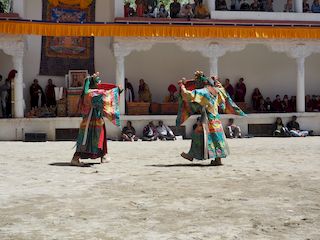
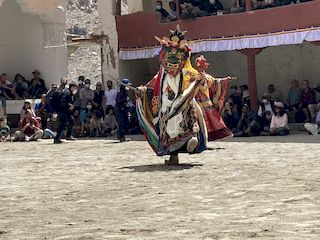
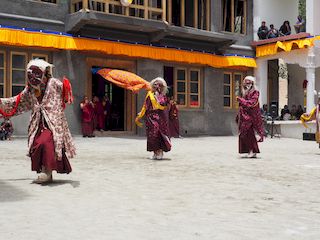
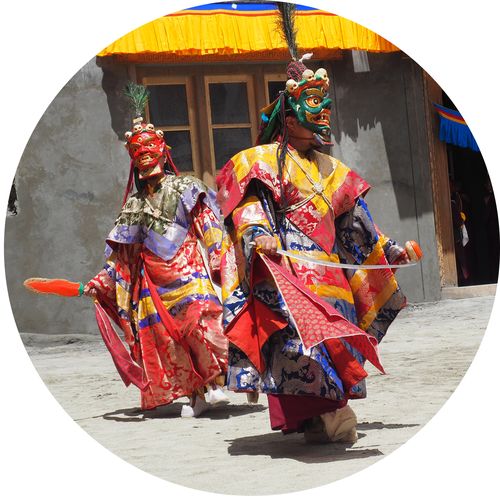
At the heart of the festival is a succession of ritual dances performed by monks. These choreographies, often involving elaborate costumes and symbolic masks, follow a structured progression. Each sequence introduces variations in rhythm, gesture, and spatial arrangement, while remaining part of a broader ceremonial framework.
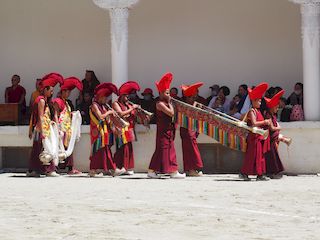
The arrival of the Grand Lama represents a key moment in the event, marking a shift in the atmosphere and emphasizing the religious significance of the gathering. Musicians, positioned along the edges of the courtyard, accompany the dancers with traditional instruments, producing deep, resonant sounds that reinforce the ritual dimension of the performances.
Among the sequences, the presentation of a reward to a dancer introduces a distinctive element. This moment reflects a form of recognition within the community, highlighting the importance of skill and participation within a structured tradition. The continuous flow of dances, extending across numerous performances, provides a comprehensive view of the diversity and richness of the festival.
A tradition rooted in Ladakhi Buddhist culture
The Phyang Tsedup festival belongs to a broader tradition of monastic festivals in Ladakh, often referred to as cham dances. These performances are not merely artistic expressions but carry religious and symbolic meanings. They depict figures associated with protective deities, spiritual concepts, and narratives drawn from Tibetan Buddhism.
Beyond their ritual function, these festivals play an important social role. They bring together local communities, reinforcing the connection between the monastery and the surrounding population. The courtyard of the monastery serves as an intermediate space between the sacred and the everyday, allowing the ritual to be both observed and shared.
The architecture of Phyang Gompa, with its layered structures and elevated position, contributes to this organization. It enhances visibility and emphasizes the integration of the festival within its architectural and environmental context.
A video format that differs from usual productions
This video stands out within the productions of travel-video. Unlike most of the site’s content, which is primarily composed of carefully selected and animated photographs, this particular film relies predominantly on moving video sequences. This distinction significantly affects the viewer’s perception of the event.
The continuous motion of the dancers, the interactions between participants, and the evolving rhythm of the music become more directly perceptible. The unfolding of the ritual is presented in real time, allowing a more immediate understanding of the choreography and the atmosphere of the festival. This approach highlights aspects that are often more difficult to grasp through still imagery, such as the fluidity of gestures and the coordination of group movements.
A living tradition within a monastic setting
The Phyang Tsedup festival illustrates the vitality of Ladakhi religious traditions. Through its dances, music, and ceremonial structure, it reflects a cultural continuity that remains actively practiced today.
The video offers a structured introduction to this event, emphasizing the key elements that define its identity. For a more in-depth understanding, the detailed pages dedicated to Phyang Gompa and to the festival itself provide further insights into the historical, religious, and cultural dimensions of this enduring tradition.
Links to related pages
Audio Commentary Transcript
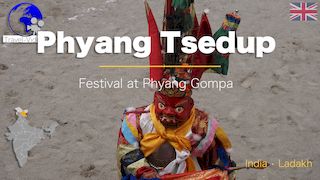
The Phyang Monastery, also known as Phyang Gompa, hosts an annual festival that is as captivating as those held by many other Buddhist monasteries in the region. The Phyang Tsedup, a Tibetan term meaning "long life", is celebrated through the colorful and traditional Cham dances.
Much like the medieval monasteries of Europe, the Buddhist monasteries of the Himalayas have played a crucial role not only in religious practice but also in the preservation and dissemination of knowledge. Faced with predominantly illiterate populations, monks had to find creative ways to share and explain Buddha's teachings. In a world where transmitting a text meant either manual copying or memorization, communication was a significant challenge.
Where the West turned to visual arts, such as paintings and stained glass to narrate biblical stories, the Buddhist traditions of the Himalayas favored the performing arts. The Cham dances are a remarkable expression of this approach: they are moving narratives, carrying sacred teachings, presented through expressive and symbolic performances. These dances are more than mere entertainment; they are a living tribute to the spirituality and cultural heritage of the region.
Each cham dance in this film reflects the slow and contemplative nature of the Phyang Tsedup. If you find a sequence a bit lengthy, feel free to explore the next chapter to continue your journey.
Music:
- (Live Music) - - Live music